
Introduction
The Bay of Fundy lies between the Canadian provinces of Nova Scotia and New Brunswick. This narrow bay provides some of the most intense tidal wave action in the world. At St. John, New Brunswick, high tides feed a falls that reverses daily in harmony with the outpouring of a large river. In the Minas Bay area, the Bay of Fundy also causes dramatic changes of water level, up to 50 feet of rise and fall in less than a day, leaving boats and ships temporarily stranded in mud until the tide returns.
Nova Scotia is a fascinating place for scientists and curious amateurs to investigate both the tides and the many exposed ancient fossil-bearing rock formations. These formations are widely exposed on the shores of the Bay of Fundy.
High school science teacher Joseph Darrow routinely explained about the water power and the geology to his children and also to his high school science students. Therefore it came as no surprise when he announced his plans to take his children on a trip to the Bay of Fundy during a summer vacation. What he did not tell his children was the family secret he was afraid to share.
Chapter 1 – A Titanic Tragedy
A strong wind began to buffet the airplane carrying the Darrow family east to Halifax, Nova Scotia.
“We must be getting close to the ocean,” Dad noted, looking out a window.
“There’s water up ahead,” Kerry pointed out. “Look at all those big rocks along the coast.”
Dad craned his neck over his 11-year-old daughter’s head and then said, “Looks like we are passing New Brunswick, kids. See the big peninsula ahead divided by a sort of blue Y-shaped channel? That’s the Bay of Fundy below us. The land acts like a bottleneck. You will see why that is important when we get to the town of Paarsboro later in the week.”
Soon the plane made a large circle over the blue ocean, turned its nose down and began the sequence for landing.
“Look at all that water,” Josie shouted as the plane began a steep descent.
“Are we at the Funny Bay now?” little Dale asked.
Josie snickered.
“Now don’t you older kids laugh. Dale’s only 6,” Dad warned. “No Dale, we aren’t there yet,” Dad replied, patting his head fondly.
***
“What are we doing first, Dad?” Kerry asked as they wheeled their baggage across the floor of the airport.
“I thought we’d see the Titanic story at the Maritime Museum.”
“What’s a Titanic?” Josie asked.
“It was a big ocean liner that got sunk a long time ago,” Kerry explained. “Right, Dad?”
“That’s right, son.”
“It was supposed to be unsinkable,” Kerry added.
“So why did it sink?” Josie wondered.
“Lucky shot by an iceberg,” Kerry explained. “But it wasn’t headed for Nova Scotia.”
“No, it wasn’t,” Dad agreed. “It was headed for New York City.”
“How come you know so much?” Josie challenged her older brother.
“Because I’m going to be a junior in high school this year and you’re just a dumb sixth-grader.”
“Enough of that,” Dad growled.
“Why are we beginning this trip with a museum, Dad?” Josie snipped. “When do we get to see something interesting?”
“I think each of you will find something of interest along the way. Tomorrow we are going to see a post office in a lighthouse. And then we may get to walk around the tallest sailboat in the world. Now stay together, kids, I don’t want to lose anyone. Look – there’s the sign for the rental cars.”
***
At the Maritime Museum, the family headed for the section that told the story of the Titanic.
“Why is this museum here when the Titanic was supposed to dock in New York?” Josie asked a guide.
“It was near here that many pieces of the wreckage were washed up onto the shore,” he explained. “Many bodies were also washed ashore. Our seagoing sailors worked in the freezing cold among chunks of ice to recover the bodies. The ship went down on April 15, 1912. That’s still winter here.
“There were many poor people traveling on the lower decks,” the guide continued. “No one claimed their bodies, so most of them were buried here. The surviving passengers were taken to New York City.”
“If it was unsinkable, why did it sink when an iceberg hit it?” Kerry asked.
The guide led them to a scale model of the ship. “The ship was constructed with many air pockets that were supposed to keep it afloat. But as near as we can figure, the ship was going so fast that when it hit an iceberg, a sharp edge opened a big seam on just one side of the ship. That side tilted as it filled with water and the ship turned upside down and sunk.”
“I’m glad we got to see this museum,” Kerry said as they left. “But I really want to see more of the Atlantic Ocean tomorrow.”
Did you know?
The Maritime Museum of the Atlantic includes a large exhibit about the famous ship Titanic and also more than 70 small craft and a 200-foot steamship.
Nova Scotia is Canada's second-smallest province. The mainland is surrounded by four major bodies of water: the Gulf of St. Lawrence to the north, the Bay of Fundy to the west, the Gulf of Maine to the southwest and Atlantic Ocean to the east.
Nova Scotia is about 300 miles long and, on the average, 60 miles wide. No location in Nova Scotia is more than 42 miles from the ocean. The western edge of Nova Scotia is about 1,500 miles from the St. Louis area.
Nova Scotia is a popular destination for travelers, particularly in July and August, when days are warm and nights are cool.
Chapter 2 – A really tall ship
Walking back to the hotel from the Maritime Museum, Kerry noted the surroundings carefully as they strolled along the waterfront of downtown Halifax.
“We’re in another country, aren’t we, Dad? So why does nearly everything look so similar to where we live?” he asked. “That video store where we just stopped has all kinds of movies made featuring stars from the United States. I saw a big section of old John Wayne Westerns.”
Dad stopped to explain. “Canadians aren’t very different from us. In most parts of Canada, they speak English, so they enjoy the same movies and books we do.”
“Look at all the shops and restaurants and office buildings,” Josie said. “They look like ours. Only we don’t have a giant Metro Ferry Terminal like I see in front of us now. And we only have small ferry boats that travel across the Mississippi River,”
“That’s right, Josie. Those monster ferries carry passengers and their cars and trucks across the Atlantic to ports in Maine and Newfoundland.”
“I’m hungry,” Dale complained.
“Let’s stop and get some supper now,” Dad said. “We’ll hit the road early tomorrow morning.”
“Why would you want to hit a road, Daddy?” Dale asked. “That would hurt your hand.”
***
The following day, Dad drove slowly through the early morning fog as the family rode south toward the town of Lunenburg.
“When will the fog lift?” Kerry asked.
“I’m not sure,” Dad answered. “We’re so close to the ocean that it could be gone quickly or last for many hours.”
“Can’t you drive any faster, Daddy?” Dale asked.
“No, son. I can’t see very far ahead. And I have on our low headlights and tail lights so others can see us.”
***
By the time they arrived at the wharf at Lunenburg, the sun had begun to peek out.
“Let’s go through the Fisheries Museum first,” Dad suggested.
“Another museum?” Josie protested.
“This is a different kind of museum,” Dad explained as they climbed steps. From a walkway above an open-topped aquarium, the family viewed live saltwater fish swimming freely in a huge tank.
The cod and haddock look like real fish,” Josie said, “but I don’t think I’d like to eat the flounder or halibut. They just sit there at the bottom of the tank and they look so ugly!”
“What is this, Daddy?” Dale asked. “It looks half-red and half-white.”
“The sign says it is a half-albino lobster.” Dad said. “See, this crustacean looks like it has a dividing line right down the middle.”
“Do they call it that because it has a crust on it?” Josie asked.
“You’re close,” Dad answered. “It has an exoskeleton on the outside instead of bones inside like we do.”
After looking at several well-preserved sea craft used for the fishing industry during the town’s 200-year history, the family moved out into the sunshine. Next they explored the Cape Sable, a full-sized, retired fishing trawler built in 1962.
A friendly boat owner explained that the area around Lunenburg had been a center for rum running in the 1700s and for bootlegging in the 1920s during Prohibition in the U.S. Foggy coasts and hundreds of miles of rugged shoreline, plus experienced mariners, had produced many talented smugglers.
Kerry craned his neck to see the top mast as they walked toward The Bluenose II “That is one tall sailing ship,” he exclaimed.
Josie read: “This ship is a reproduction of one of the world’s tallest sailing vessels. The Bluenose I was a famous sailing ship built at Lunenburg in 1921. Far out in the ocean are the Grand Banks, where fishing has been big business for centuries. The first fishing ships to return from the Grand Banks got the best prices for their catches. Bluenose I was famous for its quick returns. After the ship sank, locals built this replica. She still visits many ports along coastal Canada and the U.S.”
“I’m tired,” Dale sighed.
“I thought that might happen,” Dad said. “Kids, I have an errand I need to run. While I’m gone, I’ve arranged for you to take a horse-and-buggy tour around the town.”
“Where are you going?” Kerry asked.
“It’s a secret,” Dad said with a strained smile.
Did you know?
The town of Lunenburg was established in 1753 and maintains much of its original layout and many historic buildings. Although written as though the stories happened in Maine, the Stephen King inspired series “Haven” was filmed for TV in Lunenburg.
The Grand Banks have historically been one of the world’s richest fishing grounds. Portuguese and Basque fishers worked the Grand Banks as early as the 1400s. The area has since been fished by fleets from England, France, Spain, Portugal and later Newfoundland, Canada, Russia, the United States and many other countries.
Nova Scotia produced Joshua Slocum, In 1897, he became the first person to officially sail solo around the world.
Chapter 3 – Elephant rocks
After touring the docks and businesses along downtown Lunenburg, Dad asked his children to wait at a corner. Soon a horse-drawn buggy approached them. Dad and the driver exchanged a few words. Then Dad repeated that they were to tour the town while he ran some errands. As Kerry, Josie and Dale climbed on board, Dad strode away quickly.
“I don’t understand why Dad didn’t tell us where he’s going,” Josie said as the buggy bounced away.
Hastily, the driver began his spiel: “As you can see, this is a traditional ship building and fishing village to this day. Now, many of the buildings that housed the fishing industry have been converted to inns, restaurants or shops so that visitors from all over can celebrate with the local people and learn about their stormy past.”
“Why are the houses painted all different colors?” Josie asked.
“In Nova Scotia, houses are painted with various bright colors and so are the boats. In olden days, red was the color of choice – highly visible far out to sea. Now sherbet colors are often favored.
“Notice that many of the private homes have either a “widow’s walk” – an observation deck – or “a widow’s watch” – a third-story window facing the port,” the driver continued, “because in the previous centuries when their men went out to sea, the wives could identify their boats returning safely long before they reached the shore. Each boat would have some unique color or flag, so their crews could be easily recognized.”
“He’s right,” Josie whispered. “There’s a lemonade-colored house and a cotton candy pink one and that one is frosty blue.”
As the driver droned on, his passengers become restless and ready for the experience to end.
“We’re hungry, Dad,” all three children shouted when they spotted him waiting for their return.
“Okay, let’s eat across the street and then we’ll drive on to Peggy’s Cove.”
A friendly waitress removed the lobsters from their shells as the family watched. Then they feasted on fresh lobster and fish, dipping pieces in butter and frequently wiping their fingers on paper towels.
“Dad, why are you so quiet and why do you look so sad?” Josie asked.
Dad blinked, then smiled: “Nothing you need to worry about, little girl.”
***
Afterward, they drove to St. Margaret’s Bay. A sign informed them that Peggy’s Cove was named in the early 1800s for the sole survivor of a shipwreck – a girl named Peggy.
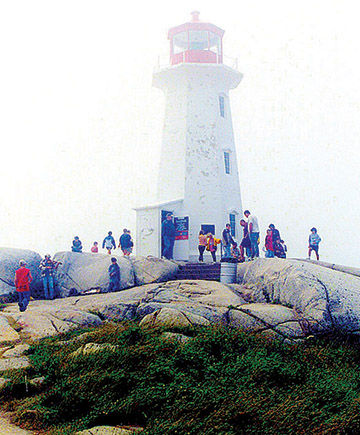
“The lighthouse at Peggy’s Cove may be one of the most photographed in the world,” Dad said. “It also does double duty as the local post office. Stamp collectors come from all over the world to mail things back to themselves with the cancelled stamp of Peggy’s Cove on the envelope.”
They stopped to watch as frothy wave after wave pounded against the rocks.
“Elephant rocks,” Dale shouted, pointing to the solid shelf of exposed granite along the cove.
“Yes, Dale, these are made of granite just like the Elephant Rocks you have climbed at home,” Dad said. “They can hold up for centuries against the pounding of these waves,”
“Look, a light fog is coming in again,” Kerry noted.
As they walked along through a playful mist toward the lighthouse, a fiddler stroked out a haunting tune. They stopped and listened as he sang of the beauty and tragedy that filled the lives of a seagoing people.
“I can’t see much of the ocean anymore with so much fog coming in now.” Josie said.
“Yes, it is getting worse,” Dad agreed. “Better get back to our hotel soon. We have a long drive tomorrow.”
***
Returning to Halifax, they crossed a major intersection. Suddenly, Kerry sat up straight. “Look, Dad, there’s a sign pointing to a town named Debert. Wasn’t that our mother’s last name before she married you?”
Dad thought for a long moment, then said: “Yes, it was.”
“I wish Mom could see all this,” Josie sighed. “She always loved to travel.”
“I wish she were here, too,” Dad agreed. “But she is in a better place, kids.”
The passengers in the car became quiet, each one thinking sad thoughts of the mother who was not with them.
I was 11, Kerry remembered. Josie was 6. And Dale was only a year old. Dale doesn’t remember her at all.
Did you know?
The lighthouse at Peggy’s Cove is an internationally recognized landmark and receives 600,000-plus visitors a year. The lighthouse is one of the most-photographed locations in the world.
The huge, exposed Precambrian rocks on Peggy’s Cove are part of the vast Canadian Shield. In Missouri we also have a tiny part of that “Shield” – exposed igneous and metamorphic rocks in Washington, Iron and Reynolds Counties. These “basement” rocks form the foundation of the continents. At Elephant Rocks State Park, visitors can see these igneous rocks.
The tragic plane crash of Swiss Air Flight 111 occurred on Sept. 2, 1998. A monument stands near Peggy’s Cover in memory of the 229 passengers who lost their lives.
Chapter 4 – Reversing falls
The following morning, the Darrow family followed the road from Halifax to St. John, New Brunswick. It ran a boomerang path that came close to a neck of the Bay of Fundy near Truro.
“Why is the ground out there so red?” Dale asked.
“There’s lots of iron in the rock,” Dad replied.
“Will we see more of the bay today?” Kerry asked.
“No, but we will see much more of it when we get to St. John.” Dad replied.
***
After passing through four hours of rolling hills and small towns, the large port city of St. John offered variety and a little excitement. Dad left the car in a parking garage and led them to a block-long, eight-story hotel building. When they entered, they found it very different from the hotels in Missouri.
“Why are there so many stores on the main floor?” Kerry asked. “It looks like a mall right next to the hotel desk clerks.”
“I don’t know,” Dad said. “Let’s look around.”
In an enclosed courtyard with a very high ceiling, they found entrances to a drug store, clothing stores, two fast-food restaurants, trinket shops and an ice cream shop.
Then they walked back to the main desk and Dad registered.
“The elevator is in the corner,” the desk clerk said, pointing.
Through the door of the glassed-in elevator, the family could see the main floor they had just left behind. The elevator rose quickly to the fifth floor, giving them a bird’s eye view of the vast open space below. Behind glass walls, they could see workers walking around offices with various names on the doors.
“Why do you think they do this, Dad?” Josie asked.
“I’d say it is because it is so much colder here most of the year. I think people would enjoy working and shopping more in a climate-controlled mall than out walking the streets.”
“It’s warm outside now,” Dale said.
“Yes, and I think that as soon as we get unpacked we should take a walk along the waterfront,” Dad said.
***
“Look at those gigantic cargo ships and even a cruise liner,” Kerry pointed out as they walked along the water’s edge.
“Let’s ask if we can take a boat ride,” Dad suggested. “I want you to see Reversing Falls.”
“What do you mean, Dad?” Josie questioned. “Water falls down. It doesn’t fall up.”
Dad smiled. “Near here, the St. John River flows into the bay. down a stairsteps of a gorge like a waterfall. But when the tide comes rushing in from the Bay of Fundy, the water level grows so high it rushes backward through the gorge and the falls completely reverses direction.”
“That’s hard to believe,” Kerry said.
“If we can find a tour boat, we can see it,” Dad said.
***
Most of the boat slips were empty but from one small boat, the captain called: “If you don’t mind my own children going along, I can take you to the falls right now. I’ve promised them a ride. I’ll show you the harbor and then we can run against the current of Reversing Falls if you want. It’s slow going, but quite a thrill.”
And so they climbed aboard.
“Look at all those birds,” Dale shouted as they rounded a curve.
“Those are cormorants,” the captain said. “They sit on the high rocks to dry their wings.”
“Why is the water in the middle a different color?” Kerry asked.
“That’s because we’re rounding into the muddy current flow from the river,” the captain said. “Hold on tight now.” Then he revved the motor. Josie squealed with excitement.
***
Later, the family ate supper at an open air cafe.
“What have you seen today that is different from home?” Dad asked.
“We saw many fishing shacks, so I guess they do a lot of commercial fishing.” Josie said.
“We saw big boats and cargo ships in the harbor and cranes to help load cargo onto them,” Kerry said.
“We saw a little boy trying to climb a moose, so I guess there are a lot of moosies around here.” Dale added.
“And now I can’t believe what I’m seeing,” Kerry said. “Look. That dog is sitting on a chair and drinking from a cup on the table just like his owner.”
“I’ve got to get a photo of that,” Josie declared, aiming her camera.
Did you know?
The land surrounding St. John is hilly and rocky, a result of the influence of two coastal mountain ranges that run along the Bay of Fundy The coastal plain has numerous freshwater lakes nearly surrounding the city.
In recent years, the city has become the province’s commercial, manufacturing and transportation center, with shipping facilities and one of the world’s longest (1,050 feet) dry docks.
The Reversing Falls in St. John is where ocean water is pushed through a narrow gorge in the middle of the city over strong rapids. This reverses the flow of the St. John River, sending tidal waters several miles upstream at high tide. The height difference from low to high tide is approximately 28 feet due to the funneling effect of the Bay of Fundy as it narrows.
In summer, the Bay of Fundy is considered to be the best natural air conditioning unit in the world. Right along the bay it is always cool, even when the temperature heats up 10 miles inland. The Bay water never measures above 60 degrees, so it can be 85 degrees inland and around 70 near the water.
Chapter 5 – Differing points of view
After breakfast, the Darrow family walked to the nearby City Market, located in a solidly built brick structure. Inside, Kerry looked around.
“This farmer’s market is full of fruit and vegetables and all kinds of food like we see at a farmer’s market under tents at home, Dad. I’ll bet it’s for the same reason the mall is located inside our hotel. It’s the middle of July and I’m still wearing a jacket this morning.”
“Oh, look at those fresh strawberries,” Josie sputtered. “I want to buy some for us.”
Dad handed her a five-dollar bill.
“Will they take our money?” she asked.
“I think they will be happy to,” he replied.
“Dad, did they cheat me?” Josie asked when she returned. “This box of strawberries cost three dollars but the seller only gave me this one coin in change.”
Dad looked, then chuckled.“ In Canada, they have two-dollar coins, so this is good money.”
“I thought Canadian money was just like the United States,” Josie said.
“Not exactly,” Dad said. “The exchange rate is 4/3. Most stores here don’t mind if we use U.S. dollars because we pay extra that way. You really paid nearly four dollars for those strawberries. And the seller got more of an advantage when they gave you a two-dollar Canadian coin in change. It’s an honest transaction – just not to our benefit. Guess I had better visit a bank today and exchange some money.”
“What’s next?” Kerry asked.
“We’re going to tour the city on a bus,” Dad said.
Their tour guide appeared dressed in a traditional English uniform from just after the American Revolution.
“Weren’t those the bad guys?” Josie whispered.
“Depends on who is telling the story,” Dad replied softly.
The guide began with a history lesson: “St. John is now the largest city in New Brunswick. St. John’s Harbor is one of the busiest in Canada. The harbor may have first been entered by European fishermen in the early 1500s. French explorer Samuel De Champlain arrived in 1604, on the feast day of St. John the Baptist. He named the river in the saint’s honor. The French started their first permanent settlement here in the early 1630s.
“At the end of the American Revolution, Loyalists began fleeing in large numbers from colonies such as Virginia by ship, spurred by fear that their rebellious neighbors would punish them for helping the British during the war.
“Some of these Loyalist families had lost everything. Their homes and property had been confiscated and sold to help the rebels pay colonial debts to local and foreign banks – money the Continental Congress had borrowed to finance the war.
“Dad, when he calls them rebels, does he mean our patriots?” Josie whispered, frowning.
“Yes, he does,” Dad said. “People from other countries don’t always see things the same way we do. They are called traitors and Tories in our country; here they are called Loyalists.”
The guide gave them a cold stare and cleared his throat.
“The small port of St. John was overrun with these Loyalist families. Many arrived in September or later and spent a miserable winter living in tents in the bitter cold. Many died of exposure. Most of us who now live here have blood ties to those Loyalists.”
Kerry quickly changed the subject by asking, “Does the Bay of Fundy freeze up in the winter?”
The guide gave a relieved smile. “Although the weather becomes very cold in winter, the bay never freezes because of the strong ocean currents that feed it.”
Then he continued his spiel.
“The great fire of 1877 reduced much of the city to ashes. By that time, many Irish laborers had arrived. They rebuilt the destroyed wooden buildings, this time in brick and stone.”
Pointing to an impressive mansion, he said, “Canadian goods were often shipped to the far east. Mahogany was so common in parts of Asia that on their return trip, ships often carried back great pieces of mahogany as ballast. Many of the stately Victorian homes tourists praise today were built in the late 1800s featuring beautiful carvings on porches and around windows made from that wood.”
“Do they all hate us here?” Josie asked after the tour ended.
“I doubt it,” Dad replied. “Most of them don’t even know their own history, It’s the same way in the U.S.”
Did you know?
The Canadian two-dollar coin is called the toonie. It was introduced in 1996 to replace the $2 bill. The coins are estimated to last 20 years. The discontinued two-dollar bill was less expensive to make, but the average bill lasted only one year.
The lives of French settlers changed drastically during the Seven Year’s War. After the British defeated the French, British troops occupied the area in 1758. They expelled many of the French settlers, built Fort Frederick and began to encourage English settlers.
During the mid-to-late 1800s, thousands of Irish immigrants were quarantined on an island near St. John during the time of the great famine in Ireland. Hundreds who survived the journey died on the overcrowded island with inadequate shelter, medical care, sanitation and drinking water. Those strong enough to make their way to the city faced poverty and discrimination in finding work.
Chapter 6 – Fit for A King
Their last morning in St. John was cool and foggy outside as the family ate breakfast at a cozy restaurant near the waterfront.
“So what are we doing today?” Kerry asked.
“We’re going to drive out of the city to a museum,” Dad said.
“Another museum?” Josie groaned.
“This is a living museum,” Dad explained. “They call it King’s Landing. There we can experience how people lived in this area more than 150 years ago.”
“You mean they wear long skirts and ride horses and don’t have any electricity?” Josie asked.
“The re-enactors do,” Dad said. “And there’s much more to see. Then in the afternoon we will head to Paarsboro. It takes about three hours to get there and we can see more of the countryside along the way and still be there by dark.”
***
At King’s Landing, the family was taken to the reconstructed village by horse and wagon. Once there, they strolled around, visiting several buildings, including a blacksmith shop, a church, a fisherman’s shack and a working grist mill.
“Now let’s go see the re-enactors,” Dad suggested.
On the street, a group of re-enactors clothed in old-fashioned vests and trousers for the men and long skirts for the women had gathered for a paupers auction. An announcer explained the problem. Among the villagers were people who could not support themselves – an elderly widow who was going blind and a young man whose parents had both died. Villagers were gathering to bid on how much tax money they would be paid to take these indigent people into their homes. The winner was not the highest bidder, but the lowest.
“I don’t understand, Dad,” Kerry said. “What’s going on here?”
“You see son, there were no social services then. Families took care of their own. But there was no good place for those who had lost their families. From collected taxes, the town would use some of the money to pay families to take in orphans and widows.
“The boy would probably grow stronger each year. He would be able to do the hard work of farming, so a family would be willing to take less in tax money to support him hoping his work would increase their prosperity. On the other hand, the old woman was going blind. She was still able to knit from memory, so a family might be able to use or sell her work. Still they would want to receive more money because it would cost more to feed and take care of her.
“That’s terrible,” Josie insisted.
“Not as terrible as allowing her to starve on the street,” Dad reminded her. “Life isn’t always right or wrong. Sometimes we have to choose the lesser of evils.”
“Look, Dad – there’s a woman who looks like Mom,” Kerry pointed out. “I sure do miss her.”
“I don’t know what my Mommy looked like,” Dale sniffled.
“I’m sorry, son,” Dad said. “She left us not long after you were born.”
“Dad, why don’t you just say she died?” Kerry asked. “That’s what happened, isn’t it?”
“Let’s not talk about your mother,” Dad insisted, with a stern look on his face. “I want to see some more of the village.”
And so they spoke with a friendly cook and a poor Irishwoman and found themselves covered in white dust when they visited a working grist mill.
“It’s time to go.” Dad finally said. “We’ll still have light so we can see the sights along our way to Paarsboro.”
“Isn’t that back in Nova Scotia?” Josie asked.
“Yes, dear,” Dad answered. “New Brunswick and Nova Scotia are called provinces in Canada but they are next door like Missouri and Illinois back home.”
***
“Look at that covered bridge,” Kerry said. “The sign says it was built in 1992. Why’s that? I thought they were all old.”
“Covered bridges are historic places in the U.S. but here in Canada, people still need their protection during the long winters,” Dad said.
As they entered Paarsboro, they were amazed to see many boats sitting in mud far below the top of the docks.
“You told us about this,” Kerry said. “It’s one thing to hear about and another thing to see twice in one day.”
“Wait until tomorrow morning,” Dad said. “We can walk down to the bay from our bed-and-breakfast and see how much has changed at high tide.”
Did you know?
Travelers to Canada might be wise to brush up on the metric system. As is Europe, this system in used there. The ratio of miles to kilometers is a bit more than 1 to 1.6, one mile equals about 1.6 kilometers. A mountain touted to be very steep at 335 meters is about 1,100 feet, not much taller than the High Ridge area. And then there are liters instead of gallons. It takes 4 liters to make a bit more than a gallon. Temperatures are measured in Celsius instead of Fahrenheit in the U.S.
Chapter 7 – Stranded
The following morning, when the family walked past, the water in the bay was lapping nearly up to the road at a place where there had been nothing but mud the afternoon before.
“Isn’t that the same boat we saw yesterday?” Josie asked, pointing.
“Yes it is,” Dad replied. “Boats that were beached last night are riding high this morning on 30 to 50 feet of water.
“Are you sure, Dad?” Kerry asked. “That’s a lot of water.”
“It’s true, Kerry. A greater volume of water ebbs and flows into this bay each six hours than flows through all the rivers in the world. But the water doesn’t rush in dramatically as it does at Reversing Falls. Instead, flows more like a bathtub, rising and falling gently.”
“I wouldn’t believe it if I weren’t looking at it,” Kerry replied.
“We will see more of the bay this afternoon,” Dad replied. “First, I want to stop at the Fundy Geological Museum.”
“Another museum?” Josie whined.
***
After the family had seen the museum, they piled back into the car.
“So what did you learn?” Dad asked.
“The skeleton of that ancient dinosaur impressed me,” Kerry said. “And I didn’t know dinosaurs could be as small as dogs or as big as whales.”
“That giant dragonfly was as tall as a man and the sow-bug was as long as a baseball bat,” Josie added.
“What about you, Dale?”
“Dale’s asleep,” Josie whispered.
***
“What’s next?” Kerry asked at lunch.
“Looking for minerals might be fun,” Dad said. “I know of a place where formations containing amethyst break off after every storm and can easily be found along the beaches. Tourists can take home what they find.”
Josie’s eyes widened in delight. “May we go?”
“What’s a-mystif?” Dale muttered.
“It’s a piece of purple rock,” Kerry said.
“Quartz rock colored with iron or manganese,” Dad added.
“Hunting them sounds like fun,” Kerry said.
***
“I can see the bluffs from here,” Dad said, as he pulled into a gravel trailhead. “I can see other people walking around, so you two should be safe by yourselves. I’m going to take sleepy-headed Dale back to the bed-and-breakfast. Looks like we’ve worn the little guy out.
“Take good care of your sister,” Dad added as he turned to leave. “Don’t wander too far. And be sure to be back here by 4 o’clock. High tide is at five.”
“We will,” Kerry called back. The pair then headed toward the first high bluff.
“What’s with Dad?” Josie asked as they strolled along a path at the base of the bluff. “Every time we mention Mom, he gets quiet and acts funny.”
“I think he’s just sad,” Kerry said.
“We don’t have any tools, so I guess we’d better just check where the rocks have fallen off,” Josie decided.
They walked for some way before finding a tiny purple crystal on the ground.
“Look, I see another crystal embedded in the rock now,” Josie said. Picking up a hard rock, she tried to break the crystal out of its matrix.
“Here, let me do that,” Kerry insisted. With effort he managed to knock the crystal out.
“Look how glistens in the sun,” Josie purred.
“I think more crystals will have formed along the same deposit, so let’s follow this strata around the bluff,” Kerry suggested.
Time passed. They found a few more crystals on the ground and another one in the bluff. Suddenly Kerry looked up at the sun and then at his phone. “It’s half past 4 o’clock, Sis. We’ve got to get back.”
They had rushed only a few hundred feet when their feet began to splash. Kerry looked out and saw that water was beginning to cover the basin all along the bluff.
“It’s too late, Sis. We’ve got to run other way.”
“Why?” Josie shouted back.
“Because we passed nothing but bluffs coming in and the water is rising. It’s too steep to climb the bluff here and we don’t have time to wade back.”
“What are we going to do?” Josie wailed.
“We’re got to find a place to climb the bluff!”
They ran swiftly. After what seemed like a long distance, the two of them spotted a dry runoff in a break between two bluffs. Quickly they scrambled up to higher ground.
Kerry’s cell phone rang. “Where are you?” Dad’s voice demanded.
Did you know?
At the Minas Basin of the Bay of Fundy, the land forms a nearly-triangular bottleneck around the bay that runs inland for approximately 80 miles.
Amethyst is the purple crystal of the mineral quartz. Its name derives from the Greek amethystos, which means "not drunk.” Amethyst in antiquity was thought to ward off drunkenness. Amethyst is most prevalent as small stubby pyramidal crystals. Many form in the internal lining of geodes. The mineral is composed of silicon dioxide. The purple color is caused by impurities of iron or manganese compounds.
The area around Paarsboro is rich in fossils of prehistoric plants and creatures. At Joggins, imprints of “Coal Age” trees, footprints of giant reptiles and the dens of amphibians are preserved in the cliffs. Scientists claim that nowhere is this record of plant, invertebrate and vertebrate life within now fossilized forests more easily read.
Also near Paarsboro are traces of the first true reptile, Hylonomus lyelli, ancestor of all dinosaurs This tiny reptile serves as the reference point when animals broke free of the water to live on land.
Chapter 8 – Night on an Island
Stranded with his sister at high tide, Kerry felt his stomach tighten as his father yelled through the phone.
“What do you mean you are surrounded by water?”
“We followed the bluff line,” Kerry said, his voice shaking. “We got too excited about finding amethyst crystals and forgot the time. When we started back, the water was rising, so we turned around and ran until we found a break in the bluff. I think we can cut over the top of this hill and find higher ground back to the highway, Dad.”
From where she stood, Josie could hear Dad sputtering in frustration. Finally he said, “I’m going to quit wasting your battery and call into town for help. I think you should stay put.”
Kerry hung up and started walking in what he thought was a western direction.
“Dad said to stay put,” Josie scolded. But she followed him across the heavily wooded top of the hill.
Near dark, she saw Kerry stop just ahead of her.
“No use going any further,” he said. “There’s water over here too. I think we’re trapped.”
He took out his phone, then frowned. “There’s no signal here.”
“Guess that’s why Dad hasn’t called back,” Josie said. “Do you think we can find our way back?”
“I’m not sure. I can’t see the sun anymore.”
“What are we going to do?” Josie asked. “Are we going to have to spend the night on this island? The wind is picking up and I’m getting cold.” She tugged up the hood of her lightweight jacket.
“Let’s find some low bushes,” Kerry suggested.
“Wish we could build a fire,” Josie sniffed.
“We have no water, no food, no matches and only the shelter of these shrubs,” Kerry said. “It’s going to be a long night if someone doesn’t find us. By morning the water should be receding and we can probably walk out. I don’t think we’ll be going anywhere before then.”
***
After speaking with Kerry, Dad had called 911. An operator took the information and his telephone number. Later she called back.
“There’s not much we can do before morning, Mr. Darrow. We have tried tracking his cell phone. Ground Search and Rescue has not been able to locate the signal so far. His battery may be dead or he may have wandered out of range. We’ll do what we can and we’ll keep in touch.”
“Thank you,” Dad replied.
“Where’s Sissy?” Dale asked, having just woken up.
Dad sighed.
***
In the thick darkness, Josie heard something moving.
“What kinds of animals live out here?” she asked as her teeth chattered.
“Oh, bears and wolves and skunks ...
“Aren’t you scared, Kerry?”
“Not very, but I think we’d better stuff some of these dry leaves into our clothes to help us keep warm.”
“I don’t think I can sleep out here on the ground, Kerry.”
“I don’t either, Sis. But maybe if I tell you a story, the time will go faster.”
“You can try.”
“While we were in the museum, one of the guides told me about the Indians that first lived around here, only Canadians call them the First Nation.
“They believed that after their highest god created humans, the dust from his body created twin brothers. One was thought to have the power to create good, the other to do evil.
“The good brother saw that hunters who killed more than they needed would destroy the balance of nature. To remedy this, he hid all the game animals so that they would not be overhunted. His brother warned him that humans would die without the animals to eat, so he let them go again.
Later, the good brother decided to capture the great bird that the highest god had placed on a mountain peak, where it generated bad weather in the flapping of its wings. He caught the bird and bound its wings. All the winds ceased. Soon, the air was so hot and heavy that the good brother could not breathe. The evil brother suggest he loosen the bird's wings enough to generate moderate weather so humanity could live.
“See Josie, they believe that something that is good, when taken too far, can become really bad.”
Kerry looked down at his sister who had curled up next to him. She had fallen asleep.
Kerry quietly began humming to himself, trying to stay awake.
Did You Know?
Around the Bay of Fundy are many points of interest including caves and rocky shelters. Maiden’s Cave was named because of an Indian legend that a British maiden was captured by pirates and stashed in a sea cave. The cave entrance was filled in. Afterwards, First Nation people reported that they could hear a cry in the cliff. They opened the entrance and found her skeleton. Locals say that at certain times of the year you can still hear her cries.
At the cliffs of Joggins, many fossil trees and hollow tree fauna have been found beginning in 1852. In the late 1890s, coal miners were paid to scale the cliffs and excavate fossil trees. In the 1980s, a former coal miner operated a private fossil center. Some experts believe that his collection shows the most important census of the biodiversity of the entire area.
Chapter 9 – A Shocking Secret
As the sunlight spilled around them, Kerry opened his eyes to find Josie curled up next to him on the ground.
“Wake up,” he whispered, scattering their blanket of dry leaves as he stood up. “I think we can find our way back now.”
As the sun rose higher in the sky, he and Josie searched until they found the dry runoff, then followed the now-muddy path back to the trailhead.
When they arrived, they found their father and Dale along with a search party preparing to seek them out.
“I know you must be hungry and cold,” Dad said after hugging them tightly. “You know you are in for a lecture, but not yet. We’ll got back to the bed-and-breakfast and you can eat and sleep first.”
“I wasn’t scared at all,” Josie said.
Then she cried.
***
Later, Dad was still shaken by what had happened.
“I think we will drive back to Halifax this afternoon and see if we can fly home early,” he said.
“But why?” Josie asked. “We’re OK. Kerry kept me safe the whole night like you asked.”
“That’s true,” Dad agreed, “but I keep worrying about what might have happened.”
***
On the ride back to Halifax, everyone was silent. Finally Kerry spoke.
“Please tell us about our mother, Dad. I was 11 when she left us. I remember that she was a loving mother but I never really thought to ask you much about her. Now that I’m here in Canada, I think I remember that she talked like they do. Was she from around here?”
Dad sighed.
“Looks like I’ve taught you well about observing and questioning everything. Yes, son. She grew up in Lunenburg. We met while going to school in Chicago. We married there, then moved back to my hometown in Missouri and started our family.”
“Does she still have family there?” Josie asked.
“Yes, she does.”
Josie and Kerry looked at each other in surprise.
“I think you said Mom had meningitis,” Kerry asked. “I only remember that she thought she had the flu. Then one day I came home from school and she was having a seizure. It really scared me. Later, you took me to visit her in the hospital. She was very sick and had tubes and stuff.”
“Yes, you were really upset and cried. After that, I wanted to shelter all three of you from the pain.”
“And then she was gone,” Josie said with tears in her eyes.
Dad pulled the car over and searched his children’s faces.
“Your mother loved all three of you very much. She was very sick and ... and then she left us.”
“Dad, I just now realized that you’ve never taken us to her grave. Why not? Where is she buried? And why didn’t you let us go to her memorial service?”
Kerry could see that tears were forming in Dad’s eyes.
“Son, I’m tired of deceiving you children. But the truth is so difficult to tell. You have grandparents ... here.”
“Grandparents on my mother’s side?” Kerry questioned.
“Yes, and they still live in Lunenburg.”
Kerry thought for a moment.
“Is that why you left us there to take the tour alone?”
“Yes, I went to visit them.
“Can’t we meet them?” Josie asked.
“I regret you have not met them sooner, kids. They are wonderful people. I’ll call them from our hotel tonight.”
***
The following day, the family drove back to Lunenburg. In a pleasant yellow clapboard home, Kerry, Josie and Dale were introduced to their grandparents. Their grandmother had baked cookies. The spicy aroma of cinnamon hung in the living room of the modest but comfortable frame home.
“Dale, would you like to have some cookies and milk?” Grandma asked.
Dale grinned and followed her to the kitchen.
Dad faced Kerry and Josie and said, “ I have something else I need to tell you. Your mother’s name is Rose. She is still alive.”
“Alive?” Kerry shouted.
“Yes, she lives but not as we do. I’ve never given up hope that she might get better someday. That hasn’t happened. I think you and Josie are older now and can face what your mother has become. But I don’t know about Dale. If we decide to tell him now, you two will have to help him understand.”
Did you know?
Meningitis is an inflammation of the membranes surrounding the brain and spinal cord. The swelling from meningitis typically triggers symptoms such as headache, fever and a stiff neck.
Most cases of meningitis in the U.S. are caused by a viral infection, but bacterial and fungal infections are other causes. Some cases of meningitis improve without treatment in a few weeks. Others can be life-threatening and require emergent antibiotic treatment. In a few cases, damage to the brain can be severe.
Chapter 10 – What Now?
While Kerry and Josie soaked in the fact that their mother was still alive, their grandfather rose and went into another room. A quiet moment later, he returned, leading a pale, thin woman. “This is Rose,” he said.
“Mommy?” Josie cried out. The woman looked at her without recognition.
“Josie, maybe you and Rose would like to play with her dolls,” Grandpa suggested. He led the woman to a corner where dolls and toys were displayed on shelves. Rose sat down on the floor, picked up a doll and hugged it to her breast.
Josie dropped down and picked up another doll. Rose smiled shyly.
“Doesn’t she know us at all, Dad?” Kerry whispered.
“No, she doesn’t even know me.”
“Are you going to let Dale see her?” Josie asked.
“I’m not sure.”
Just then Dale ran into the room, followed quickly by his grandmother. “I’m sorry,” she said. “I couldn’t stop him.”
Dale hesitated. He looked at his sister and then the woman sitting on the floor. He stared at the woman and she stared back. Then he plopped down on the floor, crawled to her and cuddled up in her arms. She smiled, hugged Dale to her as through he were a bigger doll and began to rock him while softly sing a tune.
Kerry and Josie looked at each other in amazement.
“Mom used to hold us like that and to sing that song to us when we were little,” Kerry said.
“She knows us, Dad,” Josie cried. “Some part of her knows who we are. She wasn’t singing when she rocked the doll.”
“And we’ve never heard her sing before,” Grandma added.
Dad shook his head, too stunned to say anything.
Josie set down the doll, reached over and hugged her mother. Rose smiled and hugged her back. Then Kerry dropped to the floor and did the same.
Their newly found grandparents looked on with tears in their eyes. Time seemed to stand still as the wonder of the situation began to strike each member of the family.
After an emotional hour of rejoicing and questions, Dad stood up and said: “I need to think about all this. And I need to speak with Josie and Kerry in private. If you grandparents will excuse us now, we will go back to the hotel and return for another visit tomorrow morning.”
The grandparents agreed.
“How did you keep this a secret from the neighbors?” Kerry asked after they were in the car.
“I told them that we had sent your mother’s body back to where her parents lived.”
“That’s a lie, Dad.” Kerry said.
“I’d like to think it is a half-truth,” Dad explained.
***
Epilogue?
Dad spent a sleepless night, crying and praying for guidance. In the morning, while Dale slept, he gathered Josie and Kerry together and tried to explain his actions.
“You see,” Dad whispered, “there are many kinds of islands. You two got stranded on a physical island last week. I’m afraid I got lost on an emotional one a long time ago. I believed it would hurt you too much to see your mother like this. I thought that if I loved you, I should protect you from pain. It never occurred to me that I would also be shutting you out from feeling the joy that your mother is still here and that somewhere inside of her, she still knows you and loves you.”
“So what are we going to do now?” Kerry asked.
“We still have to leave tomorrow. I have job commitments at home that I have to keep. Today we will pay Rose another visit.”
“Can’t we take her home with us?” Josie begged.
“I don’t think we should,” Dad answered. “She’s happy with her parents. The doctors say part of her brain was so badly damaged that she will always be a little child.”
***
“Where’s Rose?” Dad asked after they again sat down in the Deberts’ cozy living room.
“She still napping. Grandma said. “I’ll waken her soon but we thought you might have some things to talk about first,”
“Won’t you let her come home with us?” Josie exploded.
“It’s not as easy a choice as that,” she said. “Your mother needs a full-time nurse.”
“We can stay with her,” Josie insisted.
“You have to go to school,” Dad reminded Josie. “And she does require a great deal of special care. Besides, I suspect her parents would miss her a great deal.”
Grandma nodded in agreement.
“Your grandmother is a retired nurse who knows what to do when she has seizures,” Dad explained in a gentle voice. “I have to work and on my salary I can’t afford to have a trained nurse to stay with her all the time. Besides, a hired nurse would never love her like her own mother does.”
“But we can come back and see her again soon, can’t we, Dad?” Kerry asked.
“Yes, I’ve already decided that now that you know about your mother, we’ll come up for a long visit during each summer vacation. And you can be sure that from now on, I’ll be working on other ways to include your mother in our lives more often.”
Did you know?
Early meningitis symptoms may mimic the flu (influenza). Symptoms may develop over several hours or over a few days:
Sudden high fever
Stiff neck
Severe headache that seems different than normal
Headache with nausea or vomiting
Confusion or difficulty concentrating
Seizures
Sleepiness or difficulty waking
Sensitivity to light
No appetite or thirst
Pregnant women, newborns, older adults and people with weakened immune systems are most susceptible.
Severe brain damage is rare.
Currently there are vaccinations for some kinds of meningitis.