
By Peggy Koch
St. Louis, 1904
Chapter 1 – Meg makes up her mind
Imagine that in August 1904, a large part of Forest Park in St. Louis was covered with elaborately decorated palaces and exhibition halls bordered by cleverly shaded gardens and outdoor restaurants.
Imagine the lure of seeing exotic animals or taking a ride on an elephant. What about riding a miniature train or splashing down a plume of water?
Imagine crowds of ladies as they browsed through acres of shops selling oriental rugs, Japanese carvings and fashions from Paris. Or perhaps they stopped to learn about the model incubators for infants and to observe the model playground for young children.
Imagine gentlemen in fashionable suits pouring through exhibits such as the working coal mine or touring the massive power plant that supplied the electricity.
Megan March could imagine many such things about the 1904 St. Louis World’s Fair. Since she was 6 years old, she had been accompanying her father on the mile-long walk up the hill to Forest Park on many Sunday afternoons.
For three years she had watched with anticipation as trees were cut down, the River des Peres tamed and European-styled palaces had begun to emerge from wooden frameworks. Meg had seen bridges built, rides constructed, shelters for animals fashioned and plumbing, sewers and restrooms installed
Neighbors who had attended the fair gave exciting accounts of their visits. Meg had learned that the 1904 fair was the largest exposition ever staged. She tried to imagine how the fairgrounds must look when as many as 100,000 people might gather there each day. She wondered how they would fit into the nearly 900 buildings.
Her neighbor, Mrs. D’Amico, told her that there were 1,272 acres of palaces, halls, gardens, rides and restaurants. Meg tried to relate that number to the vast area she had seen being built.
She heard from friends and neighbors about wonderful inventions she had not yet had the chance to see – moving pictures, telephones, air conditioning, a wireless telegraph message system and electric lights in houses.
She longed to observe the strangely dressed people who came from all those foreign countries. She looked up Russia, Germany, China, Sweden, Brazil, Austria, Holland, Argentina, Belgium, Canada, Italy, Ceylon, France, Great Britain, India, Japan, Mexico, Nicaragua, Siam and the Philippine Islands on a map her father had brought home for her.
“What would someone from Japan look like?” she wondered. “And did people from California or the other 44 states represented look different, too?”
Meg delighted at the thought of being able to see a re-enactment of the Galveston flood of 1900 that Mrs. D’Amico had told her about.
“You should have seen it, Meg,” she told the girl. “First, we could see the city of Galveston. The designers have carefully reproduced it, complete with boats passing on the bay at sunset and then the lights of the city coming on at dusk. I’ve been there. It looks almost real.
“I shivered when the clouds gathered. Winds blew and rain turned into a squall. The waters of the gulf rose, 50,000 gallons worth, they say.
“Morning’s light found the city in wreckage. Boats had been driven aground.”
“What a thrilling sight that must be,” Meg gushed.
“Yes, but even more thrilling was the ending when the announcer reminded us of what a great country this is. He showed us a new Galveston, rebuilt by Americans with courage, energy and vision. I do believe Americans can accomplish anything we want.”
After that, Meg’s mind rebelled against her mean parents. Her father had promised to take her to the fair, but it was already late August. Every time she asked, “When can we go?” her father had reminded her that he had to work six days a week at the nearby Scullin Steel factory to earn a living. The family could not afford for him to take a day off. Somehow both parents were always too busy or too tired to make the long walk up the hill on a Saturday evening.
“Just my luck that on Sundays the fair is closed,” Meg complained.
“What shall I do?” she wondered. “School is just about to start. I’ll never get to see the fair once it does.
“I know what I will do. I’ll sneak off and go see it by myself. I’m nearly 10 years old now. I’m not a child anymore. I can take care of myself.”
So Meg began to make a plan.
LOOK IT UP
• Today, only three original World’s Fair buildings remain standing in their original locations: The Art Museum, the bird cage at the St. Louis Zoo and Brookings Hall at Washington University.
• The Utah House, then located in the Plateau of States, was moved to a lot in the Dogtown neighborhood. It has been remodeled and no longer looks like the building at the fair.
• To the exhibitors’ delight, someone actually struck a vein of coal on the grounds of Forest Park. It was there that they built their model coal mine.
• This fair was called the Louisiana Purchase Exposition because it celebrated the Centennial of the Lewis and Clark exploration of the Louisiana Purchase of 1803.
• Excellent photos of the 1904 World’s Fair may be found on the Internet.
Chapter 2 -- Sneaking to the fair
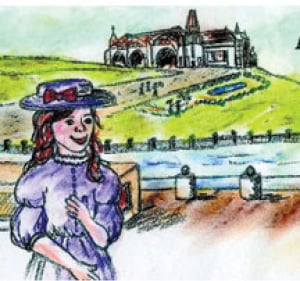
Megan March washed her face and hands carefully. Then she put on her only Sunday dress, a muslin frock with tiny buttons and ruffled trim and added a straw hat. In a cracked mirror, she inspected herself.
Though she was a mature 9-year-old, soon to celebrate her 10th birthday, her small stature made her seem much younger. But if she was small in size, she still had big plans.
This Friday was the day she would go to the St. Louis World’s Fair.
“My parents just don’t care about me,” Meg told the mirror. “All they care about is my older brother. Father pays a lot more attention to him now that he is old enough to go to work. I just don’t matter! They won’t even notice I’m gone.”
Peeping out a window, Meg could see her mother on her knees pulling weeds in their large garden. Quickly, Meg scampered out the front door and ran up the street. A low bark alerted her that the family dog was following her.
“Go home, Brownie,” she ordered as he came up beside her. He gave her a puzzled look, then trotted back to the house with his tail between his legs.
She felt just a twinge of guilt. She was supposed to be helping her in the garden.
“I do really do feel sick to my stomach,” she said out loud.
She skirted far around the D’Amico house, hoping Mrs. D’Amico would not spot her. This nosy neighbor was always reporting suspected misbehavior to the children’s parents.
At a crossing south of Manchester Road, Meg waited impatiently for a slow-moving freight train to pass by. She counted each freight car, then waved merrily to the man in the caboose. He waved back.
She headed north along Tamm Avenue past the clay pits that dotted the land and made the area look like it was inhabited by giant moles. She smiled at the dirt-streaked workers as she walked by.
Meg knew the way well because she and her father had strolled up the steep hill to Forest Park together many times. On Sunday afternoons, before adults had to pay to get in, the two of them had watched the fairgrounds emerge.
The River des Peres was still running muddy to the valley, she observed. That caused her to remember that three years ago, her father had showed her how workers were rechanneling it in the park. The water course had snaked back and forth through the site where the major buildings for the fair were to be placed in the shape of a fan. Soon, the three-channel wooden sluice boxes were carrying the water away to newly built sewers, along with soil disturbed by all the digging.
During the next two years, workers had transformed the ground of Forest Park into a wonderland of vast buildings with decorative arches and curlicued columns.
Meg found it difficult to believe what her father had told her – that most of those elaborate buildings would be torn down after the fair. Trees would be replanted in their places so that in 10 years a person would not even know that the fair had been held there.
“See how the buildings are framed in lumber,” he showed her. “If they wanted them to last, they would have used steel like I make at work.
“The walls are made with a mix of plaster of Paris and hemp fiber, not cement,” he pointed out. “With too much rain and snow, they will eventually melt away.”
Meg arrived at the Cheltenham entrance on Oakland Avenue wet and sticky from the exertion of her walk uphill in the hot sun. Very soon she discovered one flaw in her plan. She didn’t have enough money.
“I thought children got in for free?” she questioned the gatekeeper.
“That’s only if they are accompanied by a paying adult,” he said. “For you, it is 25 cents to enter. Where are you parents, anyhow?”
Meg turned and hurried away. When the gatekeeper could no longer see her, she paused.
“What can I do now?” she wondered.
LOOK IT UP
Scullin Steel: It was located at 6700 Manchester Road in the southwest part of St. Louis. By 1899, the Scullin-Gallagher Iron and Steel Co. had built a foundry and rolling mill and was producing steel for the burgeoning railroads. The company sponsored an industrial exhibit at the 1904 World’s Fair.
The Palace of Varied Industries was built near (or over) one of those sluice boxes. Begun in 1901, this palace was the first to be completed. It covered 452,000 square feet of exhibition floor space.
Caboose: At the end of the train, a special car carried switchmen and brakemen who were needed to manually work or fix the equipment. Conductors were also needed on passengers trains. A caboose usually contained bunks and a small stove. Trains no longer carry cabooses since most of these functions have been automated in the past few years.
Chapter 3 – Don’t speak to strangers
Meg was about to cry in disappointment. The five pennies she had so carefully saved wouldn’t even get her into the fair.
Behind her, Meg could hear two men talking. “You don’t need any money to walk down the Pike, John,” one said to the other.
“Where is the Pike?” Meg turned and asked.
“Follow us,” the stranger named John suggested.
Meg dutifully followed them as they skirted around the eastern edge of the fairgrounds. She had to walk fast to keep up with them. She wished they would slow down so she had time to see more of the sights.
“That’s the Plateau of States,” John told the other man. “Most of the United States are represented here. Their exhibits showcase their resources and achievements.”
“Right now, I’m more impressed by their trees,” his companion replied. “It’s cooler here walking in the ample shade they provide.
“Look, John, there’s the Palace of Liberal Arts. I read that they are exhibiting an extensive coin collection from the British Mint and ancient books and carving from China, There’s a whole section on modern printing machinery as well.”
“Here’s the Palace of Manufactures, Fred. I hear at least 900 industries are represented – textiles, glass and crystal, modern plumbing and even lighting fixtures.”
“Do you think seeing all that’s worth the price of admission?” John asked.
“I’m still making up my mind. I think I’d rather spend my limited funds having fun on the Pike. Here’s the Pike now. Let’s go see what’s to do.”
John turned to Meg.
“By the way, little girl, didn’t your mother tell you not to talk to strange men?”
Then he grinned and the two men walked away.
Tired, Meg rested in a shaded area. She was tempted to use her five pennies for a small glass of lemonade being offered at a nearby stand. Finally, she spotted a water fountain and took a drink there instead.
Refreshed, she began walking down the mile-long Pike. She gaped in amazement at the elaborately arched and decorated entrance to one of the rides.
Meg read the sign: “Creation: Through this gate you can see how God created everything. You can see what God did each day.”
“I wonder if the ride is as wonderful as the statues outside,” Meg pondered. But then she saw another sign: “Admission: 50 cents for adults; 25 cents for children.”
Disappointed, she walked on.
Amid the crowd, she stopped to gawk at the huge Observation Wheel.
“I wonder what it would look like to see the park from so high up? Could I even see the top of my plain old house?” she questioned.
“Are you lost, little girl?” a kindly woman’s voice asked.
Meg started to say “no” but looking at the well-dressed woman, her husband and two children, Meg had an idea.
“Yes,” she answered in a sad voice. “My parents are somewhere in the crowd.”
“Oh dear,” the woman exclaimed. “We’ll have to help you.”
“Maybe if I stay with you, we will find my parents,” Meg suggested.
“Yes, why don’t you do that. If you don’t see them soon, we will find a police station along the way where missing children can be reported.
“I’m Mrs. Appleby. This is Mr. Appleby. These are our children, Beth and Peter. Now what is your name?”
“Margaret,” Meg answered. “Margaret Jones. But my family calls me Meg.”
“Well, then, come along, Meg.”
“We’ve been here a whole week,” Peter reminded his father as they walked along. “We still haven’t had time to see Geronimo or the statues made out of butter or taken a ride on a camel. And I want to go on the Observation Wheel, too.”
“And which do you want to do first?”
“The Observation Wheel, please!”
“Are you sure?”
“Yes, I really want to go.”
“Then we’ll go.” And Mr. Appleby began striding in that direction.
“Hey, Meg, how old are you?” Peter whispered. “I’m 9 years old,” he added with pride in his voice.
“Where are you from?” Meg asked, trying to change the subject.
“De Soto,” he answered. “Took a train in to see the fair.”
“Is that far away?” Meg wanted to know.
“Not really.”
“Where are you from?”
Meg thought fast.
“I’m from Illinois,” she whispered.
LOOK IT UP
The mile-long Pike was lined with amusements. They ranged in color and imagination from a realistic diorama of the Galveston flood to Fair Japan, where all things Oriental were on display and sold and a formal tea was served Japanese style.
Just one “ride” called “Creation” could take up to two hours. The ride began with a boat trip around a blue-domed building that showed painted illustrations and dioramas of the works of God, which included Grand Canyon, Yosemite and Alaska. In the great dome, the six days of the Creation of the World were represented.
Then riders were taken back through time enjoying scenes from early forests and volcanoes to primeval man. Later they saw recreations of scenes from Egypt, Assyria, Greece, Rome, China, Japan, Spain, France and England.
Chapter 4 – Stranded In the Air
“I can’t wait to ride on the Observation Wheel,” Peter crowed to Mr. Appleby as they strolled down the Pike.
“It’s awfully tall. Do you think you will be afraid?
“No I won’t, Father,” Peter insisted.
“Well I would,” Mrs. Appleby interjected. “I’ll take Beth and Meg. We can see the Japanese Fair while we wait.”
Mr. Appleby groaned. “There goes our budget.”
“Could I please go on the wheel, too?” Meg asked shyly. “I promise I won’t be afraid.
“Are you sure, child? They say it’s more than 250 feet to the top. That’s a long way up. And it takes half an hour to go around twice.” Mr. Appleby explained.
“Please let me go,” Meg pleaded.
“All right. But once you get in, you can’t get out again until the ride is over. Do you understand that?”
“Yes,” said Meg.
“I do, too,” Peter added.
Up close, Meg did begin to wonder. The car they would ride in was so wide. It looked about the size of a caboose.
As they waited in line, Peter began to count.
“Look father, I think there are 36 cars. How many people can ride in a car?”
“It looks like they are letting about 30 people get into each car, son. But they say there is room for twice that many.”
Meg noted that each car had glassed-in windows. She swiveled in her seat so she could see more. She found she wasn’t frightened at all as the powerful machinery began to grind them upward.
At the first stop, their guide began pointing out the closest buildings and gardens as other visitors were loaded into the car below them.
And so it went as the car moved slowly upward. Stop and start, stop and start.
“There are so many buildings,” Meg gasped as they began to see the shape of the fairgrounds. And doesn’t the lake look beautiful with all those palaces around it? What’s that big building at the top of the hill?”
“That’s the Palace of Fine Arts,” Mr. Appleby explained.
“We went there yesterday,” Peter chimed in. “There were so many painting and statues, and things called architectural elements that I got tired of looking at them.
“Some of the statues don’t have any clothes on,” Peter whispered.
“I heard that, young man. That’s not an appropriate thing to say to a young lady,” Mr. Appleby admonished.
The passenger car had slowly rotated to its ninth stop.
“Everything looks smaller, but I can see so much more,” Meg exclaimed. “Look at all the water. Seems there are little lakes everywhere.”
“Someone told us that the River des Peres used to run through the park. The engineers have sent much of the river into sewers,” Mr. Appleby explained.
Meg started to say that she knew all about that. But she quickly stopped herself. She had told them she was from Illinois.
“You look about 6 but you sound like you are older,” Peter commented. “How old are you anyhow?”
“I’m 7,” Meg lied.
“Girls mature earlier than boys,” Mr. Appleby explained with a grin.
“Look, the sky is getting cloudy back there,” Meg observed.
They were nearly to the top of the great wheel, when the gears of the machinery came to a grinding halt. They waited expectantly for the rotation to resume. After several minutes, Peter finally asked, “Why have we stopped for so long?”
“I guess there’s a problem with the power,” Mr. Appleby explained. “No doubt it will be fixed in a moment.” But Mr. Appleby did look around doubtfully.
“Those clouds are almost over our heads now,” Peter pointed out the window. “I sure hope it doesn’t rain on us.”
Just as he said it, a bolt of lightning discharged in the distance. A few seconds later a low roll of thunder followed.
“There’s been more than average rainfall this summer,” Mr. Appleby noted. “Lots of fair-goers have been rained on.”
“I want to get down,” Peter insisted.
The three could hear other passengers in the car express the same sentiment.
“Not to worry,” the guide explained. “This has happened before, and no one has been hurt.”
Almost as soon as he said this, rain began to pelt down on the car. They all sat in quiet misery as they waited.
LOOK IT UP
The massive Observation Wheel had the capacity to carry 2,160 passengers at one time. Its steel components weighed 4,200 tons. 175 freight cars were required to transport all its parts. Assembled, it stood 264 feet high; the wheel was 250 feet in diameter and thirty feet wide. The axle was 45 feet long and 32 inches in diameter. At 70 tons, the axle was the largest single piece of forged iron in that time. The construction of the wheel presented great engineering difficulties. It contained 4,200 tons of metal. This mass was formed into what may be called a bicycle wheel with tension spokes. It bore 36 cars, each with an attendant. It was not uncommon to see the wheel carry 1,500 or 2,000 persons, making up to four revolutions in an hour. The ride was comfortable and safe. It was reported that more than 3 million people were carried without injury.
The Palace of Fine Arts (now the Art Museum) rose 60 feet above the Grand Basin. The main building was devoted to architecture. Close by was a sculpture pavilion and gardens decorated with fountains and statuary. In all, there were 134 galleries that included a Grand Court of International Sculpture, lighted paintings in oil, alcoves with architectural and sculptural ornament for study and 32 galleries devoted to American paintings and industrial art.
Chapter 5 – Where are Meg’s parents?
“It feels good to be walking on solid ground again,” Mr. Appleby commented to Peter and Meg as he finally stepped out of the Observation Wheel car nearly an hour after it had been stopped by the power outage. They rushed to where Mrs. Appleby was waiting for them.
“Mother, did you see us up there?” Peter shouted. “I don’t think I ever want to go in a Ferris wheel again.”
“No damage done, I suppose,” Mrs. Appleby comforted, “but I was so worried about you. That lightning came really close.”
“Wait here.” Mr. Appleby instructed his family a little later. “I see the Model Playground. That’s where the Jefferson Guard told me to check on a missing child. I’ll see if Meg’s parents have called for her. No doubt they’ve been looking.”
A few moments later, he emerged looking puzzled.
“The attendant told me they hadn’t heard of anyone looking for a Margaret Jones who is 7 years old.”
Mrs. Appleby frowned.
“I can’t imagine your parents haven’t noticed your absence by now, Meg. Not to worry. We’ll try again later.”
“It’s my turn to pick the next exhibition,” Mr. Appleby stated as they showed their passes at the gate. So we will go see the Machinery Building where all the power is generated for the Fair’s rides and lights. Then we’ll see the big pumping station.
Mrs. Appleby yawned.
“Look at that 600-horsepower Westinghouse steam turbine, son.” Mr. Appleby pointed. “Now that’s what I call power. And over here is the lighting plant with its 45,000-horsepower generator. I hear it’s the third-largest power plant in U.S.”
“I’m hungry, Daddy,” Beth pouted.
“As soon as we go through the Palace of Electricity, we will eat,” he promised.
“This building covers eight acres,” Peter read out loud. “It’s supposed to tell us all about electrical progress and the advancements in electrical engineering.”
“Does it tell us when we will be able to have electric lights in our home?” Mrs. Appleby asked.
“I’m afraid not,” Mr. Appleby answered. “But it should happen soon with all these rapid advancements.”
“Look at all these dynamos and motors and batteries, children. And look at all the ways they are using them. Here’s an X-ray apparatus and a Finsen light.
“I’ve been told there are 120,000 electrical lamps and 20,000 incandescent lamps on this campus. Arc lights are used along the borders of the fairgrounds. On the Pike, there is an arc lamp every 75 feet. We’ll stay later tonight so you children can see how everything sparkles,” Mr. Appleby promised.
“I think it is time to eat,” Mrs. Appleby noted, as Beth yanked on her skirt yet again.
Four-year-old Beth nodded yes with enthusiasm.
“I want another hot dog,” Peter demanded.
Meg frowned. “Do you eat dogs?” she asked.
Mr. Appleby laughed.
“Of course not, my dear. Have you ever had a sausage? Well, it’s like that. We’ll buy you one.”
And so the family found a table and soon Mr. Appleby and Peter returned loaded down with hot dogs and lemonade.
“Mmmm… good,” Meg pronounced after tasting the hot dog.
“I want ice cream,” little Beth insisted.
“Have you ever had ice cream in a waffle?” Peter asked Meg.
“What’s a waffle?” Meg hated to admit that she had never had either ice cream or a waffle.
“Father, can we show Meg?”
And so the family bought servings of the delicious treat.
Meg smiled after she had tasted hers. “This is so good!”
“I want to see the horse again,” Peter requested.
“What’s so special about a horse?” Meg asked.
“Why, they say Jim Key can write his name on a blackboard. He can spell. He can add and subtract and multiply and divide,” Peter rattled on in an excited voice.
“I’d sure like to see that,” Meg affirmed.
“We’ll do that, but first I’d better check to see if your parents have called for you yet.”
“Oh, couldn’t we please see the horse first?” Meg pleaded.
“I really should sneak off and go home, “she thought to herself. “I know I’m going to get into a lot of trouble but I’m having such a good time.
“May as well make the punishment worth my while,” she finally decided.
LOOK IT UP
A Finsen light was a powerful UV light thought to cure skin disorders. Its power was discovered by Niels Tyberg Finsen (1860-1903).
Many foods were either invented or made popular during the 1904 World’s Fair. These included hot dogs, hamburgers, iced tea, puffed wheat and rice, peanut butter, cotton candy and the soft drink, Dr. Pepper.
Chapter 6 – Jim the wonder horse
The crowd that had funneled into Silver Horseshoe Building on the Pike was so thick that it was difficult for the children to see over the heads of the adults.
“Jim’s so beautiful,” Meg commented. “It looks like someone has brushed his coat a thousand times!”
“Hush,” Peter replied. “Look he’s just about to start.”
His trainer asked the audience for words Jim should spell. Someone yelled out “Hires Root Beer.” In order, Jim began picking up blocks bearing the correct letters with his teeth and giving them to his trainer.
“He can spell better than I can,” Peter commented.
When he had completed the words, someone else called out, “Okay Jim, how much is 3 times 6 plus 5 minus 9?
“Look! He just picked up the block numbered 14,” Meg gasped.
“He sure did,” Mr. Appleby agreed. “Wonder if it’s a trick.”
“Now Jim,” the trainer asked, “If I bought a sandwich for 10 cents and a lemonade for 10 cents and gave you a 50 cent piece, how much change would I get?”
Jim patiently lifted a quarter and a nickel from a cash register in front of him and gave his trainer each coin.
The trainer grinned.
“Folks, it took me six years to train Jim. He learns new tricks every day. I first noticed how extra-smart he was when I was throwing sticks for our dog to bring back and Jim started going after them, too.
“You children remember that animals have feelings, too. If you are kind to them, you’ll soon find out how much they can do.”
“What shall we do next?” Mr. Appleby asked as they filed out of the building.
“I still want to see the Church of Holy Sepulcher,” Mrs. Appleby said. “They say it is the same size as the original church in Jerusalem,”
“And then there’s the Galveston flood,” Peter said. “And the Zuni Indians doing the snake dance. And we didn’t get to ride the submarine boat that sinks under real water yet.”
“Well, then, we’d better get going,” Mr. Appleby encouraged.
“Look at that sunset. I didn’t realize how late it is. I’d better inquire about your parents again,” Mr. Appleby told Meg. “Then the rest of us will stay to see the fireworks.”
As they waited, the lights that illuminated the many palaces and buildings at the World’s Fair were beginning to gleam a dull red in the gathering gloom.
Mr. Appleby returned with an expression of real concern on his face. He called Mrs. Appleby aside.
“The attendant told me that no one has asked for Meg. But a young man did come by looking for his sister, Megan March, who is 9 years old.”
“What shall we do?” he asked. “The attendant said they have nowhere to keep children overnight. They would have to turn Meg over to the police, who would take her to the station.”
“Well, we certainly can’t have that happen,” Mrs. Appleby said. “She’s far too young to stay with criminals.”
“I guess we will have to take her back to the hotel with us, dear. I’ve left my name and where we are staying with the police.”
“I hear the band playing,” Peter shouted. “That means the fireworks will soon be starting.”
“Let’s hurry over to the Grand Basin,” Mr. Appleby said. “They say the viewing of the fireworks is best there.”
“Oh, look, fire” Beth mumbled, pointing to the sky.
They scurried across the De Soto Bridge and watched in wonder as fiery fountains, floating on the water, sent up sparks of light. Floating water lilies changed color and sent out sparks that seemed to dart across the water like a school of agitated fish. Aerial bombs exploded in green and red.
Soon, the thousands of lighted street lamps began to dim, all at the same time.
“That’s to let us know the fair is closing,” Mr. Appleby said. “Look how they are fading.”
Before long, all that was left was a faint red glow, then darkness.
They walked back to the Kenilworth Hotel in dim illumination. Just as they arrived, Meg noticed two men. She recognized the voice of one as her brother. She hid behind the Applebys, being sure to keep her face in the shadows.
Megan spent a sleepless night wondering what her parents might be thinking.
LOOK IT UP
Jim the Wonder Horse was owned and trained by a former slave, Dr. William Key, a self-taught veterinarian who had raised Jim from a crippled foal. Some believed that Jim was simply well-trained and responded to his trainer’s cues. But most observers came away believing that Jim could not only count, he could also calculate values. He could make change. He could also spell. William Key performed for then-President Teddy Roosevelt’s daughter, Alice. Jim Key even spelled out Alice’s name, Alice Roosevelt Longworth.
Dr. Key’s words and Jim’s seeming intelligence influenced many school children to pledge that they would never intentionally hurt animals.
The Kenilworth, at West Park and Billon (Hampton) could accommodate up to 1,000 guests. It was a long walk to the Pike near Lindell Avenue but guests who stayed there did not have to rely on trollies or taxi cabs for transportation.
Chapter 7 – A mysterious man
In the morning, the family dressed in preparation for their last day at the fair.
“I don’t know what to do,” Mr. Appleby confided to his wife. “We have to go home this afternoon. I hate to leave little Meg not knowing where her parents are. Do you suppose something dreadful could have happened to them?”
Although they spoke softly, Meg could overhear their conversation. She was almost tempted to tell them the truth. Almost. But when she thought of spending another morning at the fair, she salved her conscience by telling herself, “I’ll go home as soon as they leave.”
“So what shall we do on our last day?” Mr. Appleby asked.
“I want to see the elephant go down the water slide,” Peter insisted.
“I’d like for the children to see that fire engine once pumped by George Washington,” Mrs. Appleby added. “And I think I’d like to have that Japanese woman tell me my fortune after all.”
“Well, I want to watch the military band perform,” Mr. Appleby asserted. I’ll have to check the schedule to see when and where.”
“I want to see myself in the funny mirrors,” Beth chimed in.
“Then, let’s go to the Foolish House first,” Mr. Appleby suggested, chucking little Beth under her chin.
“But wait, before we do that, I need to check to see if your parents have called for you, Meg. I’ll meet you at the Japanese Fair.”
“No word,” Mr. Appleby informed them on his return. “They’re still looking for that Megan girl. I hope her parents find her soon.”
“Do you want a ring, little lady?” the attendant at the Foolish House asked Meg in a loud voice, while picking up her hand as if to check the size of her finger. “They’re free just for today, you see.”
“Really? Oh yes.”
Meg noticed a smirk on Peter’s face. Then she realized why the man had picked up a pair of sleigh bells and was ringing them. The crowd laughed and Meg blushed.
The family spent quite a bit of time going from mirror to mirror. One made Mr. Appleby look tall and thin. Another showed Peter looking short and very wide. Looking through a mirror with a hole in it, Meg could see her face on the body of a monkey. Soon the family slid awkwardly down a long metal chute and back onto the Pike.
Walking down the Pike, Meg had a strange feeling that she was being watched. She looked up into the eyes of a man in a dark suit. She quickly moved closer to Mrs. Appleby
He looks familiar, Meg pondered. But where have I seen him before?
She forgot all about the man as the family explored the Atlantic Oceanliner, 500 feet long and 80 feet high. Then they watched a reenactment of the recent South African Boer War.
“That’s the De Forrest Wireless Telegraph Tower,” Mr. Appleby pointed out as they passed. “They say it can send a telegraph message as far as Chicago, no wires needed.”
“I want some fairy floss,” Beth stated.
“What’s fairy floss?” Meg asked.
“We’ll show you,” Mrs. Appleby promised.
Meg watched in fascination as a machine spun tiny strands of a pinkish substance while the attendant wound it around a paper cone until it took the shape of a giant pink puff.
“Taste it,” Beth ordered with a delighted giggle as she handed the cone to Meg.
“Yum! It tastes so sweet.”
“That’s because it is spun sugar,” Mr. Appleby explained.
Beth and Meg pulled off big gobs of the treat and soon discovered that their fingers were sticky.
“We need to rinse our hands,” Meg announced, heading for a nearby restroom.
When the girls emerged, the man in the dark suit was standing across from the door.
Was he really watching her? Meg wasn’t sure. They rejoined the family.
At the Flight Cage, they walked through the mesh tunnel that separated the larger birds from the smaller ones.
“Father, I think that man is following us.” Peter pointed in the direction of the man in the dark suit.
“Nonsense,” Mr. Appleby replied, sounding annoyed. “He’s probably just wandering around like we are.”
But Meg wasn’t convinced.
LOOK IT UP
Flight Cage: In 1904, it was the largest bird cage ever built. It was designed to allow birds to fly freely. The steel and wire enclosure was constructed to house the Smithsonian Institute’s bird exhibit. Frank Baker, the superintendent of the National Zoo Bird Cage, was both the architect and the designer. The Bird Cage, now called the Edward K. Love Conservation Foundation Cypress Swamp at the St. Louis Zoo, is still one of the world’s largest free-flight aviaries. Its steel truss framework measures 228 feet long, 84 feet wide and 50 feet high.
The City of St. Louis purchased the large cage for $3,500 in late 1904. Local pride in the giant cage motivated St. Louis to establish a zoo in 1910.
Chapter 8 – Meg meets a new friend
“I want to ride a big turtle,” Beth announced.
“How about an elephant ride instead?” Mrs. Appleby suggested as they passed a baby elephant carrying five children on his back. “There’s more to hold on to.”
They followed the baby elephant to Carl Hagenbeck’s Zoological Paradise and Animal Circus.
After Beth’s ride the family waited in line to see the Elephant Slide.
Meg watched in fascination as one elephant was lead up the ramp of an artificial river bank. Without pausing, he raised his trunk high above his head, breathed in deeply to keep water out of his trunk and stepped onto the slide. Whoosh! He slid down the water-washed slide and stood up easily in the deep pool at the bottom.
The next elephant was much younger. His trainer had to repeat his cue three times before the baby made an awkward dash and landed on his seat. He went down the chute, then didn’t seem to know how to get up out of the deep water. He had gotten water into his trunk and the crowd laughed as he spewed it onto his trainer.
A few moments later, Mr. Appleby looked at his watch and announced, “Sorry, children, we have to leave.”
“Can’t we stay longer?” Peter protested. “We haven’t done everything we wanted to do.”
“No, we didn’t,” Mr. Appleby agreed. “But we’re going to have to hurry back to the hotel and get ready to catch our train.
“I’m sorry Meg, but I guess the last thing I can do for you is to walk you to the Model Playground. Here’s a dollar, so you can buy some lunch.”
With tears in her eyes, Meg hugged Mrs. Appleby and Beth. Then she solemnly shook hands with Peter.
“Go on. I’ll catch up with you,” Mr. Appleby told his family.
“I can go in by myself,” Meg told him when they arrived. Then she reached up and kissed Mr. Appleby on the cheek. “Thank you so much for letting me go to the Fair with you,” she whispered.
“I wish there was more we could do for you,” he replied with a look of regret on his face.
Meg ran into the building quickly. But inside, she only asked, “Where is the nearest restroom?”
The attendant gave her directions and Meg walked out by a door on the other side of the building.
Again, a voice told her she should go home. But she thought, I’ve got a whole dollar and I’d still like to go on the Magic Whirlpool.
Having read the sign that children had to be accompanied by an adult, Meg waited and watched until she saw a older-looking woman join the line.
“Could I please go on this ride with you?” Meg inquired.
The woman looked her over and asked, “Why are you alone?
“I live near here and my parents gave me the money,” Meg told her, showing the dollar.
“You look too young to be alone. How old are you anyhow?”
“I’m 12 years old. But I’m really small for my age, you see.” Meg answered while showing an engaging smile.
“Very well, then. “I’m Mrs. Gregg. My husband didn’t want to visit today. Said it was too hot. And what is your name?”
“Margaret Jones,” Meg replied.
As their car approached the circular waterfall, Meg began to wonder if she really wanted to ride. From a distance she could hear the wind howl and sounds like thunder coming from under the waterfall. Suddenly, the car was spun into a great whirlpool. In the near darkness, the howling and thundering and spinning of the car made Meg want to scream for help.
But it’s only a ride, Meg reminded herself. They wouldn’t let us go if it wasn’t safe.
Meg stumbled from the car feeling a bit tipsy. Mrs. Gregg giggled. “You weren’t expecting that, were you?”
“No,” Meg agreed. “But now that I know it won’t hurt me, I wouldn’t mind doing it again!”
“Let’s go, then,” Mrs. Gregg agreed.
Far in the distance, Meg spotted the man in the black suit walking toward her. She reached out and took Mrs. Gregg’s hand with a trusting look on her face.
LOOK IT UP
Hagenbeck’s animals: This area was one of the most patronized exhibits at the fair. Carl Haganbeck was a pioneer in believing that animals should not be caged. In addition to the animal rides, his shows included bears, monkeys, seals, elephants, snakes, lions and tigers in a 3,000-seat theater where some animals performed continuously.
Along with the elephants, he offered rides on turtles, camels, llamas, ostriches, and zebras.
Magic Whirlpool: It consisted of a circular waterfall 60 feet in diameter and 40 feet high with a dark, cavern-like area below.
Chapter 9 – The hard way home
“I’ve enjoyed your company,” Mrs. Gregg told Meg, “but I have to go home soon. My husband will be wanting his supper.”
“Can’t we please go see the natives first?” Meg asked. “I want to see the pygmies from Africa.”
“Oh, sure, child,” she said, smiling. “But then, I really have to leave.”
Meg stared at the tiny black man not much taller than she was. He stared back at her.
“They look real, don’t they?” Mrs. Gregg remarked. “But you can see that they are savages, specimens, not real human beings.”
“He looks angry. Doesn’t that mean he has feelings?” Meg asked.
‘They don’t have feelings like we do,” Mrs. Gregg corrected. “They are little but don’t be fooled. They are savages who hunt with poisoned darts. The darts can kill a man very quickly.”
“Maybe he just wants to go home,” Meg responded. “He looks unhappy. I wouldn’t like to be stared at all day long.”
Mrs. Gregg smiled smugly, as if she knew better.
Walking a bit further they came to the Igorot village.
“These primitives live in the Philippines,” Mrs. Gregg explained. “The sign says that this Igorot village has savages from three tribes. The Tinguanes are the ones who supply food for the others. The Suyocs are miners. They are showing how they extract metals from raw ore. The Bontocks are headhunters. Look at all those tattoos. Uggh! They also eat dogs, I hear. Bet you’ve read about that in the newspaper. I hear there aren’t many dogs left in the neighborhood south of here because they steal them.”
Meg thought to tell her that every dog she knew about was safe, but then she thought better of it.
“Look how long our shadows are,” Mrs. Gregg said. “I absolutely must be going now. How lucky your parents are to have such a well-behaved child. They must be very proud of you.”
She patted Meg and headed toward the gate.
The woman’s remark stung. Meg thought about how difficult it had been for her father to get an education and how much he wanted her to have one. She thought of how hard both her parents worked to make their home a safe and pleasant place to live. She shuddered knowing that by now they would be really angry. Well, they were already angry, so she had better go ahead and enjoy the Fair while she could. Meg wondered what to do next. She still had 50 cents left.
It’s getting dark, Meg realized two hours later. I’ve spent all the money on rides and food.
Meg watched some vendors on the Pike begin to pull down their shutters and close up.
“I’d better go home and face my punishment,” she decided.
Just as she turned to head toward the Cheltenham gate, she saw the man in the dark suit out of the corner of her eye.
There he was again. She looked around frantically, then turned and ran down a corridor between some buildings.
Behind her, she could hear his footsteps running after her. Faster, faster, she told her feet. But as she ran faster, so did he.
Then she heard the shrill noise of a police whistle and sensed that now two men were pursuing her. She tried a door, but it was locked. A blue-shirted arm grabbed her from behind.
She wasn’t sure if she was frightened or relieved when she turned around to see a familiar policeman’s uniform.
“All right, little girl,” the man in the black suit demanded as he tried to catch his breath. “Where are your parents?”
“I don’t know,” she answered and started crying.
“Well then, we’ll have to put ye in jail,” the policeman threatened her.
“Now tell me what’s your name,” the black-suited man demanded.
“Margaret Jones,” she told him.
He eyed her suspiciously.
“It’s not Margaret Jones, is it? I think you are Jim March’s girl.”
Seeing the determined look in the eyes of both men, Meg finally confessed.
“I’m Megan March. I live just down the hill in Cheltenham.”
“So you are Jim’s girl. I thought I recognized you,” the man in the black suit crowed. “At first, I thought I was mistaken because you were with that other family. You are in a heap of trouble now, young lady! We’ll have to put you in jail.”
LOOK IT UP
Igorots: Since the U.S. had recently taken over the Philippine Islands, some of the Igorots wanted to vote in the presidential election held in November 1904. Two polling places were established in their village and photos of the two candidates were posted. Beans were used for voting. Theodore Roosevelt won, 83 votes to 2.
Officials at the Fair insisted that the native peoples, including those from equatorial Africa, dress as they would at home. In October and November this became a real problem for the pygmies, who shivered inside their huts rather than go out in the cold in nothing but a loin cloth. On one occasion, some fairgoers tried to bring them out by throwing stones at the huts. The Africans rushed out against them carrying their spears.
Chapter 10 – Consequences
“Are you really going to put me in jail?” Meg was trembling as she asked the policeman. She felt his hand tighten around her arm.
“No, but I’d like to,” he replied. “Your father is worried sick about you, young lady. He’s been searching for you all day. Even took off work.”
Meg’s eyes widened.
“He did? You mean he really cares about me?”
“Whatever would make ye think your father doesn’t care about you?” the policeman asked in a gruff voice.
“He wouldn’t take me to the fair after he promised,” Meg replied.
“Is that it? As hard as that man works, ‘tis a fine way to treat him! Well, it’s home you’ll be goin’ now.”
The policeman took Meg’s hand and led her down the street.
“Can ye ride behind me?” he asked, untangling the bridle from the hitching post.
“I guess so,” Meg answered. He helped her onto the horse.
Within a few minutes, the two arrived in front of the Marches’ home.
“Thank goodness,” her mother shouted as she ran out the door and hugged her daughter. But then her face darkened.
“And just where have you been?” she demanded.
“I went to the Fair,” Meg whispered.
“You were gone all last night. We were so worried.”
“I stayed with a nice family at the Kenilworth Hotel,” Meg explained.
Slowly she told of her adventures.
“I’m so sorry you couldn’t have seen it, Mama. It was all so beautiful.”
“I would have seen it, daughter. We were planning to take you on your birthday in September. But now your father has already taken off a day from work and we can’t afford another.”
“Oh, Mama, I’m so sorry. I didn’t know.” Meg began to cry.
“Now, you are to go straight to bed. We’ll deal with you tomorrow!”
It was nearly midnight when her father knocked gently on Meg’s door, then pushed it open.
“Are you awake?” he whispered. When Meg didn’t answer, he repeated the question in a louder voice. Finally she sobbed a “Yes.”
He came over then and hugged her. “I’m not happy about this, Meggie, but I’m glad you are home safe.”
“Oh, Daddy, I’m so sorry,” Meg cried out. “I’d never really though about how you and Mother would feel. I was just worried about how you would punish me.”
Meg dressed slowly the following morning, afraid to face her mother. Her brother didn’t help things when he teased, “You’re really gonna get it!” as she passed him in the hall.
Downstairs, the expression on Meg’s mother’s face was mild as she served her daughter a bowl of oatmeal with raisins in it.
“I really am sorry, Mother,” Meg sobbed, bowing her head.
“If you are, then what do you think you should do about it?”
Meg thought. “The Bible says I should make restitution, doesn’t it?”
“That’s right, daughter. So how are you going to do it? Perhaps you should apologize to the people who helped you.”
“Oh, how can I do that? What will they think of me?” Meg cried out.
“Sometimes, the truth hurts,” her mother told her. But then she patted her hand. “Get busy.”
The following evening both Meg and her mother met her father at the door with smiles on their faces. Her father set his lunch box down.
“What’s going on?” he asked with suspicion in his eyes.
“I know now that what I did was wrong, Father. I sort-of lied to the Applebys.”
“Sort of?” he interrupted.
“Anyhow, I want to make amends. The lady who manages the Kenilworth Hotel says I can work for her after school until I earn enough money to pay back Mr. Appleby what they spent on me at the Fair. I’ll have to wash dishes and mop floors to earn it.
“I also wrote a note to the Applebys telling the truth. And I apologized for what I have done. Mother and I walked up to the police station and got the address,” Meg said with pride in her voice.
“So please forgive me. No matter what I have to do now, I’m happy to be home knowing that you both really care about me after all.”
LOOK IT UP
The Fair was open from April 30 until Dec. 1 of 1904. During that time, about 20 million people attended. An important outcome was the seed money for several building projects we still enjoy was generated from the Fair.
The St. Louis Zoo, Art Museum, Jefferson Memorial (now Missouri History Museum), Jewel Box, World’s Fair Pavilion and Muny Opera were all offshoots of the 1904 World’s Fair.