
Chapter 1—Flight to the desert
June 16: The trip from Jefferson County, Missouri to Dubai in the United Arab Emerites was long but exciting for Lisa Marshall and her father. The blue Persian Gulf sparkled in the distance as their plane turned to land.
“I still can’t believe I won that writing contest and got this trip,” Lisa said as the plane descended into an island of skyscrapers and green plants encircled by an expanding sea of drab sand. “Thank goodness for Mrs. Granger, our librarian. She has encouraged me so much, Dad.”
“I’m glad for this chance to travel with you, Lisa. You’ll be 16 in September and a junior in high school. You’ll be driving and you probably won’t want to travel with your old dad anymore.”
“Are you sure this trip is going to be fun, Dad?”
“If not, you can still impress your teachers when you write about your experiences – and maybe get that scholarship.”
Lisa frowned. “What if the committee members don’t like what I write and I don’t get it?”
“So what? You’ve had the experience and that will stay with you for the rest of your life. Besides, we don’t always win in life. Sometimes we get on the wrong track. Most of us find our way back.”
“Dad, you know I’m missing my track practice.”
“Yes, but I think this cruise to middle Eastern ports will be more memorable than a few missed practices.”
***
As they left the airport, the brilliant sun hit them in the face, making the cosmopolitan scene before them shimmer in the 100-degree heat.
“Take us to this hotel,” Dad said as he showed a taxi driver a computer image of the name and location. The driver replied, “Salam,” and gestured for them to hop in.
“You’re in good hands, Lisa,” Dad reassured. “I’ve read everything I could find about the ports we’ll visit.”
“Tell me about Dubai.” Lisa asked as the taxi pushed its way along a five-lane boulevard.
“We’ll have tomorrow to tour the city before we catch our cruise ship, Lisa. Dubai is the largest city in the United Arab Emirates. There is plenty to see, so we will have to use our time carefully. I definitely want to tour the tallest building in the world.”
“Hope it has an elevator,” Lisa snickered.
“We could also see a camel race.”
“That doesn’t sound very interesting, Dad.”
“Racing in Dubai is different. Children once served as jockeys but when human rights activists objected, the camel owners developed child-sized robots.”
“Sounds like somebody has too much money and too much time on their hands, Dad.”
“Yes, it’s a place where some people are enormously wealthy but others are very poor, particularly the guest workers from other countries who do most of the hard labor.”
“Does that money come from oil, Dad?”
“Only 6 percent of Dubai’s economy comes from oil these days. Tourism and real estate are the real money-makers here.”
“Who in the world would want to buy real estate among all the sandy dunes, Dad?”
“Wealthy people who want to avoid paying taxes and people who want to live in protected luxury. By the way, we could also go skiing at the Mall of the Emirates, Lisa.”
“What? Skiing indoors in the middle of a desert?”
“Yes. Have you noticed all the construction cranes we’ve passed? Those are all for new buildings. Living comfortably where temperatures can reach 120 degrees would be impossible without air-conditioned buildings. That goes for recreation, too. Those large green spaces we saw from the airplane were mostly golf courses. Dubai has 20 golf courses, some considered to be world-class. It takes 4 million gallons of water a day to keep just one of them green. The water comes from deep wells and desalinization of the ocean. One local beach even offers refrigerated sand to keep guests comfortable. Public transportation pods at bus stops are also air-conditioned.”
“Dubai also has heavy traffic, doesn’t it? I wouldn’t want to take a driver’s test here.”
“Look at that,” Dad pointed.
Lisa gasped as she saw a large leopard seat-belted next to a man driving a Lamborghini.
“Some wealthy residents like to keep exotic pets to show off,” Dad explained. “Here we are at our hotel. Let’s get some rest and we’ll tour the city tomorrow.”
Did you know?
Dubai boasts the world’s tallest man-made structure, the Burj Khalifa building. At a height of 2,717 feet, this skyscraper also has the world’s highest restaurant, highest outdoor observation deck, highest nightclub and highest mosque. Dubai’s Airport Terminal 3 is the largest in the world. The Dubai Mall is the largest mall in the world and inside is the largest aquarium. The JW Marriott Marquis Dubai is the tallest hotel.
Plans have been made to build a 45 million-square-foot indoor temperature controlled city-within-a-city. Designers claim it will be sustainable, efficient and environmentally friendly.
Chapter 2 – To the heights
June 17: The following morning, Lisa opened her sleepy eyes to the exotic decor of the hotel suite. The brilliantly colorful decorations reminded her that she was in a foreign city.
“We have today to see the sights,” Dad called from the bedroom as he dressed. “Have you decided where you want to visit?”
“Let’s check out that big shopping center.”
Dad groaned. “We’ll do that first. But I really want to see Dubai from the top of the Burj Khalifa.”
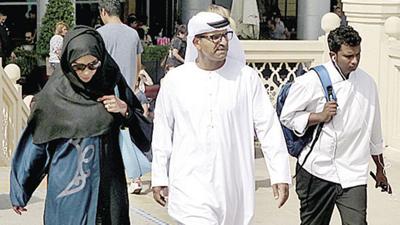
“Let’s go over the rules before you dress.” Dad said. “We can’t show our knees or our shoulders in Arab countries. You should wear one of the loose-fitting cotton dresses you packed. Wrap a scarf around your neck in case you need it. By the way, you must not do that little happy dance thing. No dancing in public here. And don’t say anything insulting in public about the government or the people. There’s no freedom of speech here.”
“They sure have a lot of rules, Dad.”
“They do. But they don’t have much violent crime because strict punishments are enforced. Dubai is considered one of the safest cities in the world.”
***
“Thank goodness the Metro Link has this long air-conditioned foot bridge,” Dad said as they emerged into the vast Dubai Mall an hour later. I thought we would melt as we walked.”
“Be glad we aren’t having a sandstorm this morning,” a robed stranger commented in passing.
“This is a huge complex,” Lisa said. “They even have an ice skating rink with lessons during the day and a disco session at night.”
“So what you want to do here, Lisa?”
“I want to see some of the fashion stores.”
“You do realize we can’t afford to buy anything in them?”
“It doesn’t cost anything to look, Dad. Come on.”
“This place is amazing,” Lisa said as they explored a fifth boutique. “But you’re right about the prices. Seems like most shoppers are looking but not buying.”
Soon they passed a miniature city of child-sized buildings. A small boy came whizzing out and nearly ran into Lisa as another boy chased him. Without thinking, Lisa put out her left hand against his shoulder to slow him down. The boy stopped, frowned at her and then ran on, but a stranger in a white robe stopped them.
“The left hand is used only for body hygiene around here. You must not use it to touch people,” he warned.
“Why not?” Lisa asked.
“It is disrespectful,” the man said as he walked away
“But I’m left-handed,” Lisa called after him.
“What was I supposed to do, Dad?” Lisa asked.
“Listen and learn. We’re just visitors.”
“As they walked on, Lisa noted, “There’s so much more I want to see. They’ve got a whole amusement park under this roof with more choices than Six Flags. “I wish we had time to stop at the flight simulator. Maybe I could become a pilot. Could I get a job as a pilot in Dubai after I graduate, Dad?”
“From what I’ve read, your chances are not good, Lisa. If you had been born here, you might have some opportunities in government or as a small business owner. Foreign women have to obtain work through a third-party contractor and are limited to unskilled work with few protections. Let’s not talk about the future now. Let’s go climb the highest building in the world.”
***
“This is such a clean, new city,” Lisa noted as they hurried the last few feet to the coolness of the Burj Khalifa building.
“This is not only the tallest building in the world,” Dad said, “it is also the tallest free-standing structure. Its elevator travels the greatest distance up and down of any in the world. The top is 1,000 feet higher than any point in Missouri.”
Dad and Lisa took an elevator to the highest floor and took photos from an observation point. They marveled at the man-made islands off the Dubai coast.
“But look how the desert closes in all around us,” Lisa observed.
“Dad, that couple is holding hands. That’s the first time I’ve seen anyone touch all day”
“Open affection is not encouraged here, Lisa.”
“Not even if you are married? This is a complicated city, isn’t it.”
“Life is complicated,” Dad sighed.
Did you know?
Not everyone in Dubai is wealthy. Many men run small businesses. They receive a good living wage; the housing is virtually free and they need only pay 20 percent of their utilities.
If a foreigner wants to start a business in Dubai, he must have a resident sponsor who officially owns the business and receives a percentage of the profits without actually doing anything.
Dubai is a city of contrasts. It is part of the conservative Muslim world, but those who can pay can enjoy Las Vegas-style nightlife. The combination of modern buildings and architectural features from the Arabian past only magnify the differences.
The Dubai Mall complex includes more than 1,200 shops, a 250-room luxury hotel, 22 cinema screens and 120 restaurants and cafes. The aquarium is one of the largest in the world. The amusement section contains 76,000 square feet of indoor space with 150 amusement games, 15 rides, motion simulators, and an obstacle course. The vast Dubai Mall is part of the $20 billion Burj Dubai complex that includes the Burj Khalifa building that is 2,717 feet tall and has 163 floors. Work on it began in 2004 and was completed in 2009.
Chapter 3 – Fit for a sultan
June 18: A wave of 95-degree heat greeted Lisa and her dad early the next morning as they boarded an air-conditioned tour bus at the city of Muscat, Oman.
“We are taking you first to the Al Alam Palace,” the guide explained, “because we can only tour the grounds. We’ll save the indoor stops for later in the day when it gets hot.”
Several tourists laughed. “What is hot?” one man asked as he wiped sweat off his brow.
“It may get up to 116 today,” the guide replied without cracking a smile. “This palace is the most important of the six owned by our great head of state, His Majesty the Sultan Qaboos. It was built in 1972 and is considered a striking example of contemporary Islamic architecture.”
“Not bad as digs go,” Dad joked in a whisper.
“It’s beautiful,” Lisa exclaimed. “
The guide continued: “Note how polished marble covers every surface of the palace complex.”
“How do they keep everything so clean?” Lisa whispered. “Don’t they have sandstorms here too?”
“Foreign workers, Lisa.”
“Beyond the palace, you’ll see a section of ancient stone walls snaking up the hillside with three large watchtowers, built to guard the harbor from attack. Note also the two castles around us. The one with the white trim is the Al Mirani Fortress, built by the Portuguese around 1588. It looms over the harbor and gives defenders a bird’s eye view of the city. During the 1500s, the Turkish Ottoman Empire fought against the Portuguese for control of these rich trade routes.”
“Do you know anything about this Sultan Qaboos?” Lisa asked as the group separated.
“I’ve read a little,” the guide said. “He is powerful. His titles include the nation’s prime minister, foreign minister, defense minister, head of state and commander-in-chief.”
“Is he rich?”
“He is vastly rich, as long as the price of oil stays above $55 a barrel.”
“What happens if it doesn’t?”
“There have been protests in the past. If his government can’t provide employment and benefits, paid for out the profits made from selling oil, he will be in trouble again.”
***
Back on the bus, the guide announced: “The next stop is the Muttrah Souk. This ancient marketplace still carries trade goods from India, China and Europe. Expect vendors to haggle with you over the prices.”
“I imagined this would be a dirty alley with wooden stalls,” Dad said as they strolled through the crowded area. “I’m surprised it is decorated with these colorful stained-glass windows and bright lanterns under a timbered roof.”
“I smell jasmine and spices,” Lisa added. “Look, Dad – they sell everything from soap powder to pottery and crafts to jewelry, silks, and embroidered clothing. Stop! May I buy this beaded bag?”
“You know your budget for souvenirs, Lisa.”
***
The last stop of the tour was the Bait Al Zubair Cultural Center.
“How are we going to see all of these heritage exhibits in two hours?” Dad asked. “There are six separate buildings with museums and art galleries and a miniature Omani village.”
“Let’s start with the display of their homes and clothing,” Lisa suggested.
“Wow, look at these fancy furnishings,” Lisa crowed. “There are richly carved beds, wardrobes, cabinets and chests.”
“Keep in mind, Lisa, most of the Arabs of earlier years lived in tents and had to move their herds each season to find grass for them. These exhibits only represent how rich city traders lived.”
“The wealthy women had beautiful clothes,” Lisa said enviously. “Look at the intricate embroidery and amazing colors. And the jewelry. Do you think those gemstones are real?”
“Probably,” Dad said with a sigh.
At the next display Lisa sounded disappointed: “Men’s clothes haven’t changed in a thousand years. Their robes are plain but the wealthy men’s cloaks are edged with golden trim. They wear silver belts with a dagger and turban.”
“Those daggers show remarkable workmanship,” Dad said. “I want one.”
“If Mom were here, she wouldn’t let you bring one home.”
“But she’s not here with us, Lisa.”
***
To Dad’s great surprise, a steward stopped them as they boarded the cruise ship. “Sir, you can’t keep that weapon on board,” he insisted. “But don’t worry. We will return it as you leave at the end of your cruise.”
“How did he know that was in our bag?” Dad asked.
Did you know?
Oman lies at the tip of the Arabian Gulf on the southern extremity of the Arabian peninsula and across the Strait of Hormuz from Iran. About a fifth of the world’s oil supply passes this point. Leaders of both Saudi Arabia and Iran would like to control the vital sea lanes Oman now governs.
At the center of an ancient trade route, Omanis were sailing to Egypt, Africa and India at least as far back as 600 B.C. to trade wares. Without needing to sail far from land, merchants could also make contact with Persia (now called Iran) to the north.
The discovery of oil around 1950 brought great changes to Oman. The national petroleum company, jointly owned with the Shell Oil Co., began exporting oil in 1967. By 1999, production of oil was approaching a million barrels a day.
Chapter 4 – Salalah’s wonderful fragrance
June 18: Back onboard the ship, Dad read a disturbing message that had been left in their cabin.
“The Promenade Deck will be closed from sunset to sunrise for the next few nights, Lisa. I wonder why.”
When Dad asked a passing steward, he was alarmed to hear that pirates sometimes posed a threat to ships in the Gulf of Aden off the coast of Oman and Yemen.
“Did you know about this?” Lisa asked.
“No. No one told me and no warning was in the ship’s literature,” Dad replied. “The steward did say navy warships patrol the area, so the blackout is just a precaution.”
Lisa let out a sigh of relief.
“Tomorrow we stay on the ship, so we can relax in air conditioning.” Dad said.
“You can stay inside, Dad. I’m heading for the sunny swimming pool to work on my tan.”
June 20: After a day at sea, Dad and Lisa got on another air-conditioned bus to tour the Omani port city of Salalah.
“The buildings are not very tall,” Lisa noted as they drove past a Hyatt Regency hotel that had only two stories.”
The guide began: “As you have probably noticed, zoning in the cities of Oman limits the height of its buildings. See that mosque with the tall minaret tower? Buildings must be lower than the tallest minaret.”
“Could I buy a house here?” a passenger asked.
“In Salalah, some foreigners can own property in limited areas. Most of the male citizens work as civil servants and receive money from the profits of oil sales. They have good retirement benefits, too. In Oman, the work week starts on Sunday and ends on Wednesday. Friday and Saturday are days of rest.”
“That sounds good,” Dad whispered.
***
“We have now arrived at the land of frankincense,” the guide said as the tourists left the bus and he showed them a shrubby tree. “See the frankincense knobs? Have any of you smelled the incense?”
“We did in a mosque in Muskat,” a visitor volunteered.
“The fragrant resin of the frankincense tree has been collected and traded since ancient times. It is still harvested here.
“Now we will move on to the archaeological site. In the last 150 years, the new city of Salalah has grown out of the stones of the remains of Al-Baleed, which used to contain palaces and mosques, and a waterway for boats. It was built in the Middle Ages, designed with a park, a city wall, a dam, animal shelters, houses and a place of worship. We believe that this old town would have been destroyed as the city expanded but was saved by rumors that ghosts haunted the site.”
The guide continued: “I worked on the excavation of old Al-Baleed. What you see today was nothing but mounds of dirt and rubble a few decades ago. Many structures have been discovered. Most artifacts we salvaged are now displayed in the museum.”
“Did you see any ghosts?” a tourist asked.
“No, I didn’t see anything but blowing dust.”
Back on the bus Dad said, “All those rocks and pillars were interesting but I sure am hot and it feels like I’ve picked up a lot of sand. Would I be impolite to empty my shoes?”
“Keep your shoes on, Dad,” Lisa advised, holding her nose.
A mile later, the guide began: “Our next stop will be the Sultan Qaboos Mosque. The building was completed in 2009. Inside, you may observe an ornate dome that is 118 feet wide with a massive crystal chandelier hung from the center. If you wish to see the inner worship center, you must take off your shoes when you enter and women must wear a scarf to cover their hair. We must leave before they observe their time of prayer.”
“Do you ever miss Mom?” Lisa asked as they strolled through the shaded garden.
“Every day,” Dad said sadly.
“I do too. I wish she were here to share all this with us. You are a great dad, but there are things I can’t ask you about.”
“You could ask, but you would get a man’s opinion. That might be helpful as you get more interested in boys.”
“I’m too busy for boys right now,” Lisa insisted. “I’ve got you to take care of and that’s all I need.”
Did you know?
In 1932, Salalah, the second-largest city in Oman, became the capital. According to local legend, the Biblical queen of Sheba once owned a palace in Salalah. Nearby is said to be the resting place of Job, as well as the Virgin Mary’s father. Muslims as well as Christians make pilgrimages to those shrines and to Jacob’s tomb nearby.
Salalah’s population includes people from India, Pakistan, Bangladesh and Sri Lanka. Most are Muslim but there are also Christians, Hindus, Buddhist and Sikhs. Arabic is the local language but English is used in commerce.
Before 1970, Oman had been one of the poorest countries in the region. Today, Oman’s economy has boomed, mostly from the sale of oil.
In 1970, the country had only three schools. More than half of the adult population was illiterate, including most of the women. Today there are 1,200 schools and 95 percent of its population is literate.
Oman borders Saudi Arabia and the United Arab Emirates and lies 35 miles from the coast of Iran.
Chapter 5—Pirate waters
June 21: Dad returned from breakfast to find Lisa busily writing on her laptop computer.
“Getting ready for that scholarship paper?” he asked.
“Taking notes, Dad, and I hope it will be what they expect. I’d really like to win.”
“What happened to being an airline pilot?”
“I have a better shot at being a journalist. So what did you learn at breakfast?”
“We have three more days of cruising through the Gulf of Aden and the Red Sea before we cross the Suez Canal. The ship’s officers are assuring everyone that our ship is too fast and too maneuverable to be a target for pirates. Apparently this is a hot spot for them right now.”
“Are you worried, Dad?”
“Not as long as the crew isn’t.”
***
As darkness approached, Dad and Lisa took a stroll around the deck.
“The food is delicious,” Dad said, “and since all we can see is the sea, I’m eating way too much. I’ve been trying to swim it off in the pool.”
“Those acrobats we saw perform last night probably don’t have to watch what they eat,” Lisa mused. “I didn’t know a human body could get into all those positions gracefully.
“Dad! Why are all those uniformed men rushing to the stern of the ship?”
“I don’t know. Let’s see.”
The rear of the deck had been cordoned off. Several men were intently watching two small boats speed toward the ship from opposite directions. Groups of ragged men were dimly visible on both boats.
“Are those pirates?” Lisa asked.
Dad frowned.
“This is a drill,” a shrill voice on the PA system said. “Leave what you are doing and go to your assigned interior rooms as we practiced. We are safe: The U.S. fleet is monitoring this ship by radar and satellite.”
Passengers began scrambling, complaining as they went: “Crazy time to have a drill.”
“Feel the vibrations below us? Lisa asked, as they and other passengers huddled in a crowded room. “Seems like the engines are working extra hard. If those boats held pirates, Dad, what would they want?”
“Sometimes they are desperately poor men who attack in small boats with automatic weapons. Most often they target oil tankers to hold for ransom. A few are terrorists. Some are involved in the current strife between Saudi Arabia and Yemen. But we’ll be safe.”
Finally, another announcement was made: “The drill is over. Please go back to playing and eating and enjoying your time on board.”
“I want to know what really happened,” Lisa insisted.
After asking several of the staff, one cabin worker finally told her.
“We speeded up and caught up with five slow freighters guarded by two Japanese Navy ships. When the men in the boats saw them, they went away.”
“Why would they chase a ship as large as ours?” Lisa asked
“Sometimes big ships will dump off crates of food, hoping to distract the hungry ones,” the girl replied. “But please don’t tell anyone I said so.”
***
June 23: “Where have you been?” Dad asked as Lisa stole quietly into the cabin early in the morning.
“I didn’t sleep well last night with the high winds and rough waves, ” Lisa replied. “I got up early and ran around the deck four times before it got too hot, The way I’ve been eating, I won’t be able to run track when I get home.”
Lisa said she had been doing some research.
“Dad, I’m confused. I figured that since we are stopping at coastal Israel next, I should read up on it. But this book says the country of Israel was not founded until 1948 by an act of the United Nations. In Sunday school, I was taught that God promised the land to Abraham and there’s been an Israel ever since. So which is true?”
“As far as I know, both are true, Lisa. But one is true politically and one is true religiously.”
“How come?”
“Our Christian faith teaches us that God gave the Holy Land to Abraham. People of the Jewish faith have always believed that. But politically, around 70 A.D., Rome destroyed much of Jerusalem and drove most of the Jewish people out of Israel into other countries.”
“We could talk more about this later, Lisa, but now I’m hungry. I’m picturing a big stack of waffles and an omelet. What about you?”
“Sounds delicious.”
Did you know?
Periodic attacks on naval vessels and merchant tankers off Yemen continue to threaten global trade between the Mediterranean, the Suez Canal and the Indian Ocean. Trade in crude oil and petroleum products at this chokepoint almost doubled between 2010 and 2014. A typical attack might be carried out as a wooden sailing vessel approaches. Then a smaller skiff might speed toward the targeted ship. The pirates are usually armed with assault rifles.
After the destruction of Jerusalem, the land was called Palestine for nearly 2,000 years.
Chapter 6 – A strategic ditch
June 25: Two days later, Lisa and her dad were anticipating the trip through the Suez Canal.
“Port Tewfik (Taufiq) and the city of Suez are smaller than I had expected,” Lisa said. “How many locks does the canal have?”
“Is doesn’t have any locks, Lisa; it runs at sea level from the Mediterranean in the north to the Red Sea in the south. The canal is so narrow at some points that ships can only go one way at a time, so the Port Authority organizes convoys. To keep schedule, each convoy from the south is expected to travel the 120 miles of the canal in less than 12 hours, so that the convoy organized at the northern city of Port Said can take a turn, beginning their 12-hour crossing.
“How many ships are in a convoy?” Lisa asked.
“The steward said 15 to 20, depending on how large the ships are.”
By 9 a.m., lines of passengers were watching as a pilot came aboard to escort their ship. Soon, it was lined up to became part of a long convoy.
“Looks like we are being sandwiched between a huge container ship and a tanker, Dad. But there’s a small fishing boat behind it.”
***
For the first few miles, a railroad line and a highway ran alongside the narrow canal. As the ship continued, signs of human activity became scarce. The morning hours went slowly as Lisa and Dad scanned barren mounds of golden sand.
“That’s the Sinai Desert to the east,” Dad said. “The Egyptian sentry stations on the western side seem to be placed about every half-mile.”
Then a stiff wind began to blow a stinging cloud of sand in their faces and they moved inside to observe from behind windows.
“So why were the Jewish people treated so badly, Dad?”
“During the Middle Ages in Europe, many kings did not trust them and would not allow them to own land. To support themselves, Jews were forced to take on more risky work such as merchants or jewelers or bankers. Some became very wealthy. Others worked the land in poverty for the owners.
“Due to mistrust, Jewish communities were sometimes attacked, the people driven out or killed and their possessions stolen. Hitler used the same tactic. After he gained power in 1933, he needed money to keep the economy of his government going. He manipulated the centuries-old mistrust of the German people. First, his henchmen confiscated the property of wealthy Jews. When they protested, he had them rounded up and sent to be worked to death in secret concentration camps. Then he began killing them outright, guaranteeing that no one would live to complain.
“In human nature, people often hate the very people they have persecuted. Unfortunately, that works both ways. As Jewish people took what they thought was their Biblical right by displacing Palestinians after 1945, they made enemies of the Arabs whose land they had taken. Now growing populations among both Jews and Arabs have made the pressure even worse and hatred grows.”
“Is there an answer, Dad?”
“Only when we learn to treat others as we want to be treated, Lisa.”
***
On the deck after lunch, Lisa and her father watched barren land give way to small settlements. They noticed a bridge and then ferries packed with people and vehicles. Soon, along the western bank, they saw military vehicles patrolling the adjacent road, keeping an eye on the convoy. Twice they noticed a soldier in a sentry box waving at the ship.
“What are those?” Lisa asked, pointing to pontoon bridge sections.
“They make it quicker to cross the canal into the Sinai in case of an outbreak of another war,” he said.
“So many wars, Dad. Look, those side canals are so narrow that the ships on them seem to be floating along in the sand.”
“We must be getting closer to the delta now,” Dad said later. “The western side is becoming more green all the time. Looks like there is a great deal of irrigation and I think I see paddy fields.”
***
At Port Said, Egyptian authorities boarded to make sure all the ship’s documents were in order. Close to midnight, the ship finally pulled into the Mediterranean Sea.
“It feels like the weather is cooler already,” Lisa noted as they began to head to their cabin for the night.
Did you know?
The Suez Canal is a vital waterway connecting the Red Sea to the Mediterranean Sea. Construction of the 120-mile canal was completed in 1869. The canal is owned by the Suez Canal Authority, whose policy is that it may be used, “in time of war as in time of peace, by every vessel of commerce or of war, without distinction of flag.”
Before its construction, sea voyagers from the Middle East to the Far East had to sail all the way to the tip of Africa and then north, crossing through the narrow Strait of Gibraltar to reach the Mediterranean. The alternative was a long and dangerous trek through arid conditions, carrying much lighter loads of trade goods than a ship could handle.
Chapter 7 – A place full of history
June 26: At breakfast the morning they were to arrive at the port of Ashdod, Lisa began to ask questions. “Our next three stops at Ashdod, Haifa and Acre are in Israel. I only know a little about its history. Israel is a very small country, isn’t it?”
“Compared to the U.S., it’s about the size of New Jersey,” her father replied. “But you already know some of its history, because we read the Bible. In the Middle East and Egypt, the ability to write – first on stone and later on papyrus and animal skins – started about 4,000 years ago.”
“So written stories began as people started building towns and cities instead of wandering, Dad?”
“We think so. We know Abraham had to keep moving to keep his flocks fed. But the coastal Phoenicians of his time were already beginning to build towns and were trading goods in sailing vessels along the coast of the Mediterranean Sea.
“After Moses led the exodus of the Israel from Egypt, they found inhabitants living in towns and villages where the herds of Abraham had once roamed freely. For many years, the Hebrews lived in the hill country, threatened by the Philistines. They won enough battles to build their own towns and cities and finally to have their own king, Saul.”
“Then David and Solomon became kings of a large part of the land we call Israel, right, Dad?”
“Yes, they lived around 1000 B.C. Soon after Solomon’s death, his kingdom was split into two parts, Israel and Judea. These kingdoms were located at the center of many emerging trade routes that invited conquerors from Egypt and Mesopotamia. The offspring of Abraham rarely enjoyed long periods of peace.”
“Later the Assyrians conquered the area, didn’t they, Dad?”
“They overran it around 722 B.C., invading from parts of countries we now call Iraq, Turkey, and Iran. The Babylonians conquered Judah around 538 B.C. Babylon was a successful city-state on the Euphrates River in Iraq. Their army destroyed Solomon’s temple and exiled prosperous Jews to Babylon.”
“The Persians came next?”
“They defeated the Babylonians about 50 years later. Their land is called Iran today. Cyrus the Great allowed a group led by Nehemiah to return to Jerusalem to rebuild the city and temple.”
“I remember from history class that the Greeks conquered the Persians under Alexander the Great.”
“That was around 332 B.C., Lisa.
“And the Romans invaded about 63 B.C., not long before Jesus.”
“Yes, by that time the general area of Judah and Israel was called Palestine by the Romans. In 70 A.D., the Jews rebelled and Jerusalem was totally destroyed. The Jewish people were expelled to live in other countries.
“After Jesus’ death, Christians from Europe began making pilgrimages to the Holy Land, sometimes taking great risks. A trip on foot could take up to a year, while the sailing time was much shorter. By the end of the Dark Ages, the coastline of Palestine had also become important to Europeans for its ports of trade in spices, sugar and silk.
“For five centuries after Jesus’ death, what was once Herod the Great’s capital city at Caesarea grew into a center of Christianity. The city was abandoned following the Islamic conquest of 640 A.D. The Christian population converted to Islam or fled.
“Haifa and Acre were conquered by Europeans during the First Crusade, around 1100 A.D. That Crusade was undertaken to provide help and protection for Christian pilgrims headed to Jerusalem. For 200 years, the area passed from European to Islamic control and back again. Most of Palestine had returned to Muslim hands by 1291.
“By 1821, a small number of Jewish people had been allowed to return and lived mostly in peace with Christians in Haifa. More came as groups of Europeans Jews wanted to escape persecution.
“The process of establishing a Jewish homeland officially began in July 1922, when the League of Nations gave Great Britain the mandate to assist what was called the Zionist Movement, the rebuilding of a Jewish state.
“At the end of World War II, Haifa become a destination for Jews fleeing the horrors of European concentration camps. Jews and Arabs became enemies as European Jews began to compete for land and livelihood. Jerusalem has been split into three parts because it is holy to Muslims, Jews and Christians.”
“My had is spinning,” Lisa said. “How does anyone keep it all straight?”
Chapter 7 – A place full of history
June 26: At breakfast the morning they were to arrive at the port of Ashdod, Lisa began to ask questions. “Our next three stops at Ashdod, Haifa and Acre are in Israel. I only know a little about its history. Israel is a very small country, isn’t it?”
“Compared to the U.S., it’s about the size of New Jersey,” her father replied. “But you already know some of its history, because we read the Bible. In the Middle East and Egypt, the ability to write – first on stone and later on papyrus and animal skins – started about 4,000 years ago.”
“So written stories began as people started building towns and cities instead of wandering, Dad?”
“We think so. We know Abraham had to keep moving to keep his flocks fed. But the coastal Phoenicians of his time were already beginning to build towns and were trading goods in sailing vessels along the coast of the Mediterranean Sea.
“After Moses led the exodus of the Israel from Egypt, they found inhabitants living in towns and villages where the herds of Abraham had once roamed freely. For many years, the Hebrews lived in the hill country, threatened by the Philistines. They won enough battles to build their own towns and cities and finally to have their own king, Saul.”
“Then David and Solomon became kings of a large part of the land we call Israel, right, Dad?”
“Yes, they lived around 1000 B.C. Soon after Solomon’s death, his kingdom was split into two parts, Israel and Judea. These kingdoms were located at the center of many emerging trade routes that invited conquerors from Egypt and Mesopotamia. The offspring of Abraham rarely enjoyed long periods of peace.”
“Later the Assyrians conquered the area, didn’t they, Dad?”
“They overran it around 722 B.C., invading from parts of countries we now call Iraq, Turkey, and Iran. The Babylonians conquered Judah around 538 B.C. Babylon was a successful city-state on the Euphrates River in Iraq. Their army destroyed Solomon’s temple and exiled prosperous Jews to Babylon.”
“The Persians came next?”
“They defeated the Babylonians about 50 years later. Their land is called Iran today. Cyrus the Great allowed a group led by Nehemiah to return to Jerusalem to rebuild the city and temple.”
“I remember from history class that the Greeks conquered the Persians under Alexander the Great.”
“That was around 332 B.C., Lisa.
“And the Romans invaded about 63 B.C., not long before Jesus.”
“Yes, by that time the general area of Judah and Israel was called Palestine by the Romans. In 70 A.D., the Jews rebelled and Jerusalem was totally destroyed. The Jewish people were expelled to live in other countries.
“After Jesus’ death, Christians from Europe began making pilgrimages to the Holy Land, sometimes taking great risks. A trip on foot could take up to a year, while the sailing time was much shorter. By the end of the Dark Ages, the coastline of Palestine had also become important to Europeans for its ports of trade in spices, sugar and silk.
“For five centuries after Jesus’ death, what was once Herod the Great’s capital city at Caesarea grew into a center of Christianity. The city was abandoned following the Islamic conquest of 640 A.D. The Christian population converted to Islam or fled.
“Haifa and Acre were conquered by Europeans during the First Crusade, around 1100 A.D. That Crusade was undertaken to provide help and protection for Christian pilgrims headed to Jerusalem. For 200 years, the area passed from European to Islamic control and back again. Most of Palestine had returned to Muslim hands by 1291.
“By 1821, a small number of Jewish people had been allowed to return and lived mostly in peace with Christians in Haifa. More came as groups of Europeans Jews wanted to escape persecution.
“The process of establishing a Jewish homeland officially began in July 1922, when the League of Nations gave Great Britain the mandate to assist what was called the Zionist Movement, the rebuilding of a Jewish state.
“At the end of World War II, Haifa become a destination for Jews fleeing the horrors of European concentration camps. Jews and Arabs became enemies as European Jews began to compete for land and livelihood. Jerusalem has been split into three parts because it is holy to Muslims, Jews and Christians.”
“My had is spinning,” Lisa said. “How does anyone keep it all straight?”
Did you know?
Many Middle Eastern countries that had been part of the Ottoman Empire were divided up into spheres of European influence by the European winners of World War I.
Persia became Iran. Parts of several tribal areas formed Iraq. No attention was paid to the divisive differences between Sunni and Shiite Muslims. In Turkey, the Shiites were mixed with yet another group, the Kurds, that occupy the southern parts of Turkey and the northern parts of Iraq. The Kurds continue to fight to establish their own country.
Many Middle Eastern countries that had been part of the Ottoman Empire were divided up into spheres of European influence by the European winners of World War I.
Persia became Iran. Parts of several tribal areas formed Iraq. No attention was paid to the divisive differences between Sunni and Shiite Muslims. In Turkey, the Shiites were mixed with yet another group, the Kurds, that occupy the southern parts of Turkey and the northern parts of Iraq. The Kurds continue to fight to establish their own country.
Chapter 8 – A tale of old cities
June 26: In Ashdod harbor, Dad read a brochure, then said: “Lisa, the tour here isn’t that interesting. I really want to see the ruins of Herod the Great’s Palace at Caesarea. That’s about 100 miles north.
“Just before Jesus’ time, Herod had a magnificent city built at a centuries-old port. His seat of government had good roads, public baths, fancy homes and temples and a large amphitheater overlooking the sea. He and his fellow Romans were entertained by competitive sports, gladiators and even theatrical plays. He imported marble, granite and limestone from Greece, Turkey and Egypt. It must have been an amazing sight. I can’t wait to see what the archaeologists have dug up there. Let’s take the ship’s bus into Ashdod and find out how to get there.”
“Is it a good idea to go off on our own, Dad?”
“I think it will be OK.”
At the Ashdod bus station, Lisa looked around carefully. “I think we’re in trouble here, Dad. Everything is written in Hebrew. If the restrooms weren’t marked with universal symbols, I wouldn’t have recognized them.”
After standing in a long line, Dad told a clerk, “We need tickets to Caesarea.”
The man gave Dad a blank stare. Dad tried again and again without success.
“Tel Aviv?” the man finally asked. Dad sighed: “Okay, Tel Aviv. That gets us closer.”
In Tel Aviv, at an even larger bus station, Dad was no more successful.
“I guess I’m not pronouncing Caesarea correctly, Lisa.”
“Yafo?” the ticket seller asked.
“Yes, let’s try Jaffa,” Dad decided wearily. “I want to see that too.”
The clerk rattled off a long sentence and pointed toward the door. They hesitated, not knowing what to do next.
“Dad, I hear someone speaking English,” Lisa whispered. “Let’s ask him.”
Having explained their problem, the man told them that it was a complicated trip by train to Caesarea and convinced them to settle for seeing nearby Jaffa instead. After a short bus ride, they arrived in Old Jaffa, where they strolled through a small museum.
“I remember reading about the Crusaders using the port of Jaffa, Lisa. Some of the structures and fortified walls around here were built by them. But that was nearly 1,000 years ago. So much has been changed and added.”
They stopped at lunchtime for Jewish pizza. “Yum, good,” Lisa decided. “Same sauce and oregano but more parmesan cheese.”
“We don’t have to return to the ship until 10 p.m. Lisa. Let’s take another shot at seeing Caesarea.”
Lisa raised her eyebrows.
After a short search, they found a tourist information booth. From there, they took a cab to a train station. With help from fellow passengers, they transferred to a second train, then found a cab to take then into Old Caesarea. When they arrived, he smiled and gave them a card to call if they needed him again.
At the site, a barren field of stone floors and foundations opened up before them.
“This archeological dig is much smaller than I thought,” Dad said, as he surveyed a few floors and column caps. “Where are all the houses and palaces?”
“Here’s a limestone block with an inscription mentioning Pontius Pilate,” Lisa said, excited.
The only major standing building, an amphitheater, had obviously been rebuilt in later times using dressed stones. They took a few photos, read signs and admired the nearby sea.
“It’s nearly 5 p.m. Shouldn’t we head back?” Lisa asked urgently.
“That late?” Dad replied. They rushed around searching for a phone to call the cab driver. By the time he returned them to the train station, they found they had just missed the 6 p.m. train so they had to wait another hour.
“Won’t the ship wait for us?” Lisa asked.
“No,” Dad explained. “We’ll have to pay to spend the night somewhere nearby and find transportation to Haifa tomorrow. We’ll miss that morning tour.”
With more help from other train passengers and cab drivers, they managed to arrive at the pickup point in Ashdod just in time to catch the last shuttle to the ship.
“I’m too beat even to eat a late supper,” Dad said.
“Me too,” Lisa agreed. “I’m glad I got to see all those places and even more glad we didn’t miss the boat. Maybe we should stick to taking guided tours, Dad.”
Did you know?
Today, Ashdod is one of Israel’s three thriving international ports and important industrial centers. In Biblical times, Ashdod was one of the five cities held by the Philistines. For many years, the Israelites were unable to subdue it. The city fell to King Uzziah of Judah, but was soon captured by Assyrian forces. Having passed through the hands of Egyptian, Greek and Roman forces and finally the Byzantines over subsequent centuries, the population declined during the Middle Ages but was reborn after 1948.
Jaffa was one of the world’s oldest ports. It is said that Jonah departed from there for Tarshish, now Spain. The port was controlled at one time by King David and Solomon. The cedars of Lebanon for building Solomon’s temple were brought into Jerusalem from there.
In 1952, the abandoned town of Caesarea was re-established near the ruins of the ancient city. Excavation began in the 1950s. The site was incorporated into a national park in 2011. Archaeological excavations have uncovered remains from many periods – in particular, a complex of Crusader fortifications and a Roman theater called the Tiberieum where a reference to Pontius Pilate was found in a marker stone.