

Chapter 1 – The cabin
My name is Cate and I have a story to tell that is mostly fun but nearly tragic.
Some time ago, my father decided to buy a cabin in the woods in the southeastern Ozarks of Missouri. Dad loves nature and wanted his family to experience something different from our suburban neighborhood with its well-groomed houses and lawns.
I still remember the first morning I saw the cabin. Autumn leaves were falling. Not long after he pulled our SUV into the yard and we stepped out of the car, my parents began trading angry words.
After 15 years of being their daughter, I knew what to do. I ignored them. In the sky, a crow was flying by at rapid speed. Half a dozen smaller birds were following behind him, screeching and pecking.
“Why did they do that?” I asked Dad, after my parents’ war of words had stopped for a moment.
“The crow was probably raiding one of their nests and eating the eggs,” he answered.
“May Kiley and I take a walk by the river?” I asked. I had hoped for a quick yes, so we could escape more harsh words. Instead my question only diverted my parents to a new argument.
“You may not,” Mom responded. “It’s dangerous. The woods are full of snakes and poison ivy and who knows what.”
Dad frowned.
“The girls could fall into quicksand or be attacked by wild animals, Liam,” she continued.
“Why can’t they walk to the river?” he responded. “You are scaring them for no good reason, Claire. The woods are safe as long as they pay attention to the few rules I’ve taught them.”
“At least, may we walk up to the spring?” I tried again. “You can see us from there and we can see you.”
“I guess so,” Mom agreed reluctantly. “Be sure to stay in sight.”
Kiley and I quickly walked to the top of the knoll toward the spring, about a hundred yards from the rustic log cabin. We explored around the spring branch and the big hole in the ground filled with water. Nothing up there but rocks and trees as far as they eye could see. Then we sat down in a pile of leaves waiting for Mom and Dad to finish their inspection of the cabin. From our perch, we could hear our parents’ angry discussion.
“Why would you want to buy a cabin in this wilderness?” Mom scolded. “The real estate agent said the nearest house was a mile away.”
“You and the girls need to learn to be less afraid of what is out here,” Dad insisted.
“I can’t stand how careless you are with our children’s lives,” Mom countered. “Why little Kiley could be stung by a bee. She could die before we could get her to a hospital.”
“Claire, she’s been stung by a bee and only got a sore spot.”
“Well, that was last time. It could be much worse if it happened again. And what about the river that runs below us in the valley? The girls could drown.”
“Most of the year, Black River is so shallow here that any of us could hold our noses and walk out of a deep hole,” he replied.
Back by the spring, Kiley whispered in my ear.
“Did you see that Indian?”
“Where?”
“Hiding behind a tree now,” Kiley said.
“Are you making things up again?” I asked.
“No, I really saw one, Cate. Why doesn’t anyone believe me?”
“Because we never see what you see,” I answered.
“My kindergarten teacher believed me last year,” Kiley insisted.
“No, she didn’t.” I responded. “I heard her tell mother that you’d outgrow your storytelling faster if we agreed with you. We’ll see if your new first-grade teacher believes you.”
My sister is cute but a little strange sometimes. Mom says she has an active imagination.
Kiley began picking up rocks and inspecting them.
“This one looks like a girl’s face,” she said.
“No it doesn’t, Kiley. It’s just a lumpy rock.
“Look how well it fits in my hand,” Kiley said a moment later. “I think someone used this as a tool.”
“There you go again, Kiley,” I replied. “I don’t see it. Maybe you should ask Dad.”
“I don’t have to. The Indian just told me it was a tool for skinning animals.”
“Kids, come back now,” Dad called. “Your mother and I have agreed to buy this cabin.”
LOOK IT UP
Arrowheads are easy to identify. Scrapers – tools used to skin and scrape the hide off deer and other animals – are more difficult to recognize. They are knapped from native chert to have a crescent-shaped sharp edge and smoothed indentations for the palm and fingers.
Chapter 2 – Paradise
After Mother had given in and agreed to buy the cabin, our parents called us back from the nearby spring to see it. Inspecting the cabin didn’t take us long because it was so small
A screened-in porch ran the length of the building.
We need to get a porch swing for out here,” Dad said. “We’ll spend warm nights enjoying the fresh air and crickets.”
“We’ll see about that,” Mother retorted.
Inside on the first floor was a large kitchen, a bedroom and a bathroom with a tub. Up narrow stairs was a small loft. Except for a cooking stove, the cabin was unfurnished.
“The bathroom looks clean enough,” Mother noted.
“Dad,” I complained, “I can’t even get a signal for my phone. No texting either. There’s no shower. We will have to carry water from the spring to wash and flush. There’s nothing here but a small log house. And worst of all there’s nothing to do.”
“You are so wrong,” Dad said. “Let’s walk down to the river now and see what’s there.”
After a short walk along the gravel road that led through the woods, we came to the wide gravel bar that outlined the Black River. There we watched as a string of canoes floated by, filled with laughing people wearing warm jackets against the cool fall air.
“They won’t be laughing if their canoes tip over,” Mom scolded. “It’s too cold to be in a canoe.”
Father heaved an unhappy sigh: “I’m sure they came prepared, Claire.”
“Have any of you noticed how colorful the leaves are?” Dad asked a few moments later. “Look across at that hillside. There’s a riot of yellow and orange and red with green pine trees interspersed between the rocky outcrops. This whole area is a natural paradise.”
Dad sighed again, but this time it was a happy sigh.
“What’s a paradise?” Kiley whispered to me.
“That means it’s a really great place to be,” I answered.
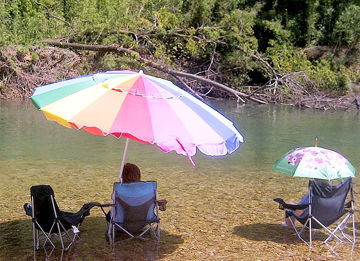
“See how clear the water flows?” Dad continued. “This river is fed by many small springs. Next summer when you go wading, you girls will be able to feel the colder spring water on your feet before it mixes with the sun-warmed water of the river. The sand shifts around here with each flood but we will always be able to find a patch of sandy beach where you can make sand castles. I can’t wait to see you two playing in the water.
“I’ll teach you girls how to catch crawdads and find hellgrammites to use for bait when we fish. I’ll show you how to identify different trees, too. No telling what kinds of animals we will see. I once saw a mink down here in the rocks.”
“How do you know all those things, Dad?” I asked.
“My family used to camp near here when I was a boy,” he said. “I’ve always wanted to take you camping here but your mother doesn’t want to sleep outdoors. Soon we’ll have a cozy cabin.”
“I know you are mad at me for not giving you a boy,” Mom said as we returned to the cabin. “But I don’t want you turning these girls into tomboys.”
“It’s up to them,” Dad said. “I do want them to have the choice to learn how to love nature.”
“It’s cold in here,” Mom complained as we re-entered the cabin. “Liam, do you think this stove will heat the place?
“I doubt it,” he said. “We’ll need to get a wood stove. For now, I guess we could try it and find out.”
Mom slid open the oven door of the old-fashioned pink electric stove. Then she screamed and pointed. A furry gray mouse with four babies clinging to her back ran out onto the floor.
“Grab that broom, Cate,” Dad ordered as he ran for the door. “Now shoo that mouse out.”
Encouraged by my broom, Mother Mouse scurried onto the porch with her babies still clinging tightly to her. By the time I ran onto the porch, she and her family had disappeared.”
“You’d better make sure no more mice get in here,” Mom threatened. “Because I’m not spending a single night here if I see even one more!”
LOOK IT UP
Hellgrammites are well known as a reliable form of bait to those who fish on a regular basis. They live in the running fresh water of streams and rivers, often hiding around rocks or debris. They feed on insects and other aquatic invertebrates. They are sometimes used by fishermen as bait.
In their larval form, they are dark colored, with six legs and an elongated, somewhat flattened body. They may grow to two or three inches before maturing. Although not naturally aggressive, they can bite if handled carelessly. As an adult, a hellgrammite becomes a dobsonfly.
Chapter 3 – Shining Moon
In early March, my family returned to our newly purchased cabin for a weekend visit. On the way, we crossed a narrow bridge built in 1900.
“Why is there only room for one car?” I asked.
“When it was built, there was only room for one wagon,” Dad said. “Years ago, there were just narrow wooden tracks to ride on. You could see the river through the gaps.”
I gasped.
The door of the cabin squeaked in protest as Dad opened it.
“I brought the WD-40,” Dad snapped before Mom had a chance to complain.
“It’s cold in here,” Mom barked as she laid down two bags of groceries on the kitchen countertop.
Dad quickly flipped on the new electric heater.
“This will give us a burst of heat. I’ll get the wood stove going later.”
Then my mother gave Dad a rare smile. “It doesn’t look so bad in here now, Liam. You and your friends have done a good job of bringing in furnishing over the winter. Let’s see – we now have a refrigerator and a table and chairs. And you hung some metal cabinets to hold the dishes I brought. How thoughtful.”
After we had finished unpacking, Mom called, “Girls, bring in some of the milk jugs we filled with water at home. When they are empty, your job will be to refill them at the spring.”
“Water sure weighs a lot,” I complained as I carried two up the steps.
“You’ll appreciate the plumbing more when we get home,” Dad said.
After we had lined up the milk jugs on the porch, Kiley and I climbed the narrow stairs to the loft.
“There are two beds up here and some kind of old cabinet,” I yelled down. “A ceiling fan, too.”
After I finished unpacking my clothes, I asked if I could take a walk.
“I’ll walk with you,” Dad volunteered.
“Me, too,” Kiley offered.
“Kiley needs to take a nap,” Mom snapped. “I’ll stay here with her.”
***
We took a leisurely stroll as the afternoon sun warmed the air to about 50 degrees. Soon we arrived at the river. I stooped down and felt the water.
“Dad, I can’t imagine wading in this river with all these sharp rocks and cold water,” I said.
“We will all have to wear shoes,” he said. “The water may feel too cold right now to think about wading. But when summer comes, you will find out how good the cold water can feel.”
“Why are some rocks so sharp and others so smooth – different colors, too?” I asked.
“The dark ones are still sharp because their minerals were compacted very tightly by a volcano. These ancient rocks don’t hold water the way the more porous limestone rocks at home do. Here, when it rains, the water runs off the steep mountains much faster. We will have to be careful because the low-water ford we have to cross to get here becomes too flooded to cross at times.”
I took a deep breath and asked: “Dad, why do you and Mom fight so much?”
Dad sighed.
“We are very different people, Cate. She likes to feel safe. I enjoy a little adventure. We do love each other, but what makes me happy makes her afraid.”
I couldn’t help but relax as I watched the sun reflecting off the ripples at a place where the river narrowed and the shallow water seemed to tinkle as it rushed by. Then I wrinkled up my nose. “What is that spicy odor I smell? Isn’t it too early for anything to be blooming?”
Dad searched around. “Look here, Cate. The witch hazel bushes have tiny flowers on them.”
I walked closer and sniffed. “Yes, that is what I’m smelling.”
***
When we arrived back at the cabin. Mom was working in the kitchen. Kiley was upstairs in the loft lying on one of the beds and gazing dreamily at the peaked ceiling.
“What’s up, sis?” I asked “You look bored.”
“No, I was just talking with the Indian.”
“Oh, him again? What was he saying?”
“It’s not a him, it’s a her. Her name is Shining Moon. She used to live here near this cabin a long time ago.”
I was surprised. “Tell me more about your friend,” I encouraged.
“For one thing, she warned me that there will soon be a big flood around here. Does it flood here, Cate?”
LOOK IT UP
Witch hazel is a plant that grows throughout northeast and southeast North America, from Nova Scotia to Florida and from the Great Lakes to eastern Texas. The shrub grows in moist, shaded sites in forests and at the forest edge.
American witch hazel has arching branches generally growing as a dense, multi-stemmed clump. Typically it does not grow more than 15 feet tall. Leaves have wavy teeth on the margins and with the upper surface dark green and the lower surface a paler green. Brushed by humans or animals, the seeds can pop up to 20 feet from the mother plant.
The forked limbs of American witch hazel have been used to find water as dowsing or divining rods. Early European settles observed Native Americans using American witch hazel to find underground sources of water. The plant can also be used for medicinal purposes.
Chapter 4
Dad and I had enjoyed our weekend at the cabin in March. I’m not so sure about Mom. At least we didn’t see any more mice.
In May, my family again traveled the bumpy, winding road to the cabin, this time for a week’s vacation.
“I hope Shining Moon will be here to play with,” Kiley whispered to me.
“Didn’t you see her at home?” I asked softly.
“No, she only likes to be here where she grew up,” Kiley answered.
“What are you girls whispering about?” Mom questioned suspiciously.
“Nothing,” we chorused at the same time.
“I don’t know what I’m going to do for a whole week without Internet,” I sighed as we neared the cabin.
“Nothing,” Mom and Dad shouted out at the same time. Then they both laughed.
“Cate, when you get older and feel you have responsibilities all the time as we do, you’ll understand why we want to stop doing them and relax,” Mom said.
***
“Let’s all go for a walk in the woods,” Dad said after our food and supplies had been stowed in the cabin. “It’s not quite time for the chiggers to be out yet.”
“I’ll stay here,” Mother volunteered.
“Is this a swamp?” I asked as Dad led us away from the road and through the budding underbrush.
“No, Cate, you are looking at a slough. Sometimes when the river floods, the water rushes down from all the steep hills and spreads out to fill most of this valley.”
“Don’t worry,” Kiley whispered to me. “Shining Moon says it won’t flood this week.”
“Is she here with us right now?” I asked in a soft voice.
“Yes, she’s right next to me. She says she likes to walk with Dad because he loves nature.”
“I see fish swimming around,” Kiley pointed out.
“Yes, it looks as though there are a few catfish in this slough.” Dad said. “When a flood recedes, they sometimes get caught in these pools of water. They may have babies here. The next time it floods, they may be washed back into the flowing river. Anyhow, one of these days, I’ll be bringing my fishing pole down here. Anyone want to come along?”
“Maybe,” I replied. “If you will put on the bait and take the fish off the hook.”
Dad laughed.
As we walked further, Dad taught us how to tell a black walnut tree by the monkey-face breaks on its branches. He pointed out the fragile sensitive fern that shut its leaves when he tickled them. He also showed us how to read a compass so we wouldn’t get lost.
Suddenly we were alarmed to hear a something very large crashing through the nearby brush.
“Is that a bear?” I called.
Before Dad could answer, a large wild turkey took off flying just over our heads. We all laughed in relief when we saw it.
As we strolled along the opposite edge of the slough, we watched as the water turned from the sky’s reflected blue to a greener color.
“Why is that happening?” I asked.
“I think it is because there are beavers or muskrats swimming underwater and stirring up the silt,” Dad said. “If it’s a muskrat, we’ll probably see it soon. If it is a beaver, we may not.”
“Dad, don’t walk so close to the edge of the slough,” Kiley suddenly cried out in a warning voice.
“Why’s that?” Dad asked.
Just then, Dad let out a surprised yelp as he fell to one knee.
I blinked in disbelief. Part of his lower leg had disappeared. Quickly, he helped himself up by drawing his leg out of a small hole.
After he had checked to see that both legs still worked, he laughed out loud: “See girls, here’s a lesson from nature. Never walk too close to the water in the slough.
“Beaver families dig their dens back from the water’s edge and angle them until they are slightly above the water. That way they can swim in and then crawl up to the dry part unobserved. I think I just accidentally stepped into one.”
He cleared his throat, “Maybe we’d better not mention this part of our walk to your mother, girls.”
“Shining Moon told you, didn’t she?” I asked Kiley later that day.
She nodded her head. “I waited too long to warn Dad,” she said hanging her head. “I’ll listen better next time.”
LOOK IT UP
People often confuse beavers with muskrats. Both spend much time in the water and both build dens, but there are several differences. Beavers are much larger. Beaver tails are wide, flat and paddle-shaped, while muskrats have long, skinny tails with flat sides. Beavers use these tails to slap the water as a danger signal.
You can usually see a muskrat’s whole body when it is swimming. With beavers, you often see only their large wedge-shaped heads. Beavers have rear legs that are longer, and their webbed feet help propel them through the water when they are swimming. When the beaver is under water, its nose and ears close up and a special membrane covers its eyes.
Beavers and muskrats are the only mammals that build their homes in the water. Sometimes they create homes by burrowing into the banks bordering the water where they swim and fish. Beavers use mud to help hold layered logs and sticks in a dome shape, while muskrats pile plants, including cattails, over a firm base such as a tree stump, using a little mud to hold the shelter together.
Chapter 5
We returned to the cabin on a Saturday in May. Sunday night, we made a campfire in the yard, using a hollow log, then toasted hot dogs and marshmallows. As mellow dusk turned into night, we gazed at the sky. Tiny specks of light turned into brightly glowing stars as we watched for comets and falling stars and satellites dancing across the sky.
At dusk, the frogs began to croak their springtime music.
“It’s so peaceful out here,” Dad whispered.
“Are you sure there are no wild animals around?” Mom asked.
“If there were, the frogs would stop singing,” Kiley said.
“How do you know that?” Mom asked.
Kiley sighed. “I just know.”
A few moments later, the family noticed that the frogs had stopped cold. Then, not far away, they could hear a snorting sound.
“It’s probably a wild boar,” Dad said. “Maybe we had better go inside now.”
No one argued with him about that.
***
On Tuesday, Mom announced that we needed to drive into town to use the Laundromat.
“There’s no way I can boil enough water to wash all these clothes by hand,” she said. “Besides, it’s raining cats and dogs right now. No where to hang them out to dry anyhow.”
“We’ll go right after breakfast,” Dad agreed.
By 9 o’clock we had piled into our SUV and plodded up the steep hill, slipping a bit where the tires ran into wet red clay deposits. Without any serious incidents, we traveled downhill to the ford of the creek.
We were met by roaring water, plummeting down into the valley at top speed.
“Sorry Claire, but we won’t be going into town this morning,” Dad said.
“It’s only about three feet deep, Liam,” Mom objected. Can’t we drive through it?
“Claire, it isn’t the depth, it’s the speed of the water. When I was a kid, I saw a place where a flood had washed out a concrete ford like this one and had moved it 20 feet downstream.”
“Some vacation,” Mom stormed as Dad backed the SUV and headed uphill toward the cabin.
***
After we arrived back at the cabin, I could see that Mom was still mad about the laundry situation.
“Kiley and I can play War on the front porch,” I said. “Come on, Kiley.” I closed the heavy wooden front door as we went out onto the porch, anticipating a new battle.
The rain was drumming onto the metal roof as we sat down at the table, but because the cabin was protected from the wind by the tall hills around it, the porch remained dry.
As I had expected, we could soon hear the muffled sounds of our parents arguing. I ignored them, produced a deck of cards and began playing War with Kiley. It didn’t take me long to become bored.
“How is your friend Shining Moon?” I asked Kiley, looking for a little amusement.
“Why don’t you ask her?” Kiley replied. “She’s right here.”
“Tell me about yourself,” I asked, looking in the direction where Kiley had pointed.
“She says that she is very happy living here now that she no longer has a body and has to worry about finding food. She and her family had lived further east by Father River until they were driven out by our ancestors. In the East, they had been able to grow crops in the deep soil. Here, the men had hunted and fished while she and her sisters gathered berries and starchy corms. Life was very hard.
“They had to hide and keep moving around these steep hills to avoid the warriors from hostile tribes who also came here to hunt. She says her family lived in a cave not far from here for a long time.”
“Where is the cave?” I asked.
“She says we can reach it by the road that runs into the valley by the big spring. It’s a dry cave near the top of the hill.”
“Lunchtime,” Mom called. “Girls, help me bring out sandwiches and freshly squeezed lemonade.”
As the family ate, I casually asked: “Are there any big springs around here?”
“Yes, Cate,” Dad said, “There is one close by. If it ever stops raining, we can drive south. The spring is in the next valley.”
“Are there any caves nearby, Dad?”
“I don’t know, Cate. We can look for a cave when we go to see the spring.”
LOOK IT UP
Cambrian and Precambrian rocks litter the bed of the black river. The darker rocks were once part of a batholith (a collection of molten rock that formed beneath, but was not able to break the surface of the earth). No fossils are found in Precambrian rocks. Most of them have washed downstream from the area around Johnson’s Shut-Ins State Park near Lesterville.
The lighter-colored rocks were formed during the Cambrian Period. They have a few small fossils in them and are generally lighter in color, rounder and not as dense.
In the early 1920s, the Black River was still surrounded by trees. First, loggers cut down many of the trees and then some of the hogs the settlers brought with them began to run wild and eat the roots along the edge of the river. When the river flooded, the soil would wash away because the roots were no longer there to protect the soil. All that would be left were gravel bars that continue to grow larger and wider.
Chapter 6 – Meeting a neighbor
Near suppertime, we were surprised to hear the sound of a motor coming down our steep hill. Dad went out to see what was happening.
A man stepped out of a four-wheeler, strolled over to Dad and offered his hand.
“Hi, I’m Ken Watts,” he said. “I own the campground across the river. The river is moving away from our beach. Since you own the ground over here, I’m wondering if you would allow me to try to change the course of the river back toward my land.
“I make my living from that campground. If I don’t have that beach, I don’t have a way to make a living.”
I listened closely as the man told Dad how he intended to change the river’s course.
“I’ll get a friend with a bulldozer to build a dam halfway across the river on your side,” Mr. Watts explained. “Fill it with gravel and dirt and tree limbs too, to force the river back over.”
“I’m not sure that is going to work,” Dad told the man. “I’ve read that to change a river’s course, you have to change things far upstream.”
“I don’t have time to get easements from all the people up stream,” Mr. Watts insisted. “This dam has to work or my goose is cooked.”
“Claire, do you see any good reason not to help this man?” Dad asked.
“Do what you want, Liam,” she replied.
“I’ll give you my handshake on it then,” Dad agreed.
***
The following day, we drove across the low-water bridge without difficulty. The concrete ford was nearly dry by then.
We washed our clothes at the Laundromat. On the way home, out of curiosity, I suggested that we visit the spring.
Driving across the valley between our cabin and the spring, we passed two houses. At the third, a man stopped us by standing in the middle of the road.
“Where you headed?” he asked with suspicion in his voice.
“We thought we’d see the spring,” Dad explained. “I hear it is at the end of this road.”
“Yup, it is, but that’s my private property.”
“I’m sorry. I didn’t know that,” Dad apologized. “I’m Liam O’Brien. We just bought the cabin in the next hollow north of here.”
“Well, that’s different,” the man said offering his hand. “If you are a neighbor, you’re welcome to come down anytime. Just take your trash with you is all. I’m Clay George. Glad to make your acquaintance.”
Then he began telling Dad the problems faced by the people living in the area.
Fifteen minutes later, Dad finally got back into the car. Mother was steaming.
“Why did you spend such a long time talking to that man?” she fussed.
“He was telling me some interesting and useful things,” Dad answered. “Weren’t you listening?”
I had been listening and now I was eyeing my sister with both respect and suspicion. How had Kiley known about the spring? Had she overheard Dad talking about it before? Or is there really a Shining Moon who speaks to my sister?
“Mr. George also mentioned there is a dry cave at the top of the hill,” Dad added.
In spite of the warmth of the day, I shivered.
***
I was disappointed with the big spring. The water just welled up from the ground. No waterfall or anything. Although the water was clear, we couldn’t see to the bottom because it was so deep.
Then we crawled up the side of the mountain. I say crawled because it was really steep near the top and we had to hold onto limbs of bushes and small trees to help us get all the way. At the top was a series of small breaks in the rock. One was almost tall enough to stand up in.
Quietly, Kiley pointed me toward a corner. She picked up a rock from a small gap.
“Shining Moon told me she had hidden it when she lived here,” Kiley whispered.
“It’s just a rock,” I said.
“Oh, I see you’ve found a scraper,” Dad said, examining the rock. “See, here’s the sharp edge for skinning a deer and the smooth places here were knapped out to accommodate a small person’s fingers. It looks almost exactly like the one you girls found last fall.”
Kiley grinned at me with a knowing smile.
LOOK IT UP
James Eads, who engineered and oversaw the building of the Eads Bridge in St. Louis had learned his craft by watching the patterns of the current of the Mississippi River in Louisiana. Because he understood the need to respect natural patterns, he was able to successfully oversee the building of three-span bridge over the Mississippi River between St. Louis and East St. Louis beginning in 1867. The bridge was completed in 1874. At that time, it spanned the widest distance across the river.
Chapter 7 – The bear facts
The following morning, I was pretending to sleep so I wouldn’t have to help Mom as she set the table for breakfast out on the porch.
“Look in the yard,” Mom suddenly shouted.
I could hear Dad’s heavy footsteps as he rushed out.
I jumped out of bed and headed for the window of the loft. In the yard was a small black bear, calmly trying to scoop out leftover fat from a can on our barbecue pit.
“Sorry Claire, I never thought that would attract animals,” Dad said.
“Well, it has. Now what do we do?” Mom questioned.
“We’d better get our food back into the cabin in a hurry and close the door and the windows so the bear can’t smell it.”
“Girls,” he yelled, “shut your window!”
In the kitchen, we ate our breakfast in silence, occasionally peeking out a window. We watched and waited as the bear licked the fat off the front of his fur, then sunned himself. Eventually he ambled off.
***
“Want to go for a walk?” Dad asked a few hours later.
“Liam,” what are you saying? That bear could be right outside, just waiting to attack you.”
“Oh Claire, he’s probably long gone by now. Black bears aren’t aggressive unless they feel trapped. He was just looking for something to eat.”
“If you want to take a walk, you go right ahead,” Mom said in an angry voice. “But the girls are staying in here with me. We’ll be packing. When you get back, we are going to our real home where there aren’t any bears!”
After seeing how determined Mom was, Dad helped us pack.
***
“It’s been an adventurous week,” Dad said as we headed back toward home. “What did you girls enjoy most?”
“I’m glad we saw the bear,” I said. “I didn’t even know there were bears in Missouri.”
“There weren’t,” Dad explained. “All of them were killed off by early settlers. Then a few years ago, conservationists reintroduced black bears into the mountains of Arkansas.”
“If bears hurt people, why did conservationists do that?” Kiley asked.
“I know,” I chimed in. “We need predators to balance out nature. When we kill off one species, another species tends to overpopulate.”
“That’s silly,” Mom said.
“No it isn’t,” I argued. “You get mad when the rabbits eat your garden at home. But out here, we rarely see rabbits. Instead we see hawks and owls.”
“That’s right,” Dad agreed. “And those feral hogs that have been causing so much trouble could use some wolves to keep them in check.
“Shotguns,” Mom suggested.
After a long silence, Dad asked again, “So what did you appreciate most?”
“I liked seeing the little deer,” Kiley said. “It followed us for a long way.”
“That deer seemed as curious about us as we were about it,” I added. “I thought he would run away when we turned and walked his way. Maybe he was still too young to be afraid. He let us get really close before he ran away.”
“That was a cool cave, even though it was so small,” Kiley said. “I don’t know how Shining Moon’s family all fit into it.”
Then she bit her lip.
Mom frowned and sighed. “Kiley, you really didn’t see an Indian, did you?”
Kiley looked at me with anxious eyes but said nothing.
“Seeing that mink catch that big fish in its mouth was really awesome,” I said, trying to change the subject.
“I’d like to ride in a canoe someday. It looked like everyone was having so much fun, Kiley added.
“Was there anything that you enjoyed, Claire?” Dad asked.
“Are you kidding? Wasps kept getting into the cabin. We had to carry our water from the spring. The frogs croaked so loudly I couldn’t sleep. The radio runs on batteries and most of the time all we could hear was static. We didn’t even know what was going on in the outside world.
“I can’t wait to get back home to a hot shower and my automatic dishwasher. I’m never going back as long as there are bears in the woods.”
Tears began to roll down Kiley’s cheeks.
“I want to go back to the cabin,” was all she would say, but she sobbed it over and over until the rhythm of the car lulled her to sleep.
LOOK IT UP
Although Missouri is home to a small number of black bears, campers are more likely to see them in the Ozarks. More than 30 verified sightings have occurred in Reynolds, Crawford, Franklin and Washington counties since 1987.
Encounters with bears are usually brief. Bears have a natural fear of humans. However, accidental bear meetings can be dangerous if the bear is startled or cornered or if a person gets between a mother and her cubs.
One effective way of avoiding surprise meetings is to make noise. Talking with companions works well. So does whistling or singing. Those who see a bear that has not seen them yet should leave the area quickly and quietly.
If the bear is aware of your presence, avoid eye contact. Bears perceive this as aggressive behavior. Look down and walk away while speaking in a normal voice.
A bear on a narrow trail may feel cornered. Step off the trail on the downhill side and leave the area quietly. Do not make sudden movements or run.
When threatened or defending cubs, black bears often make huffing sounds, pop their jaws or beat the ground with their front paws. This is a warning that you are too close. People who take the hint and withdraw immediately after a mock charge almost always avoid further trouble.
Do not attract bears by feeding them or allowing them to raid trash or other human food sources. If you encounter an aggressive bear in Missouri, contact the Department of Conservation or your local sheriff’s department immediately.
Chapter 8 – Back to the cabin
By July, Mom’s anger had finally cooled. We returned for another week at the cabin after a news spot on TV showed that the bear had been captured by a conservation agent and returned to Arkansas. Dad prepared for the visit by buying some big truck inner-tubes, fishing gear, a lifejacket for Kiley and two kinds of insect repellent.
Kiley was all smiles as we narrowed the distance between home and our cabin.
“I hope Shining Moon will be there,” she kept whispering.
“I was hoping the school counselor would have talked her out of that silly fantasy by now,” Mom whispered to Dad.
“Give her a break, Claire,” he responded. “Children often have vivid imaginations. If having a Native American friend helps her to enjoy the out-of-doors, what harm is that?”
“I knew you’d take her side,” Mom hissed. “You always take the children’s side against me.”
“I’m not taking sides, Claire. I’m just saying what I think is right.”
The rest of our ride was spent in silence.
***
“Let’s walk down to the river and see what’s going on,” Dad suggested after we had carried in our packages.
“You do that. I’ll stay here and do all the work,” Mom said with a martyred look on her face.
As we walked past the slough, I asked, “What happened to all the water?”
“It hasn’t rained for quite a while,” Dad replied. “It’s not unusual in July for the slough to shrink and the river to narrow.”
We arrived at the beach just as a chain of canoes went floating past. Some of the canoeists were paddling, guiding their canoes to stay in the deeper channel of the water. Others rode as passengers, relaxing and sunning themselves.
In the last canoe, one guy began rocking the boat violently. The other two guys shouted at him to stop. Soon he had tipped the canoe over. All three of them fell out, then began laughing and splashing in the shallow water.
Finally, they remembered to collect their gear. Some items in sealed plastic bags had already floated far ahead of them. Friends in the front canoes grabbed the bags and their floating cooler as they bobbed by, carried by the current.
“That looks like fun,” I said. “Can we rent a canoe sometime?”
“I’d rather use an inner tube,” Dad said. “Inner tubes are harder to flip over. You girls can learn how to control an inner tube with your hands before you try paddling a canoe.
“When we get back to the cabin, I’ll pump up those tire tubes and we can do some of our own splashing.”
***
Later that afternoon, the three of us hiked upstream a ways before climbing into our inner tubes.
“You were right, Dad. This river is really shallow. I’m not a bit afraid,” I said as we gently floated along with the current.
“Why do I have to wear this lifejacket?” Kiley whined. “You aren’t wearing one.”
“You’ll see when we float over the rapids,” Dad replied.
“You are still small, Kiley. We will soon be coming to a shallow rapid. That’s where floating takes some skill. You will be moving so fast through the water that you may hit bottom and some of those rocks can be sharp. So when I yell, ‘Bottoms up,’ do what I say.
“Then there’s a deep hole just beyond the rapids. That’s where you might fall out of the tube and need your lifejacket to keep you afloat until I can help you.
“Does Shining Moon like to go floating?” I whispered to Kiley.
“Yes, she does. But she just floats along above the water. She doesn’t have to wear a lifejacket,” Kiley replied indignantly.
We floated the rapids safely. Before we arrived at our own beach, we passed the barrier that our neighbor Mr. Watts had erected. The massive pile of gravel and rock reached halfway across the river and caused the slow current to skirt around it.
“See how the current is running strongest right next to the partial dam?” Dad asked. “The water will slowly eat away at the rocks. It may take a year or two before there’s a large flood, but that dam is bound to collapse when it comes.”
“Shining Moon says it will be sooner than that,” Kiley assured us.
“Then ask her to be sure to warn us,” I said.
Dad gave me a puzzled look.
LOOK IT UP
On the average, the upper part of the Black River has minor floods two or three times a year. Because the water faces so little resistance from plant life along the barren gravel, the course of the river changes frequently. Heavy spring floods many bring major changes to the course.
The Black River of eastern Missouri begins from the heights of Reynolds and Iron counties.
In the northern part of the river, there are excessive amounts of gravel in the stream channel. Two reservoirs – Clearwater Lake and Lower Taum Sauk Lake – affect the ability of the stream to flow.
The river is home to 132 species of fish, 42 types of mussel and 12 species of crayfish.
Chapter 9 - Flood
Although it was still dark outside one morning, Dad called to me, “Let’s go fishing.”
“The fish won’t even be awake,” I called back, wiping sleep from my eyes. Kiley was still asleep as I pulled on my jeans and shirt before climbing down the steep stairs.
“What are we using for bait?” I asked as we walked to the river, our path illuminated by Dad’s flashlight. Dad was carrying a bucket with fishing tackle while I struggled to keep two fishing poles from being caught in the low-hanging trees.
“We’ll catch some minnows when we get down there,” Dad said.
I waited patiently as Dad baited and then set the minnow trap. As a fine mist rose, the sun’s rays began to glisten on the ripples in the stream. Time seemed to stand still.
Just before we could see the sun rise, Dad handed me my baited pole and showed me how to cast it into the water. Then we fished in silence.
***
Some time later, we heard shouting from a distance.
“Can you make out what’s going on or where it’s coming from?” Dad asked.
“No,” I replied without interest.
Suddenly, we could hear running. I turned and saw Kiley sprinting toward us.
“Run!” she screamed just as Mom appeared, grabbed her and tried to drag her back to the cabin.
“What’s going on?” Dad shouted as he raced toward them.
“She’s gone crazy, Liam!” Mom shouted back. “She says that Indian told her there is going to be a flood right now.”
Dad stopped dead in his tracks for a moment while Kiley squirmed out of Mom’s grip and ran toward him.
“You’ve got to get to higher ground right now!” she shouted. “Shining Moon says there’s going to be a big flood!”
“Better safe than sorry,” Dad shouted to me as he began to load up our bucket. “Even if there’s no flood, we need to deal with Kiley and Mom.”
I grabbed the rest of our things and we began taking swift steps toward the woods. The water began rising slowly as we came to the wooded gravel road. By the time we reached the road past the gully of the slough, the low part was running with inches of water.
Through the trees, we began to hear the roar of water rushing along, snapping limbs as it went. Dad’s eyes widened with fear.
We dropped the fishing gear and ran the last hundred yards or so past the slough and up the rise to the cabin.
Looking back, we could see that where the road had been dry nearly a moment before, now five feet or more of water was rushing across it. The water continued to rise at an astonishing pace.
Mother was standing in the yard. Her face was white as a sheet.
“Liam, when I got Kiley back to the cabin, she told me that Shining Moon wants her to see what’s going on. Then she ran up the road toward the top of the hill. I couldn’t stop her.”
“Let’s turn on the radio and get some information so we know what to do,” Dad shouted. He ran into the cabin and brought out the portable radio.
All we could hear from it was static.
“I forgot to bring fresh batteries,” he groaned. “Guess we’d better all get into the SUV and drive up to the top of the hill.”
“What are you talking about?” Mom asked. “You told me this cabin was too high up to flood.”
“I know I did,” he said, “but this is something different. There was only a trickle of water coming down the spring branch this morning, so it hasn’t rained nearby, but what Cate and I just saw was a wall of water.”
When Dad tried the engine of the SUV, it wouldn’t start.
“You probably flooded it in your haste,” Mom yelled.
Dad took off at a run and I followed closely behind him. He huffed and puffed as we climbed the hill to a point 300 feet above the river valley. At the top, we saw Kiley calmly sitting on a large rock, watching the water below through the gap in the trees that had been made when the electric company ran our power line to the cabin.
“Look, Daddy,” Kiley called when she saw him, I can see the whole river valley from here.
LOOK IT UP
Native Americans were the first inhabitants of the Ozarks. The people we call the Osage had semi-permanent villages throughout most of the Ozarks, especially near the streams. Along with the Quapaw, Fox and Sauk tribes, members of the Osage tribe were pushed out of the Ozarks early in the 1800s by settlers of European ancestry. Perhaps some who loved the land may still haunt its hills, hollows and scenic streams.
Chapter 10 – The wisdom of Shining Moon
Dad shouted to Kiley over the distant roar of the water, “What are you doing up here, young lady?”
“Shining Moon told me to come up here and watch the flood,” she said.
“Did Shining Moon tell you why it is flooding?” Dad asked.
“No, she doesn’t know either but she did tell me to see what happens to Mr. Watts’ dam.”
As the sun rose higher in the sky, the three of us watched in horrified fascination as the great wall of water began to licking the tall pile of rocks at the edge.
“Watching this reminds me of watching butter melt over a pile of mashed potatoes,” Dad said. He had no more than said it when the great mound began to melt away from both sides. Finally, the middle collapsed all at once and the water roared though the rest of the valley, sounding like an express train.
“Look,” Kiley shouted, “there goes a school bus!”
Somewhere in the middle of the raging water, we could see a yellow bus being carried like a toy car. Wooden picnic tables were following it.
“Hope it is too early for anyone to be out there in the torrent,” Dad said, “because there is absolutely nothing I can do about any of this.”
***
For a long time, we watched in awed silence as the water continued gushing through the valley. Then slowly the water level began to decrease and the roar diminished.
“I’m surprised your mother hasn’t come up to join us,” Dad said. “Guess we had better go downhill and see how she is doing. She’ll be happy to know you are safe, Kiley.”
At the bottom of the hill, we saw Mom sitting in the SUV.
“Preparing to take off up the hill if you had to?” Dad asked.
“No Liam, in our panic we forgot about having a car radio that works,” she snapped. “So now I’ll bet I’m the only one that knows what happened.”
“So why is it flooding?” Dad asked.
“You know that sign for a children’s camp with a large lake we always pass just before we get here? Mother said. “Sometime early this morning, the dam of that lake split wide open and sent all the water in it crashing down the river. According to the announcer, the crest has probably already passed us. The remainder of the extra water should pass us by in a few hours.”
“And you two,” Mom looked at Dad and me angrily, “Why didn’t you let me know sooner that Kiley was safe? Don’t I matter to anyone?”
Mom’s eyes narrowed. “Right now, Liam, I intend to discipline Kiley whether you agree or not.
“Young lady, you are a terrible person. I was worried sick about you this whole time. You had no right to scare me the way you did. You deserve the spanking of your life.”
She lunged for my sister.
Instead of running away, Kiley stood up straight, ran to mother and threw her arms around her.
Mom tried to disentangle herself but Kiley wouldn’t let go. Dad and I stood in shocked silence.
Finally Mom began crying. “Why are you doing this to me?” she asked.
Kiley looked at her with a trusting face. “Shining Moon told me that you are unhappy,” Kiley said. “She says you think we both love Dad more than you because he is more fun to be around. But I love you just as much.”
Mom remained silent for a long time, then slowly began embracing Kiley. Her tears began to fall.
“Shining Moon really is a wise woman,” she finally agreed. “Now that I think about it, what she has said is true. I am jealous of how much you love your father and he loves you.
“Liam, I’m sorry…Cate, too.”
Mom was silent for a moment longer. Then she gazed at us and said: “Maybe next time you do something like fishing or floating or just walking, I will try to get past my fears and go with you. But only if you invite your friend Shining Moon to go with us,” she continued, turning back toward Kiley.
“Liam, you said the river changes course each time it floods. Maybe tomorrow we can all walk to the river and see what new course the river will have taken this time.”
LOOK IT UP
Two massive floods have affected the upper Black River in the near past. The more recent occurred when the was a sudden breach in the Taum Sauk Reservoir at the top of Proffit Mountain. This breach allowed a great wall of water to flow down into Black River. Although the initial damage was done in less than a day, for three years thereafter, the silt from the flood was present in the water in diminishing traces.
The earlier flood resulted when Claylick Dam collapsed, allowing the Black River near Lesterville to rise 12 feet in less than an hour.