


I am not a member of any organized political party. I am a Democrat. – Will Rogers
Happy New Year!
The recent announcement that the Democratic Party finally was yanking the first-in-the-nation punch bowl away from the Iowa presidential caucus and giving it to South Carolina for 2024 seemed to challenge Will Rogers’ wisdom.
Or did it?
I hearken back 23 years when a Jefferson County native, one William Warren Bradley, decided to run for president in 2000 after conquering – more or less in order – academia, college basketball, professional basketball and politics as a three-term U.S. senator from New Jersey.
He was 56 years old and plenty of people were still around who remembered exploits even older than those listed – his all-universe performance as a member of the Crystal City Hornets basketball team, Class of 1961.
A batch of those Jefferson County supporters decided to go to Iowa to stump for Bradley. A bus trip was organized. I went along to report on it, a couple of weeks before the late January caucus.
My memory might be a little faulty, but I’m pretty sure it was about 85 degrees below zero when we got to Iowa. The Bradleyites tromped through the snow and knocked on doors, telling residents that they knew first-hand what a great guy Bradley was and that he would make a terrific president. I tried to take notes and photos as best my frozen fingers would allow.
You can’t do that without thinking – more than once! – why is Iowa first? If this process is going to start in January, why not in Arizona or Florida or Mississippi or Hawaii?
Or South Carolina?
Despite the best efforts of the local door-knockers, Bradley won six Iowa counties out of 99. Al Gore won the rest and, eventually, the 2000 Democratic nomination.
Flashing to the present, it wasn’t good sense or frostbite that caused the Democrats to beat it out of Iowa for 2024. It was what Will Rogers said.
The 2020 Democratic Iowa caucuses were an earthquake, a tidal wave and the Fall of Rome all in one. The machinery didn’t work. The software didn’t work. Even the big abacus was frozen solid and wouldn’t count.
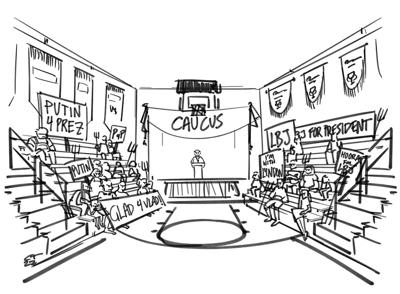
The first reported vote leader was Lyndon Johnson, who had been dead since 1973. Vladimir Putin ran strong for an hour or two but quickly fell back, even after professing, “I know how to campaign in the cold, comrade.”
All right, I made up that last paragraph.
Six agonizing days after the caucus, results finally were verified. Iowa Democrats blamed the Democratic National Committee. The DNC claimed the locals clogged the computers with corn kernels.
It was clear a divorce was looming. It arrived with the South Carolina announcement. Irreconcilable differences. Plus, too darned cold.
This might be a good time to describe what a “caucus” is. A caucus occurs when party insiders (though all are welcome, sure they are) crowd into a school gym and go to their respective corners literally to cheerlead for their preferred candidate and try to win delegates to the national nominating convention.
In reality, it’s a cross between a high school student council election and an Old Testament stoning. The clustered partisans send arm-twisters to other corners to try to convince those people that their loser candidate has no chance and to come join the winning corner with the cool kids. This can go on for hours. Eventually, a prom king or queen is anointed.
Some states still hold caucuses. Others have turned to primary elections open to all. Still others have closed primaries, in which voters who declare membership to one party or the other get to vote.
Which brings us to us.
Since 2000, our fair state has held a sensible presidential primary. In the last decade, as the state turned redder than a clown’s nose, efforts have been made in the Legislature to “reform” elections, all in the name of “election integrity.” Missouri’s presidential primary was caught in this crossfire and got eliminated in the latest “election integrity” bill passed last session.
It is curious that politicians so worried about election integrity – and lacking evidence of any widespread electoral mischief – want to return to those gyms with only party insiders calling the shots, instead of allowing the general public to decide nominees at the ballot box.
Unless someone acts, we are headed back to the Old Testament in 2024.
But wait! Someone is acting. State Rep. Cyndi Buchheit-Courtway (R-Festus) has pre-filed a bill for the 2023 session of the General Assembly, which convenes next week, that would restore Missouri’s presidential primary, giving all voters a say on their party’s nominee.
As it is, less than 30 percent of voters typically show up for primary elections, but that is still many times greater than the number of people willing to subject themselves to caucus rowdies.
I would like to salute Rep. Buchheit-Courtway, whom I have never met, for standing tall for ballot access – and sanity. I urge her colleagues to support her bill.
Otherwise, voters, gather your stones together.