


If you think exercise and physical fitness are the fountain of youth or an insurance policy against serious health problems, I’ve got news for you.
They’re not.
In the predawn hours of May 8, I landed in the emergency room at Mercy Hospital Jefferson with life-threatening arrhythmia, the clinical term for an out-of-control heartbeat. It was registering 200 beats a minute when a team of doctors and nurses descended on me in a trauma room. My abdomen, from my waist to my sternum, was a five-alarm fire.
They applied defibrillator paddles to my chest and gave me the shock designed to bring my pulse back to its normal 45-50 beats per minute. The kick, as from a mule, was so strong my legs flew up off the table.
My pulse immediately dropped to normal. But 15 minutes later, a nurse exclaimed, “He’s going again!” and they gave me three more shocks, each unsuccessful.
Finally they administered what is, for me, a wonder drug called amiodarone, one of the most common medications for many types of arrhythmia. That did the trick and I was sent to intensive care.
I had a second episode five days later, and – long story short – I’m now the proud owner of an “ICD,” an implanted cardioverter defibrillator, positioned just below my left collarbone. It sets my resting heart rate at 60 beats per minute and can deliver a shock directly to the heart if I have another episode (a direct shock being, it is hoped, more effective than the paddles in the ER were).
After seven days in the hospital, I came home with my new device and the challenge of rebuilding my heart health over the next six to 12 months. The cardiac rehab specialists at Mercy Jefferson are super-professional and helpful in my thrice-weekly rehab sessions. Between those, my medications (seven pills in the morning, two in the evening), daily walks and the watchful eyes of my wife and two cardiologists, I am slowly gaining strength.
Now to the irony.
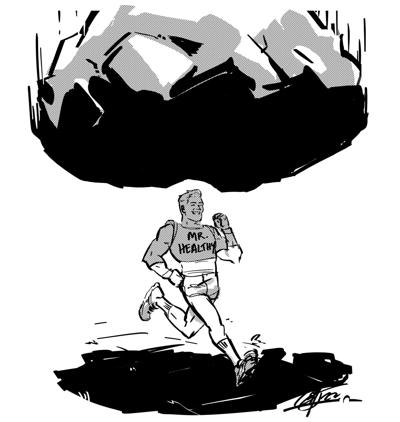
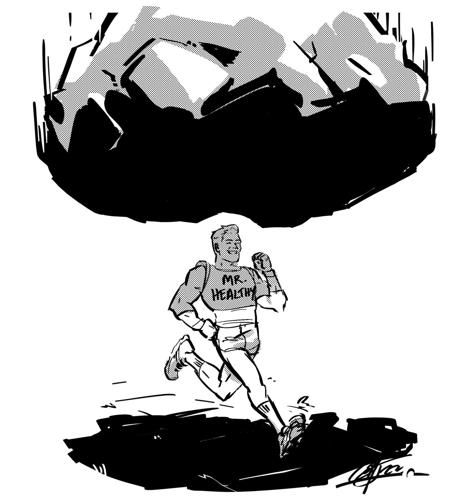
Those who know me were shocked themselves, figuratively speaking, when they heard about my heart problems. That’s because they knew I was a lifelong runner. I’ve been running regularly for more than 50 years, including a lot of competitive running in high school and college. Right up to the events of May 8, I was the picture of health, even doing upper-body strength workouts and stationary bike rides on my running off-days.
In hindsight, at age 67, I was overdoing it. But the exercise itself wasn’t what caused my heart to go haywire. In fact, my doctors say we’ll probably never know what caused it, beyond perhaps a genetic trigger, since my dad had a bad heart.
No, exercise didn’t cause my condition – but it didn’t prevent it, either. And I now know how hazardous it is to assume you’ll live a long, healthy, trouble-free life if you’re a workout fiend like I was.
Assumptions are dangerous. I remember in my first week in journalism school at Mizzou, an instructor wrote the word “ASSUME” on the blackboard and said, “In journalism, when you ASSUME, you make an ASS out of U and ME.”
Health assumptions can cost you your life. Over the last five years, I had episodes of light-headedness that were warning signs of heart trouble. They were over quickly, just a fleeting thing, so I ignored them. I assumed my passion for physical fitness exempted me from trouble.
Take my word for it, it doesn’t.
The heart is the hardest-working organ in the body and the one we take most for granted. You can’t do anything about genetic triggers, but you stand a better chance of lifelong heart health if you pay close attention to your body and follow the “Simple Seven” rules laid out by the American Heart Association.
1. If you smoke, stop.
2. Maintain a healthy weight.
3. If you’re not active (regular physical activity, with your doctor’s OK), get moving.
4. Eat better. (Watch out for sodium, a culprit in high blood pressure and strokes. I used to be really bad in my sodium intake.)
5. Control your cholesterol; pay attention to nutrition labels on food.
6. Manage your blood pressure (any reading over 130/80 is elevated).
7. Control blood sugar (a healthy non-diabetic adult should be below 100 milligrams per deciliter, fasting).
I would add a No. 8: Listen to your body and don’t ignore even slight warning signs like I did. I’m not suggesting you lapse toward hypochondria, but your doctor really doesn’t mind how often you walk through his or her door.
Above all, keep things in perspective. Inflation is terrible, gas prices are way too high and the stock market is in the tank. But it’s no big deal as long as you protect your most valuable asset – your health.
As Joni Mitchell sang, “Don’t it always seem to go that you don’t know what you’ve got ’til it’s gone.”