
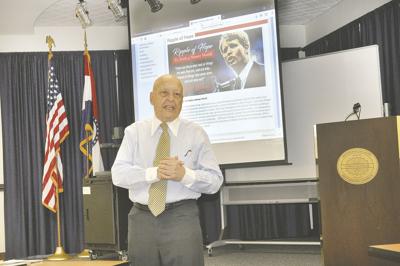
Fifty years later, the emotions still run deep for Adam Walinsky at the loss of his friend and colleague, Robert F. Kennedy.
Walinsky came to Jefferson College in Arnold last week, the wizened messenger of living American history. In three presentations to the public and students, he delivered a lot more than I or anyone could have expected.
Walinsky, 81, was Kennedy’s loyal aide and speechwriter during the terrifying spring of 1968. On the night of April 4, when news spread of Dr. Martin Luther King Jr.’s assassination, Kennedy was in Indianapolis campaigning for the Democratic nomination for president.
The then-U.S. senator and former attorney general under his brother, President John F. Kennedy – the victim of an assassin’s bullets less than five years earlier – ignored police warnings, went straight to a heavily black neighborhood and spoke from a flatbed truck to an angry, anxious crowd.
“What we need in the United States is not division,” he said. “What we need in the United States is not hatred. What we need in the United States is not violence and lawlessness, but is love, and wisdom, and compassion toward one another. And a feeling of justice toward those who still suffer within our country, whether they be white or whether they be black.”
The crowd, despite its grief and shock, applauded and cheered. Major cities across America suffered deadly rioting that night – but not Indianapolis. It was Kennedy’s finest hour. Just nine weeks later, he, too, fell in yet another assassination that left our country numb with anguish.
I was 13 that year and I vividly recall the sense of helplessness as our nation seemed out of control, torn apart by racial strife and rising opposition to the war in Vietnam. King and Kennedy might have led us out of those gut-wrenching problems. We will never know.
This was Walinsky’s second visit to Jefferson College in the “Ripple of Hope” series that started three years ago, through his long friendship with Mark Byington, a criminal justice and world religions instructor at the school. The title comes from a speech Kennedy gave to students in South Africa in 1966.
The words, which Walinsky cited from memory, are inscribed in granite at the Kennedy gravesite in Arlington National Cemetery.
“It is from numberless diverse acts of courage and belief that human history is shaped each time a man stands up for an ideal or acts to improve the lot of others or strikes out against injustice. He sends forth a tiny ripple of hope…”
Walinsky had to pause to compose himself and hold back tears in remembering those words, unlike most anything you hear from politicians today.
“People still have this feeling and tremendous interest about him,” Walinsky said of Kennedy. “Think about why that is and what it tells us about our politics. We haven’t felt a similar attachment to anyone else since then.”
Losing both King and Kennedy created a void, he said. “That loss is still there and still echoes.”
Remembering Kennedy provided the springboard for Walinksy’s two main themes. The first was that truth is what matters most.
“It’s the truth that makes us free,” he said. “Only the truth. If you live with lies, you die.
“Truth is everything; it is absolutely vital. We can’t fear it, we can’t hide it, we can’t walk away from it.”
Therefore, he said, “We have to start actually learning about these things” – meaning the events and issues of our times.
“Everybody starts with enormous ignorance,” he said. “How do we, together, start to teach ourselves about the things we don’t know?”
He left it to the audience to answer the question. Students who discussed his themes in a breakout session came back to him talking about empathy, humility and the patient struggle for social change. And the need to question everything in the pursuit of truth.
Had all this been the entire substance of Walinksy’s presentations, it would have been plenty for everyone in attendance to think about. But he also talked at length about his own ideas of “the truth” under the broad theme that as citizens we cannot trust our government. This was the unexpected part.
Example: “The FBI has for years and years been one of the most corrupt organizations in America.” His evidence was the major misdeeds of the late J. Edgar Hoover, who ran the bureau ruthlessly for 48 years.
Hoover spied on anyone he regarded as a political enemy, including (in great detail) King and the Kennedy family. His corruption is widely known – but he’s been dead for 46 years. Can the FBI be that contaminated today? I have to believe most Americans doubt it, as I do.
And another: “There’s a huge fever for war with Russia,” he said. “Huge numbers of people are doing their best to drum up a war with these people.” Walinsky took criticism from his fellow Democrats in 2016 for endorsing Donald Trump for president. He based his support on Trump’s willingness not to go to war with the Russians. But he offered no hard evidence for such an out-there claim of war fever.
After his talks I informally interviewed Walinsky. Besides giving fascinating insight into the Kennedy brothers – e.g., they were planning to fire Hoover after the 1964 presidential election, presuming a JFK victory – he revealed more conspiracy-colored observations, including the granddaddy of them all.
He said he believes the Warren Commission’s conclusion that Lee Harvey Oswald, and he alone, assassinated John Kennedy, is a “joke” and that the mountain of evidence pointing to Oswald is all fake.
Instead, he said, Kennedy was murdered by a team of four Corsican snipers recruited by mob boss Sam Giancana at the behest of the CIA.
Whoa, baby! As my friends and family will tell you, I believe the legion of JFK assassination buffs who conjure up all these exotic conspiracy theories are the real joke. Show me hard, substantial evidence.
They can’t, because none exists. Oswald was the lone, crazed gunman, case closed.
But I don’t hold any of Walinsky’s bold claims against him. He served at the elbow of a great man and he clearly loves his country. In more ways than one, he made his point: Let us discover the truth or die trying.
It’s the Robert Kennedy way.