
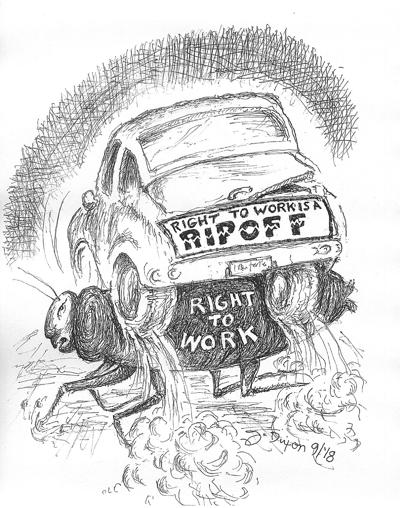
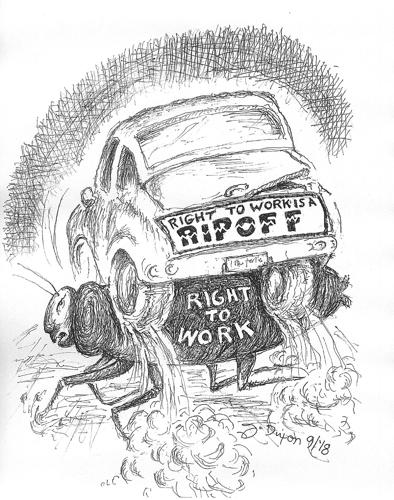
My husband swears he’s seen this car in Jefferson County in the past year. You could call it vintage, but he used the word “junker.” His eyes were drawn to the back bumper, where a faded sticker could still be deciphered: “Right to Work is a RIPOFF,” with the word “RIP-OFF” cleverly torn in the middle.
The ancient car and sticker were probably both newish on Nov. 7, 1978, when Missouri voters were polled on a constitutional amendment to make Missouri a Right to Work state, where employees in a union shop could opt out of paying union dues.
The car’s owner(s) probably never dreamed the bumper sticker’s sentiment would return to relevance, 40 years and probably several hundred thousand miles down the road.
In case you don’t remember (or weren’t born yet), Missourians way back then said HECK NO, sinking the proposed amendment by a 60-40 margin.
Vintage sentiments didn’t stop the Missouri Legislature’s Republican majority from passing a Right to Work law in 2017.
Union supporters jumped to action, garnering 310,000 signatures, more than three times the required number, to let voters have their say again.
That happened on Aug. 7. They said no by a more strident 67-33 margin, squashing that freshly minted law like a bad bug. Change the last two letters in HECK to double L’s to catch the mood.
In Jefferson County, you need stronger language.
Voter turnout was 40 percent, shocking for a primary election, as Prop A was sent to the cellar with a 78.45 percent majority. That was the fifth-largest rejection in the state, behind only the forget-about-it votes in Kansas City (82.88 percent against) and St. Louis city (88.07 percent), and neighbors Ste. Genevieve County (84.81 percent) and Washington County (82.1), along with Ray County (near Kansas City, 78.96 percent).
In all, Right to Work was supported by only 15 of the state’s 115 counties, most of them situated near our border with Arkansas, one of the nation’s 27 Right to Work states.
The stomp-down got national attention. Missouri’s vote came after five states since 2012 approved Right to Work – Indiana, West Virginia, Michigan, Wisconsin and Kentucky. Not to mention the U.S. Supreme Court ruling in June that banned the collection of dues from public-sector workers who opt out of joining unions.
Union spokespeople say Missouri’s vote could be a national bellwether for a resurgence of labor’s power.
Maybe, but those of us who live here know that Missourians have an independent streak not governed by prevailing winds. Twenty-seven other states, and even our own state Legislature better not try to tell us how to think.
Right to Work is a Republican notion, and indeed, has the support of President Donald Trump, from his own mouth in 2016 and repeated in June by U.S. Sen. Rand Paul, who is pushing for a national Right to Work law and says Trump has promised he would sign one.
Four of five Jefferson County voters may want to know about that.
Most of our county’s nine state legislators oppose Right to Work and voted against the 2017 law. Two, however – Republican state representatives Dan Shaul of Imperial and Rob Vescovo of Arnold – voted for it. Both men’s positions were known before they were re-elected in 2016, so they might not be too worried about voter revenge in the Nov. 6 general election, where both have a Democratic opponent.
Vescovo, the majority floor leader for the House in the last legislative session and for the upcoming one, did not return a message asking for comment.
Shaul did.
He said polling in his district, 113, is a little softer than the county at large, with 67 percent dissing Right to Work instead of 78 percent. Nevertheless, he said, that’s enough for him.
“That’s still two to one,” he said. “The voters spoke very loudly. I plan on respecting the voters’ voice. I’d be a no vote if it came up again in the General Assembly, although I don’t think it will.”
Mary Elizabeth Coleman, the Republican candidate running for state representative in the 97th District in northwest Jefferson County, said before the primary she favored Right to Work because of union support for left-leaning positions. The Democrat in the race, Mike Revis, was elected in February with lots of union door-knockers, so Coleman’s position seemed risky.
She acknowledged as much in a meeting with the Leader editorial board, but said she needed to be honest.
“You tell people the truth, even if it’s not popular,” she repeated last week.
In light of the Aug. 7 election, however, she said she would be a no vote if Right to Work resurfaces in the Legislature. “I don’t think ignoring your constituents is a conservative value,” Coleman said.
But stick a fork in Right to Work, she said. “I was at the summer caucus and did not hear a desire to bring it back up.”
Republican state Rep. Elaine Gannon of De Soto, a consistent voice for labor, attended the summer caucus, too, and heard discussion about Right to Work, although there was no vote to resurrect it.
“I would hope this would be put to bed. That’s what I want,” said Gannon, who said county residents have been heartfelt in thanking her for supporting labor.
But she said passionate proponents of Right to Work remain. She expects them to take a break, but not necessarily to give up.
So, if you had one of the bazillion “Right to Work is Wrong for Missouri” signs in your yard, or perhaps a bumper sticker, don’t discard.
Those items could come in handy someday – maybe sooner than in 40 years.