

"That is the land of lost content
I see it shining plain
The happy highways where I went
And cannot come again."
The poet A.E. Housman had it right. Good roads arouse good feelings. Bad roads are depressed – and depressing.
Last summer I saw cracked and broken Horine Road in Festus get a much-needed makeover, from the BNSF railroad trestle north to Richard Avenue, roughly 3/4 mile. Jokerst Paving and Contracting, a Festus company that has done many projects all over Jefferson County, milled down the old surface and laid a new carpet of asphalt in its place. For icing on the cake, they built a wide sidewalk along the whole stretch.
In the broad perspective of infrastructure – a word you will hear a lot in weeks to come – this was small stuff. But to the few hundred folks who, like me, drive that route every day, it was sheer delight to cruise down fresh, smooth, well-lined pavement. Not to mention taking a stroll (or in my case, a run) on the new sidewalk.
Now, what about that broad perspective? Simply put, our country is falling apart. The American Society of Civil Engineers has released its 2017 Infrastructure Report Card (its sixth since 1998), in which it issued grades from A to F on 16 categories of infrastructure. Here are the categories and national grades:
Aviation D; Bridges C+; Dams D; Drinking Water D; Energy D+; Hazardous Waste D+; Inland Waterways D; Levees D; Ports C+; Public Parks and Recreation D+; Rail B; Roads D; Schools D+; Solid Waste C+; Transit D-; Wastewater D+.
The overall grade? D+.
If your kids brought home a report card like that, would you shrug it off? Heck, no. You’d take immediate action.
Remarkably, our dysfunctional U.S. Congress and President Trump are seeking common ground on this issue. There’s a decent chance they may all agree on a modest start to infrastructure repairs and development. And by “modest” I mean $1 trillion.
I can hear you exclaiming, “What? You call a trillion dollars MODEST?”
Compared to the need, yes. The latest ASCE Report Card states that we’ll need $4.59 trillion over the next 10 years ($2 trillion just for roads) to bring those grades up to acceptable levels. So, the $1 trillion Congress might approve would simply be a down payment.
How about Missouri? It may surprise you that our state is not quite as bad off as the national average. Missouri gets a C- from the engineer group, including straight C’s in eight of 11 categories: Aviation, Bridges, Drinking Water, Levees, Railroads, Roads, Schools and Wastewater.
Then again, C- is not much above D+. We’ve got plenty of work to do and we must find the money to do it.
It all comes down to dollars and (common) sense, where there’s good news and bad news.
The good news is, a ridiculously simple and obvious solution is staring us in the face.
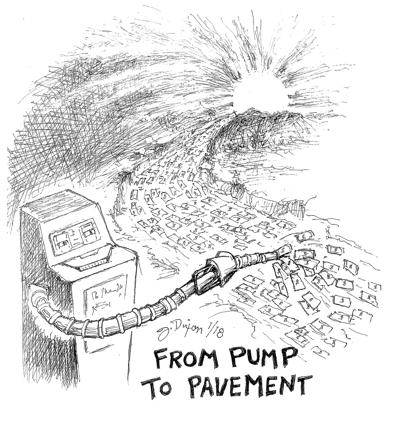
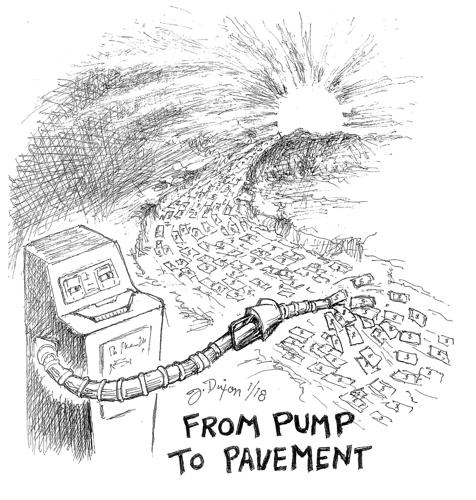
Raise gasoline taxes.
We don’t think about the taxes we pay on fuel because they’re excise taxes, charged to refiners and distributors and passed on to consumers in the price at the pump. Thus, they are almost invisible to motorists.
Which means – duh! – raising the taxes will feel the same as an ordinary market-driven increase in pump prices. Remember when gas spiked up to $4 a gallon (2008)? Our ceiling of tolerance is much higher than current prices, which in Missouri have floated between $1.70 and $2.50 per gallon for the past two years.
The bipartisan 21st Century Missouri Transportation System Task Force, whose 23 members include state representatives and senators, state officials and appointees from the public, has figured this out. It held 10 public meetings across the state between June and December 2017 and issued an 87-page report last week.
One key recommendation is an increase in the state gasoline tax from the current 17 cents to 27 cents per gallon (29 cents for diesel fuel), which would raise an additional $430 million per year. To become law, the increase needs the approval of both the Legislature and Missouri voters.
This should be a slam-dunk move. Consider:
■ The 17-cent gas tax is the fourth-lowest in the country and hasn’t changed since 1996. Twenty-one years of inflation has effectively cut that purchasing power by more than half.
■ Missouri ranks 47th nationally in revenue raised per mile.
■ Our state has 131,549 miles of public roads – only five states (Texas, California, Illinois, Kansas and Minnesota) have more.
■ We have 24,350 bridges – only five states (Texas, Ohio, Illinois, Kansas and Iowa) have more.
Getting an increase through the Republican-controlled Legislature, which has no shortage of anti-tax zealots, will be a tall order.
Sen. Bill Eigel (R-Weldon Spring) has filed a wide-ranging tax bill (SB 617) that would raise the gas tax to 23 cents, 4 cents below the task force recommendation.
Any increase is better than none. We can only hope logic will prevail. I believe voters statewide, once they understand the facts, would readily approve the 10-cent proposal if given the opportunity.
You can read the task force report at www.senate.mo.gov/17web/MTTF.
It’s the same story at the federal level. The federal gas tax has stood at 18.4 cents per gallon since August 1993. Inflation has shrunk real revenue by nearly two-thirds. Meanwhile, the Highway Trust Fund hovers near bankruptcy because Congress won’t pass long-term transportation funding. The fund takes in the federal gas tax revenue and doles it back out to the states, as in several road projects underway or coming soon throughout Jefferson County.
Come on, Washington. Get your act together and pass a tax increase we all can afford and all desperately need.
Housman’s happy highways can yet again be.