


I often listen to sports talk radio, so I am prepared to hear all kinds of statements from show hosts and callers. Some I agree with, but others I not only disagree with, but some statements seem utterly ridiculous to me.
In times past, you’d hear someone suggest that the Cardinals trade a second-string catcher for a superstar of the caliber of Mike Trout or the Blues swap two minor leaguers for Alex Ovechkin. I don’t believe people make these kinds of harebrained proposals as much anymore over the airwaves – maybe they share these thoughts on social media now – but a caller or two occasionally offers his insights into being a general manager.
A couple of recurring topics have been rankling me in recent years, however.
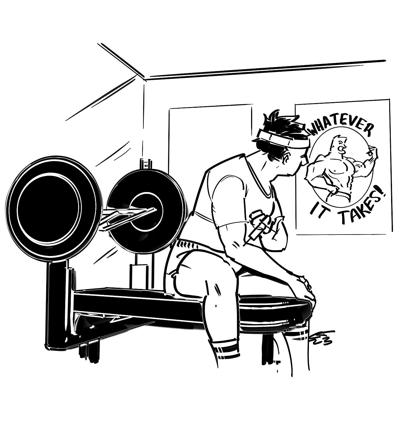
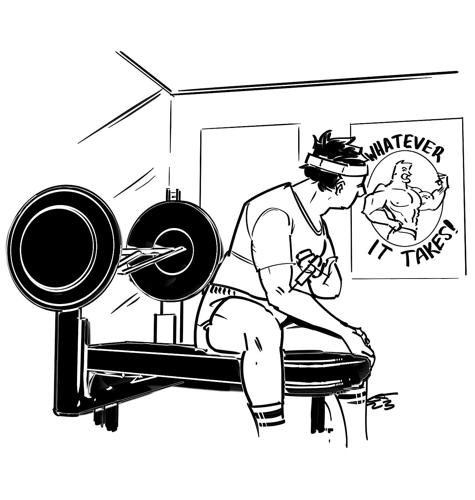
First, there is a school of thought that it’s not so bad for athletes to use steroids to help them muscle up. Proponents of this idea will say, “Hey, if somebody wants to put his or her internal organs at risk to try for a scholarship or to become a pro, it’s their choice.”
I could not be more opposed to this idea, and here’s why.
Condoning or merely allowing steroid use puts those who want to improve themselves naturally without putting their health at risk at a disadvantage.
I do not want to see any kid placed in the position of feeling the need to use steroids to keep up with their competition. It’s just not right.
I actually have a personal story about being offered steroids.
My first journalism job after I graduated from Mizzou was in Louisiana, Mo., in late 1984. I was an avid weightlifter from the fifth grade – yes, the fifth grade – on, looking for power, not bodybuilding. I continued to lift into my early 30s, until physical problems made it difficult to keep pumping iron.
Well, a couple months after I moved to Louisiana I joined a little gym. I was in my early 20s and enjoyed lifting weights. The guy who owned the gym got to know me and would spot me during my lifts on occasion.
We’d talk and I told him I was getting frustrated that no matter how hard I worked and how much I improved in other lifts, I could not seem to advance much in my bench presses. My best bench press was 315 pounds. That’s nothing compared to what they can do today, although it wasn’t bad back then.
After a few months of these types of discussions and, I guess, him feeling he knew me, he asked, “Would you like to bench 400?”
Well, yeah.
You know what’s coming. He suggested that I start taking steroids and that he could supply me with them.
I quit that gym shortly after and lifted my own weights in my apartment.
Fortunately for me, my physical education teachers for years had stressed to us how steroids could negatively affect your health, particularly your reproductive organs. This was an extremely effective way to get through to young men.
But, to this day I find it amazing that I was offered steroids in that little gym. No matter how much I bulked up, I was not going to become an NFL lineman. He obviously thought I had a greater desire to improve my bench presses than I did.
On the other hand, clearly there was a market for steroids since they were readily available at this gym in that small town. By the late 1990s, steroids seemed to be everywhere in the sports world. I would not have been surprised to find out a bass fisherman had tested positive for roids.
If I had taken steroids, maybe I would have eventually benched 400. Then again, maybe my heart would have exploded in my chest when I was 45.
The second item that comes up for discussion quite a bit is the belief, apparently held by a sizable segment of the sports community, that Pete Rose should be allowed into the National Baseball Hall of Fame. I embrace the opposite viewpoint.
The man admitted to betting on baseball games. It took years before he would own up to it. He signed a document accepting a lifetime ban from the game in 1989, but followed that by denying he had bet on baseball for a decade and a half. He finally admitted to betting on baseball and his own team in his autobiography, published in 2004.
People will bring this situation up on sports talk radio shows. They say that Rose should be enshrined in the hall because, among other reasons, he was a great player, what he did wasn’t so bad, especially compared with some Hall of Famers who were drug users, alcoholics or committed heinous crimes. And, they say, Rose has suffered enough.
Rose was a terrific baseball player, gathering the record for career hits with 4,256. He was a hard-nosed player who greatly contributed to the Cincinnati Reds winning the World Series in 1975 and 1976.
Yet, I am on the side that says Rose should continue to be barred from the Hall of Fame. Betting on sports as an active player or manager – especially the sport you’re involved in – is one of the worst infractions an athlete can commit.
The reason is that for fans to care about sports – and we do care, maybe more than we should – they must believe everyone involved in an athletic competition is trying to win.
Whether Rose tried to win while making bets as a player-manager while he was still active in the game is irrelevant. Just the possibility that placing bets may have affected his judgment in crucial situations or who he put on the field as a manager is enough to cast doubt on what he was doing.
For those who say it’s unfair to keep Rose out of the Hall of Fame while other unworthy people are in Cooperstown, I’d rather see the other bad apples removed than allow Rose to get a plaque.