


My cousin AJ and I were floating down the Meramec River earlier this spring when I pointed out the pretty purple flowers along the bank.
“Sweet Williams, I think,” he responded with a degree of confidence.
“That’s impressive,” I replied. I was feeling pretty good about just noticing the flowers and acknowledging something besides the water and places to make my next cast.
Then he fessed up. “Sweet William is my go-to guess whenever I notice little purple flowers,” he said.
Fair enough. We didn’t paddle over for a closer view, even though the stream gave us ample opportunities to work on our wildflower-identification skills. We wanted to catch fish, but in hindsight, we probably would have been better served by a botany lesson.
This is a great time of year to discover the creative colors nature has to offer. In the past week, the state departments of conservation and natural resources hosted wildflower walks and even a virtual class on how to identify those glorious little signs of spring.
I couldn’t synch up my schedule with those events, but the Taum Sauk Mountain State Park hike sounded like a great way to learn more. I visited the conservation department’s webpage for a self-guided tutorial, and now I want to get out in the woods for some field research.
Navigating the website was not as tricky (or exhilarating) as a 3-mile walk to Mina Sauk Falls, but I was able to find quite a bit of information at mdc.mo.gov by clicking on Discover Nature, then Field Guide, then Wildflowers, Grasses and Other Nonwoody Plants. The site has descriptions of 411 entries in the category and photographs of most of them. (On closer review, the Field Guide includes numerous duplicates, so the actual number of unique species is closer to 300.)
Of course, I looked first to check out wweet William, whom AJ knows so well. Blue phlox is the official name, and based on the details I found online, I’m pretty sure my cousin got it right. The other thing that caught my eye in the guide was how much fun someone had coming up with the names. Wild sweet William was tame compared to what they call many other natural gems to look for in the woods and on the riverbanks.
I have to learn a few of them just to be able to shout them out as a best guess. See a cluster of bright yellow: “That’s a showy partridge pea.” Spot a splash of little sky blue and white faces: “blue-eyed Marys.” What are those white ones? “It could be foxglove beardtongue.” Do you know those flat-faced violets? “I’m going with Johnny jump-ups.”
There are names that match the flowers’ appearances, at least in someone’s eye, including several different lady’s slippers, and the Dutchman’s or woollen breeches. It’s not hard to guess how they settled on the purple-headed sneezeweed.
Other names made me think I was perusing a list of punk-rock bands. Would you consider buying tickets to see deptford pink, goat’s beard, downy skullcap,smooth spiderwort, Philadelphia fleabane or Jerusalem artichoke? How about one of my favorites, dead nettle, or its close relative henbit?
Of course the best way to check out these natural beauties is to explore the hills and dales. Since we all rarely go anywhere without a camera, it is easy to capture images and then return for identification. I was too busy trying to catch fish while AJ and I were floating along, but I do have some other pictures from previous trips.
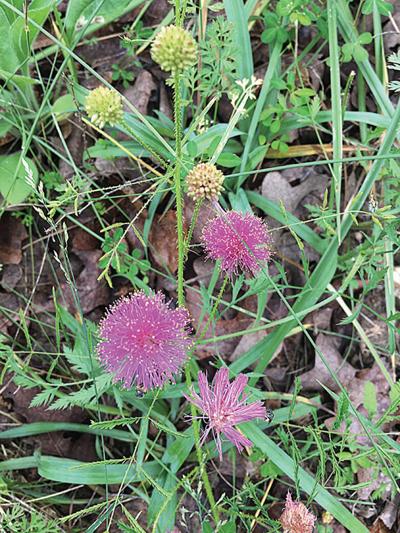
The online field guide allows you to narrow your search by flower color, habitat and other key identifiers. I was easily able to figure out that I had a shot of a sensitive briar in my collection. Now I know it is more than just a good-looking wildflower, which is why I took the photo. Its nickname, devil’s shoelaces, is pretty cool, too.
Missouri wildflowers bloom from early spring into the fall, so they can be a reward for a hike or float trip almost anytime. Learning about them can be fun as well.
John Winkelman has been writing about outdoors news and issues in Jefferson County for more than 30 years and is the Associate Editor for Outdoor Guide Magazine. If you have story ideas for the Leader outdoor news page, e-mail ogmjohnw@aol.com, and you can find more outdoor news and updates at johnjwink.com.