


The reading program at Festus Public Library invited everyone to enjoy some book time this summer with the catchy slogan, “Adventure Begins at Your Library.”
A July 10 program brought that phrase to life for a big group of 7- to 17-year-olds and the adults who accompanied them.
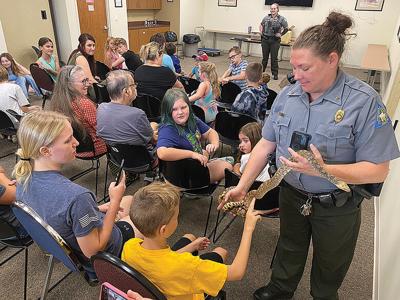
Jefferson County conservation agent Cpl. Lexis Wilson and agent Ashton Crance from Warren County brought two snakes to the program and allowed everyone in the audience to meet and learn about Missouri’s most misunderstood reptiles.
“Raise your hands if you’re afraid of snakes,” Wilson instructed the group seated in the meeting room chairs and on the floor. “Adults that includes you, too.”
The crowd’s reaction was immediate and almost unanimous.
“I was really afraid of them until I was 30 years old,” she said, explaining that the fear is a learned response.
Wilson said her fear of snakes came from the same guy who took her hunting and fishing and taught her to love the outdoors.
“My dad was the toughest guy I know, but he was afraid of snakes and killed them to protect us from them. I learned it from him,” she said.
If you can be influenced to fear them, then the goal of the program is to teach people the opposite reaction through better understanding.
“I’m not saying you should go out into the woods looking for them to play with. Don’t play with any wild animals,” Wilson said. “For 10 years I have been talking about snakes and why you shouldn’t be afraid of them.”
There are about 45 different species of snakes in Missouri and only five are venomous, she said. Those five, like many of the other 40, are rare or reclusive. The pygmy and Massasauga rattlesnakes are only found in isolated areas of the state. The western cottonmouth (aka water moccasin) lives exclusively south of Jefferson County, so the only two that may be encountered here are the Osage copperhead and the timber rattlesnake, she said.
While Wilson explained ways to identify the differences between venomous and non-venomous snakes, Crance circulated through the room with cast models of a copperhead and a timber rattlesnake. She pointed out the vertical pupils and the diamond-shaped head or “cheeks” of the two pit vipers.
“Missouri’s non-venomous snakes’ heads are the same shape as the rest of their bodies,” Wilson said.
The audience participated with many questions and answers, and they waited patiently for the conclusion, well aware that the mini-aquarium and pet carrier on the front table held the stars of the show.
Crance carried a small hog-nosed snake through the rows of chairs for everyone to see up close but not touch. After that opening act, Wilson brought out a representative of Missouri’s largest snake. The bullsnake she had at the Festus Library program was about 5-feet long, which is an average size for the species, but the species has been documented to grow to nearly 9 feet long.
After giving instructions for how to pet the snake (with two fingers and from front-to-back along the scales), Wilson gave everyone a chance to feel the snake’s skin as the big reptile worked to wrap itself in the agent’s equipment belt and uniform loops.
All of the same people who admitted a fear of snakes at the beginning of the program took a turn to touch the bullsnake as it passed through the crowd.
The program opened with an explanation of the conservation agent’s job and a pitch directed to the older members of the audience. Wilson explained that the Protection Volunteer Program allows 18-year-olds to ride along with agents and participate in programs as an introduction to the career opportunity.
“I spend most of my time out in nature. It’s the best job in the world,” Wilson said.
John Winkelman has been writing about outdoors news and issues in Jefferson County for more than 30 years and was the Associate Editor for Outdoor Guide Magazine. If you have story ideas, e-mail ogmjohnw@aol.com, and you can find more outdoor news and updates at johnjwink.com.