


For our #Firstday hike this year, we did not visit one of the official Missouri State Park events, but chose a location known for much more than its paths through the woods.
For 45 years, the World Bird Sanctuary near Eureka has served as a rehabilitation hospital for raptors and a showcase for many other avian species.
The birds and the work that is being done with them bring visitors from all over. A paved footpath leads past large enclosures that serve as homes for injured birds that have been rescued, but for many reasons can’t be returned to the wild. The hiking trails are a bonus.
Located at 125 Bald Eagle Ridge Way, the bird recognized as our national symbol is an obvious star of the show. The bald eagle’s story of recovery in North America is symbolic of the work that goes on at the sanctuary. Once exploited and nearly extinguished, bald eagle flocks are now a main winter attraction in our area along the Mississippi River.
Along the footpath you can observe birds from big emus to comparatively tiny sharp-shinned hawks, with a menagerie in between. They watch you watching them, often trying to hide from prying eyes, but sometimes answering back to a visitor’s greeting.
Dozens of birds recovering from a variety of injuries and circumstances are available for viewing. The sanctuary and its hospital are home to about 270 different critters including eagles, hawks, parrots, vultures, owls, pelicans, pheasants, falcons, and other injured or endangered species (also including reptiles) from our backyards and around the world.
The 305-acre facility works cooperatively with the state Department of Natural Resources. Outreach programs have educated more than a million school children. The rehabilitation hospital has treated more than 21,000 injured birds, and the facility has connections for bird conservation on four continents.
An admission charge funds the work at the sanctuary. The cost is $8 for an individual, $12 for a vehicle with two or more people, or $20 for buses with 10 or more. Children ages 5 and under are admitted for free. The facility is open daily from 8 a.m. to 5 p.m. Other ways to support the birds include direct donations, memberships, guest experience events, volunteering and more. For additional information, call 636-225-4390.
After checking out the birds, we found the hiking trails we were looking for. The Turtle Bob Trail is a one-mile loop up and down the valleys of the hardwood forest. It is well-maintained and clearly marked. The Hickory Trail begins at the end of the bird-viewing foot path. It is a quarter-mile, one-way trail that connects with the longer Chubb Trail, which along with the Mariah’s Summit Trail will get you back to the main entrance.
The Chubb Trail is one of our area’s most challenging, as a point-to-point walk of about seven miles. With one trail head at the bird sanctuary and the other at West Tyson County Park, this multi-purpose trail allows mountain bikers and equestrians in addition to hikers and hardy runners.
In addition to Chubb’s full-length challenge, several side loops are available, including a Castlewood Loop of 2.8 miles and the North and South Prairie Loops of about three-quarters of a mile each. The Chinkapin Trail and Flint Quarry Trail offer two more miles of hiking options at West Tyson Park.
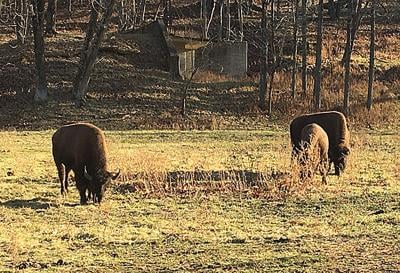
That was more walking than we were looking for, so we headed across the road after finishing our tour of the World Bird Sanctuary’s woods. The entrance to Lone Elk Park is on the opposite side of the road. The drive-through park includes herds of Rocky Mountain Elk and American Bison. A challenging 3.3-mile loop trail winds through the woods where the elk and white-tailed deer roam. Visitors must stay in their vehicles in the bison area, and are advised repeatedly not to approach the elk or other wildlife in the park.
John Winkelman has been writing about outdoors news and issues in Jefferson County for more than 30 years and is the Associate Editor for Outdoor Guide Magazine. If you have story ideas for the Leader outdoor news page, e-mail ogmjohnw@aol.com, and you can find more outdoor news and updates at johnjwink.com.