


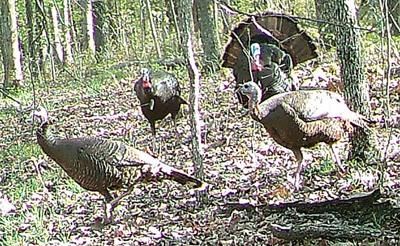
The Missouri fall firearms turkey hunting season opened on Oct. 1 and continues through Halloween. While the number of participating hunters has waned in recent years, the turkey population has seen an even more dramatic drop.
The parallel declines are correlated. With fewer chances to fill tags or even find a flock, the incentives for chasing the biggest wild fowl in the fall can’t keep pace with other activities available during a golden time of the year to be outside.
The reasons for the reduction in turkey numbers are more difficult to discern, but it’s not for lack of theories. There are almost as many suspected reasons as there are hunters. Everyone has an opinion, ranging from too many armadillos to too few zygentoma and other insects.
For more than 60 years, the state Department of Conservation has monitored the turkey population through an index called the hen-to-poult ratio as a measure of nesting success. The current numbers are historically low, with a statewide average of just one poult observed for each hen, according to the Missouri Wild Turkey Harvest and Population Status Report 2021, available at mdc.mo.gov.
Spikes in the data since 1959 have shown ratios as high as four-to-one in four different years and more than three-to-one in 14 summers. In the past 60 years, however, the numbers have been down to one-to-one or lower seven times, including each of the past six years. Statewide the ratio is down 17 percent over the recent 10-year average and 23 percent below the 20-year average.
The poult-to-hen ratio surveys are conducted by volunteers and conservation department staff who observe birds in June, July and August. Numbers are recorded by county and then analyzed in regions that have similar habitat. Jefferson County is in a group of 12 counties in a corridor called the Union Breaks that borders on the western and southern banks of the Mississippi and Missouri rivers, from Cape Girardeau to Cooper County upstream from Jefferson City.
The other numbers monitored to assess the status of the state’s turkey population are overall harvest totals, which are most heavily weighted by the spring season, when only male turkeys are targeted, and make up more than 98 percent of the harvest. Spring totals exceeded 60,000 in one year and stayed above 50,000 birds from 1999 through 2006, before spending a decade in the 40,000s and falling to a 25-year low of 34,595 in 2021.
Archery and fall firearms harvest totals combined have been less than 5,000 total turkeys in each of the past five years, but those hunting seasons allow hunters to take birds of either sex, and consistently the majority are hens. Further reduction of a hunter’s chances to fill a tag may cause additional decline in fall firearms hunting participation, but protecting potential brood-builders seems like a better plan for the near future.
The conservation department has teamed up with the University of Missouri to study how habitat, predators, and weather conditions in Putnam County, starting in 2021, affected the survival of turkey hatchlings. The research is collecting data on temperature and precipitation in the same locations where nest predators like skunks, raccoons and opossums and larger predators such as foxes, bobcats, and coyotes are being monitored. The cooperative research project is scheduled to last more than five years, so even initial results are a long way off.
The expanding range of nine-banded armadillos is a least-likely cause for turkey population concerns and poult survival, except for indicating a warming climate. More frequent spring flooding and violent storms are much more deadly for the little birds than is competition for insects.
Two other factors not included in the study are also possible contributors to the reduced turkey populations. The proliferation of pesticides eliminates a lot more bugs than an army of armadillos can eat, and the use of herbicides to control weeds on cropland can’t be healthy for the wildlife that use those same tracts of land. No one in his right mind would walk barefoot across a field immediately after spraying it with Roundup, but that’s what wild turkeys have to do. They also eat seeds that may contain trace amounts of those chemicals. No matter how safe they may be, substances designed to kill plants can’t be healthy for birds to consume.
The challenges are significant, and the evidence is still being collected. But the perils facing the state’s No. 1 game bird are real.
John Winkelman has been writing about outdoors news and issues in Jefferson County for more than 30 years and is the Associate Editor for Outdoor Guide Magazine. If you have story ideas for the Leader outdoor news page, e-mail ogmjohnw@aol.com, and you can find more outdoor news and updates at johnjwink.com.