


Long periods of dry weather and hot temperatures through the summer and into early fall often lead to outbreaks of hemorrhagic diseases in deer. Late August and most of September this year have produced prime conditions for deer deaths.
Jefferson County is one of five counties to report multiple incidents of the disease and cases have been identified in 20 counties throughout the state. The two reported deaths in Jefferson County have been attributed to blue tongue virus, one of the two variants caused by the same circumstances.
Epizootic hemorrhagic disease and blue tongue virus are both caused by the bite of a midge fly and tend to peak when deer are concentrated near limited water sources where the flies reproduce. The state Department of Conservation is asking area residents to report deer carcasses they find with no apparent cause of death symptoms.
Deer that die from hemorrhagic diseases are frequently found near water sources, according to a department press release. Symptoms of the disease may include reluctance to move, difficulty breathing, swelling of the head, neck or tongue, and unusual behavior such as appearing dazed or unresponsive. The virus causes internal bleeding and can cause high fever, prompting infected deer to seek water.
“Hemorrhagic disease is a naturally occurring virus in Missouri’s deer population,” said Brigid Niemeyer, wildlife health program supervisor for the Conservation Department. “Outbreaks are most common between July and October and typically end after a heavy frost kills the midges that spread the virus.”
Reports from the public help biologists identify and understand the scope of the disease in any given year. Missouri’s most significant outbreak of the disease was reported in 2012 during an extended drought, the department stated.
“We care deeply about Missouri deer and deer hunting,” Niemeyer said. “By reporting suspected cases of HD, members of the public can help us track where the disease is occurring and how it’s affecting deer numbers in specific areas.”
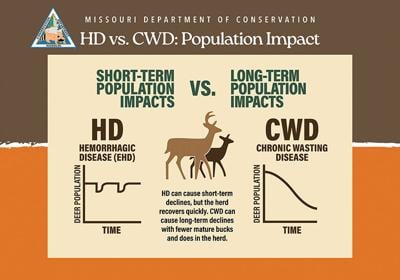
While some deer may develop resistance and survive, most animals that are infected by hemorrhagic disease die quickly, making the effect obvious. By comparison, deer that contract chronic wasting disease may carry the deadly prion for years before succumbing to its brain degenerating symptoms.
An outbreak of hemorrhagic disease does not have long-term effects on the overall health or sustainability of Missouri’s deer herd. Even after a severe outbreak, the deer population recovers within a few years, the department release stated.
CWD is transmitted from deer-to-deer contact, bodily fluids, and through infectious material left in the soil. A deer carrying the disease may appear healthy, but it can spread the infection to others. The prions can survive in the environment for years. Unless infection rates are kept low, chronic wasting disease has the potential for long-term significant declines in deer populations.
According to the department, the virus that causes hemorrhagic diseases does not affect humans and cannot be spread by handling or eating meat from deer with HD. However, the disease may weaken a deer’s immune system, allowing secondary infections that make the meat unsuitable for consumption.
There is no evidence that CWD is a health issue for humans, but the US Centers for Disease Control advises hunters in areas where the disease is present to have their deer tested and wait for results before eating the venison.
Jefferson County residents can report deer deaths suspected of being caused by disease to our local conservation agents, Cpl. Lexis Wilson or Dominick Montileone. Wilson’s phone number is 314-696-9425 and her email is lexis.wilson@mdc.mo.gov. Montileone can be reached at 314-954-5697 or by email at dominick.montileone@mdc.mo.gov.
John Winkelman has been writing about outdoors news and issues in Jefferson County for more than 35 years and was the associate editor for Outdoor Guide Magazine. If you have story ideas for the Leader outdoor news page, e-mail ogmjohnw@aol.com, and you can find more outdoor news and updates at johnjwink.com.