


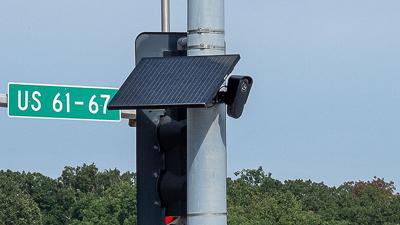

Most of Jefferson County’s law enforcement agencies have adjusted their policies on the use of automated license plate reader (ALPR) technology, such as Flock Safety cameras, and say they intend to keep using them.
On Sept. 16, Gov. Mike Kehoe signed an executive order implementing statewide safeguards to protect residents from misuse.
The order was signed after months of nationwide criticism and allegations of misuse of ALPR technology.
U.S. Sen. Josh Hawley, R-Missouri, recently announced he has launched an investigation into “AI-powered surveillance cameras,” including Flock Safety, amidst rising concerns about the threat it poses to privacy and national security. He has invited the CEOs of Flock Safety, Axon, Motorola and Verkada to testify before a Sept. 23 Senate Judiciary Subcommittee on Crime and Counterterrorism hearing and is encouraging Congress to write protections into laws.
Hawley told Fox 2 that Kehoe’s order was a great step forward.
After signing the executive order, Kehoe said, “Protecting citizens also means protecting their constitutional rights. The unchecked collection and indefinite storage of location data belonging to law-abiding citizens raises substantial, valid constitutional and privacy concerns. The government should not be building a permanent record of where law-abiding Missourians go, who they visit or how they live their daily lives.
“This executive order is the first step in creating safeguards against abuse of this data, while still understanding the benefits of these vital public safety tools for law enforcement.”
The governor’s order requires most license plate and vehicle data to be permanently deleted within 30 days; prohibits vendors from selling, sharing or commercializing Missouri-generated data; limits the use to legitimate criminal justice and lifesaving purposes; requires accountability measures to prevent and penalize misuse; and prohibits the integration of artificial intelligence facial recognition technology with the systems.
The governor directed the Missouri Department of Public Safety to establish statewide safeguards for state agencies and state-funded local law enforcement entities using ALPR technology. The order states any misuse of ALPR technology will trigger immediate disciplinary proceedings, criminal referral, where appropriate, and a mandatory report to the state for officer license revocation or discipline.
Most departments plan to keep Flock
The governor’s order came two days after the Hillsboro Board of Alderpersons voted to end its contract with Flock Safety.
Police Chief Darrick Curtis asked the board not to renew the contract for the city’s five Flock cameras. He said it had to do with the cost of the cameras and it did not have to do with privacy concerns.
“I’m not going to weigh in on that,” he said. “I don’t know where that is going to land. However, when I look at our usage of it, we’re just not making very many cases off it for it to be worth it in my opinion. I think that there’s some other crime prevention strategies that we could use that I think are to be more effective than (Flock cameras).”
Curtis said the contract expired Sept. 14, and the cameras should be removed this fall.
But all other law enforcement leaders in the county said they intend to keep using the technology. According to Jefferson County agencies, there are at least 83 ALPR devices in use in the county.
The Jefferson County Sheriff’s Office started using Flock cameras in 2019, with other departments following suit from 2021-2024. The cost of one camera averages about $3,000 a year.
Most agency leaders said they had policies in place and are adjusting those to meet the new rules.
“The governor’s executive order is a positive step in showing the citizens of this state that law enforcement needs to be transparent with the use of these automatic license plate readers to garner their trust and support,” said Byrnes Mill Police Chief Frank T. Selvaggio. Byrnes Mill has four Flock cameras that were purchased with American Rescue Plan Act (ARPA) funds.
Arnold Police Chief Brian Carroll also welcomed the safeguards from the governor.
“This technology only works if the public trusts how we use it, and a uniform statewide standard helps build that trust far better than each agency having a different policy,” he said. “The governor’s order recognizes both halves of this issue, and so do we. ALPR cameras help us recover stolen vehicles, find missing and endangered people, and generate leads on crime. At the same time, the people of Arnold are entitled to know that we are not tracking law-abiding citizens going about their daily lives.”
Carroll said the 30-day deletion rule was already in Arnold’s policy.
“We have reviewed our policy against the governor’s executive order and identified a couple places where we will strengthen our written policy to match it, including an explicit prohibition on integrating facial recognition with our ALPR system (which we currently don’t use) and a requirement that every single search be tied to a documented case number or law enforcement justification,” he said. “Those revisions are underway now, and we will also review the best-practices guidance the Department of Public Safety is directed to issue in the near future.”
Carroll said the police department operates nine ALPRs, with some partially funded by a state grant. Other entities, including private businesses, subdivisions and schools, make up the other 18 cameras in Arnold.
He said one of the department’s Flock contracts ends early next year and acknowledged it will be ultimately up to the City Council whether it will be renewed.
“This technology does real work for Arnold residents – recovering stolen vehicles, locating missing and endangered people and developing leads in criminal investigations,” Carroll said. “Since we began using Flock cameras in March 2023, I have documented nearly 300 cases in which Flock technology has helped us keep our community safe.
“We understand why some Missouri communities suspended their programs – the governor’s own order notes that several did so ‘due to a lack of uniform, trustworthy statewide guardrails.’ Our view is that this executive order now supplies those guardrails, which addresses the concern rather than requiring us to shut the cameras off.
“Turning it off would take that away from the community without making anyone’s privacy safer, because the actual privacy risk lies in how long data is kept, who can search it and whether searches are audited.”
Jefferson County Sheriff Dave Marshak said he was pleased the governor took action. He said a police officer’s responsibility is to protect public safety and individual liberty.
“Removing an effective investigative tool because it could potentially be misused would not serve the public well,” Marshak said. “The better approach is to establish clear rules governing how it can be used and meaningful consequences when those rules are violated. That is why I support the direction Gov. Kehoe has taken. There is a reasonable middle ground between unrestricted government surveillance and preventing law enforcement from using modern investigative technology.”
He said ALPR technology is a valuable law enforcement tool.
“But valuable technology needs appropriate safeguards and accountability,” Marshak said. “I believe we can protect the privacy and constitutional rights of law-abiding citizens while still giving law enforcement the tools necessary to find missing people, recover stolen vehicles and identify violent offenders. Many of the safeguards identified by Gov. Kehoe are consistent with practices we already have in place or have been discussing locally.
“The executive order is also an important first step rather than the end of the discussion. I look forward to working with Gov. Kehoe, the Missouri Department of Public Safety, legislators and other law enforcement leaders during the upcoming legislative session to help develop a reasonable and consistent statewide framework.”
Marshak said the ALPR technology is used every day to keep the community safe. He said it has helped the department identify stolen vehicles, locate missing or endangered people, develop leads in violent crimes and solve serious criminal investigations including a home invasion, an armed robbery, a fatal shooting during an apparent road-rage incident, and a sexual assault and kidnapping case.
“A severely injured victim sought help after reporting being kidnapped, sexually assaulted and prevented from leaving a rental vehicle,” he said. “The victim was able to provide investigators with a distinctive feature of the vehicle. Detectives used that information and ALPR data to identify the vehicle and its renter. The investigation ultimately resulted in the identification of a suspect.”
As for Flock Safety, a spokesperson praised the statewide order.
“Flock supports strong guardrails for license plate reader technology that protect privacy, ensure accountability and preserve its important public safety uses,” said Paris Lewbel, a Flock Safety spokesperson. “License plate readers help law enforcement solve serious crimes and find missing people, and clear rules are critical to maintaining public trust in these tools. Missouri’s executive order is an important step toward establishing those guardrails while allowing law enforcement to continue using technology that helps keep communities safe.”