


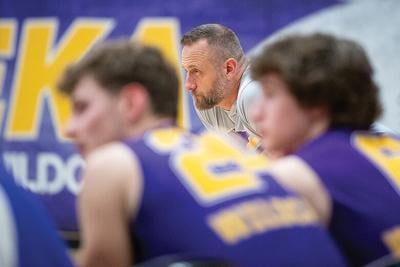
There’s a lot more to Bryan Pieschel than volleyball.
He just finished his fourth season as head coach of the Eureka boys team and once served as the director of High Performance Volleyball, an elite club volleyball organization based in Fenton.
But before he was a coach, Pieschel was a decorated U.S. Army combat medic with the Fifth Engineer Battalion based out of Fort Leonard Wood. He was awarded the Purple Heart after his vehicle hit an explosive device in Iraq in 2006. His unit sustained many casualties during his two-year deployment and he learned a lot about the ravages of war – physical and psychological.
He’s carried that knowledge as director of veterans services for Dogs for our Brave, a St. Louis non-profit organization founded in 2013. DFOB’s mission “is to provide professionally trained service dogs at no cost to veterans who have suffered debilitating injury or illness while in service to our country.”
DFOB places highly-trained service dogs all over the country and pays for every aspect of the animal’s care, for life. Pieschel joined the organization last July and his main duty is to review veterans’ applications for service dogs.
April Haskins is the executive director of DFOB. Haskins said on
Pieschel’s first day, they traveled to Ohio with a newer rescue/service dog, who was later named Riddick.
“Why we thrive with Bryan is, he’s our first veteran to work for us, so he’s able to connect with veterans in the field,” Haskins said. “He can have tough conversations with people. Since he came on board, he’s been excellent drawing in our veterans.
“He chose to be extremely vulnerable about communicating his effort to help other veterans. It’s that domino effect. He’s leading that charge to help them stop being what they were taught to be in the military and just be real and let it out.”
Haskins said there are currently seven dogs in training, with space for 10. She said they have to be careful about which dogs are selected. Breeds used in active military service, like German Shepards or Belgian Malinois, usually aren’t good service dogs. One of the requirements is the dog must weigh at least 35 pounds. The training alone costs $40,000.
“It’s hard enough to train a rescue (dog) but we chose to do that,” Haskins said. “We’re growing as an organization. Sometimes we only have a dog for a couple of days. A service dog has to be able to remain extremely calm. They have to be silent and observant. Their demeanor can’t be ferocious-looking.”
When I talked with Pieschel last week, the Wildcats had just lost to Parkway South in the District 4 semifinals in five grueling sets, ending their season.
As the Eureka players left the postgame meeting, their mood was somber as they hugged each other in the hallway. Pieschel said he was proud of their effort. He knows how to mend young men dealing with physical or emotional pain.
“I’m very blessed for the opportunity to go from one passion to another,” he said. “Not many people get to chase one. It’s very meaningful. It fills my cup in a different way. I still adore being on the court, coaching these boys and leading young men. But (DFOB) is a different challenge. There’s a whole different set of responsibilities, which I enjoy. We need more people in the fight with us.”
Pieschel said joining DFOB came through his volleyball relationships.
“Worlds kind of collided,” he said. “The opportunity came last summer, (with) being a veteran, and dealing with a lot of veteran issues that our community’s facing right now, especially veteran suicide. I’ve lost more (fellow soldiers) from my unit to suicide that I care to admit. This was a chance for me to get back into the fight, so it wasn’t a hard decision.”
According to the Veterans Administration (va.gov), in 2021, the veteran suicide rate in Missouri was “significantly higher” than the national veteran suicide rate and the rate for the general population. The numbers are sobering. The national veteran suicide rate per 100,000 was 33.9 percent in 2021. The latest data indicates 22 veterans commit suicide every day.
Pieschel’s Army unit ran route clearance in advance looking for IEDs (improvised explosive devices). Even for the soldiers who weren’t wounded, the daily stress of deployment in a forward area can take its toll well beyond active years of service.
“I’m extremely fortunate to be here today. I had some close calls,” said Pieschel, who with his family lives in Eureka accompanied by dogs, horses and chickens, among other living creatures. “That’s another reason why I live my life with purpose. We lost quite a few guys over there. That’s always been a driving force in working through my own demons. That fits into my purpose now. I hope I’ve always been a positive influence as a volleyball coach.”
DFOB currently has 15 dogs in the field, ranging from California and Nevada to Virginia, Ohio, Illinois, Missouri and Florida. Pieschel said the dogs are specifically mobility-assistance service trained for wounded and sick combat veterans. A staff of trainers takes about 18 months to get the dogs ready. If there ever was a win-win situation, it’s that DFOB obtains its dogs from shelters. Five Acres Animal Shelter in St. Charles provided one of the current dogs in service.
While the selection process is not breed-specific, Pieschel and Haskins said Golden and Labrador retrievers and standard poodles make excellent service animals. The dogs selected for training are usually between six months and two years old.
“Any older than that tends to take away from their time in service,” Pieschel said. “Any younger and there’s a lot more work to be done. We need dogs with size because of the mobility techniques they use. Our dogs can pick up things off the floor like keys, credit cards, cell phones. They can turn light switches on and off. They can open and close dryers, refrigerators.
“We focus on a mind-body-spirit training style. That’s how I approach the veterans as well. Our trainers say, ‘Our dogs aren’t there to make their lives easier, they’re meant to make them better.’
“My job and goal for veterans is, we challenge them to get out there and live their best life. We use these dogs as a bridge and use the strength inside, because of what they’ve been through, to make a positive change, whether that’s in their family or ripple effects into the community.”
After returning from Iraq, Pieschel needed healing, too. He suffered from significant post-traumatic stress disorder and was medically retired from the Army in 2009.
Volleyball was one of the instruments in Pieschel’s recovery. The now-middle-aged combat veterans from Iraq and Afghanistan deal with the same sorts of physical trauma pro athletes do at the same stage in life.
“Those guys who went on six, seven, eight forward combat deployments, their bodies are going to break down and their injuries are going to get worse,” said Pieschel, who appears fit enough to return to active duty. He talks at least once a month to each veteran with a service dog, and more often if they’re struggling.
“That is very fulfilling,” he said. “It gives me a chance to be a doc again.”