


According to Kermit, “It ain’t easy being green.”
But as a frog, he would find life a lot more difficult without all that pigmentation. Lacking natural camouflage in the outdoor world is an inherited – and inherently dangerous – trait.
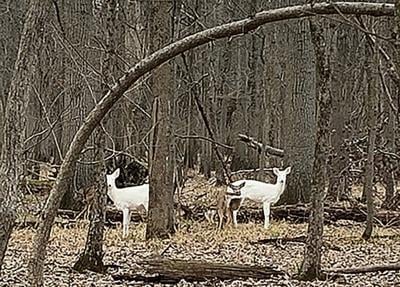
I have heard from several Arnold residents about white deer in their neighborhoods, even in their backyards. Rich Hoefli sent a mirror-image photo of two of the rare creatures he spotted in Arnold Park earlier this year.
A shot by Mike Scheetz shows a white deer with three other members in its herd near a white fence in someone’s yard; the albino blends into the environment better than the other three.
Depending on the species, the frequency of albinism is varied but always rare, according to the state Department of Conservation. Research in all mammals indicates a rate of about one in 10,000. Some bird studies have found prevalence closer to one in 2,000, while in humans the matching of recessive genes happens to about one person in 20,000.
The science and math are way more than this outdoor writer can convey, but according to the information I found, about one in 70 people carries the recessive gene, so the chances of pairing are slim. Normal or random breeding usually reduces the rate, while inbreeding among small isolated populations can increase the chances.
Albinism presents itself in degrees, with true albinos being the most rare. They have no pigmentation at all, so the blood vessels in their eyes make them look pink. Leucistic animals (those with partial loss of coloration) are mostly white or pink with patches of their natural color, but frequently have light blue eyes. Partial albinos have patches of white on their mostly normal colored skin, eyes and hair, and are often referred to as piebald.
Another Leader reader reached out about an albino catfish his son caught during the recent Firecracker Festival fishing derby. The conservation department hatchery research indicates that those show up in about one fish per 20,000. Because the small fry spend most of their growing time in protected ponds with siblings and fish their size, they are not so imperiled by their lack of coloration until they grow big enough to get stocked for catching.
Lack of color makes wild animals stand out from their environment. It certainly makes them easier to see among the trees and foliage where others of their kind can hide in plain sight. The lack of pigmentation in their eyes is a challenge too, because it may affect the animals’ vision, making it more difficult for them to spot predators or even find food.
You can make a case that some albinos might not face as much danger as we think. We don’t know for sure how animals see colors, and in the case of birds of prey that hunt by movement and sound, the small animals that make up their meals will get snatched regardless of how they look.
The questions about white deer or turkeys come up every hunting season. Based on the permits the hunter carries, the unique animals are fair game as long as they meet antler-point restrictions in specific areas, are legal with an antlerless tag, or in the case of spring turkeys, have a visible beard.
The conservation department also notes that among Native Americans on the plains, the white bison achieved mythical status as a source of great power and good fortune. Doing any harm to the god-like creature was considered sacrilege.
The opportunity to see an albino of any species can be the reward for spending more time in the great outdoors.
John Winkelman has been writing about outdoors news and issues in Jefferson County for more than 30 years and is the Associate Editor for Outdoor Guide Magazine. If you have story ideas for the Leader outdoor news page, e-mail ogmjohnw@aol.com, and you can find more outdoor news and updates at johnjwink.com.