


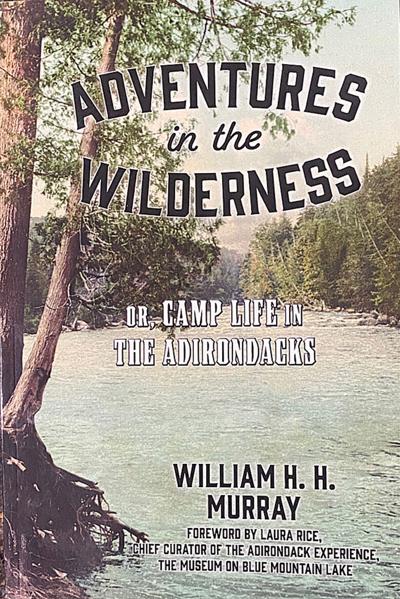
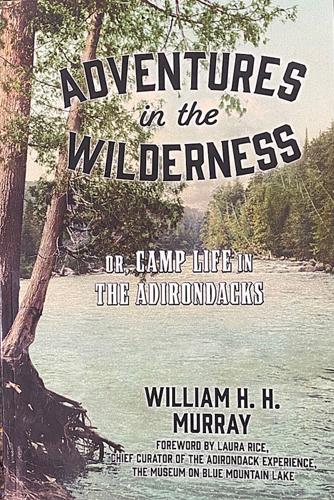
As I’ve mentioned in the past, one of the prized perks of the outdoors writer is receiving free books to review from publishers seeking to promote them. This spring I got a fresh copy of a book written more than 150 years ago.
Adventures in the Wilderness by William H.H. Murray, first published in 1869, is considered the first book about recreational camping in America, and now is a good time to revisit it with June as National Camping Month.
The setting for the book is referenced in its subtitle, Camp Life in the Adirondacks. The forests, lakes and rivers of upstate New York represented America’s unspoiled wilderness at the time. Murray contrasted it with Maine (a beautiful state whose mountains and forests I explored a century and a half after him), which he claimed had been pillaged by profiteers cutting timber and choking streams.
“In the Adirondack wilderness you escape this,” he writes. “There the lumberman has never been. No axe has sounded along its mountain-sides, or echoed across its peaceful waters. The forest stands as it has stood, from the beginning of time, in all its majesty of growth, in all the beauty of its unshorn foliage.”
And therein lies the real charm of Murray’s prose. I found myself having to reread sentences to translate the 19th century vernacular, but from my perspective, writing weekly about the outdoors, I am impressed with the clergyman’s ability to turn a phrase.
The book was reproduced this year for the Adirondack Experience – the Museum on Blue Mountain Lake, and includes a new foreword by Laura Rice, chief curator at the museum since 2007. Her modern English is more easily understood, and her points well made, including suggesting that Murray may have done too well in convincing people to enjoy the outdoors. Obviously many of our national natural resources have become overwhelmed since.
Serving as a minister to churches in Connecticut and then Boston, Murray headed for the woods to restore his soul, and he chronicled his adventures to hone his sermon-writing skills. When the local newspaper, the Meriden Literary Recorder, needed to fill some space, he offered one of his tales. It was a hit, so his stories became regular features and eventually led to the book.
I found kinship with Murray as he described the joy of writing about outdoor adventures: “The composition of these articles has furnished me, amid grave and arduous labors, with mental recreation from time to time, almost equal to that which I enjoyed when passing through the experiences which they are intended to describe.”
In addition to the psychological rehabilitation provided by spending time outdoors, Murray documents (or at least tells tales) of the physical restoration fresh air and wild fragrances provide. One story is of a sickly boy brought to the woods to die in peace.
“He went in the first of June, carried in the arms of his guide. The second week of November he came out bronzed as an Indian and as hearty. In five months he had gained 65 pounds of flesh, and flesh, too, ‘well packed on,’ as they say in the woods.”
The book has 11 chapters and while most of the stories are as dated as the author’s language, they are still entertaining. In “Jack Shooting in a Foggy Night,” Murray lambastes those who would use buck shot to take down a deer, calling it unsporting. But he also writes about using a spotlight to shoot deer at night – admitting to a frightfully dangerous and unethical act. The shiny spot he saw along the river could have been something other than a deer’s eyes reflecting the beam of his custom-built helmet headlight.
Those who get to spend a few days camping this month, or throughout the summer, know about the benefits of experiencing the outdoors. Taking along a good book, like this 220-page paperback from North Country Books, is not a bad plan either.
“I deem the excursion eminently adapted to restore impaired health,” Murray eloquently explains. “Indeed, it is marvelous what benefit physically is often derived from a trip of a few weeks to these woods.”
John Winkelman has been writing about outdoors news and issues in Jefferson County for more than 30 years and was the Associate Editor for Outdoor Guide Magazine. If you have story ideas, e-mail ogmjohnw@aol.com, and you can find more outdoor news and updates at johnjwink.com.