
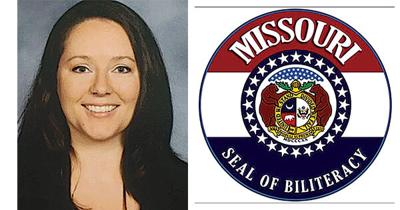
Three recent Windsor High School graduates were the first in Jefferson County to earn the Missouri Seal of Biliteracy, an award recognizing students who attain proficiency in English and at least one other language.
Windsor is the first school district in the county to offer the program, and 2020 graduates Mark Grogan, Samantha Young and Zulema Pagan Cruz were its first honorees.
The Missouri Department of Elementary and Secondary Education introduced the program in 2017.
“Learning another language helps open new worlds and cultures for our students,” said Ryan Rumpf, director of the English learners program at DESE. “We’d like to see many students take advantage of this opportunity to distinguish themselves as bilingual as they continue their education or begin a career.”
Windsor High Spanish teacher Caitlin Maksimovich spearheaded the effort to bring the program to the school, along with district curriculum coach Julie Schubert. They drafted the proposal and set up the program criteria.
“This was the first year, and when COVID-19 hit, it all had to be done differently,” Maksimovich said. “I didn’t think anyone would be able to earn it – but we had three who did. It wasn’t easy, and I am really proud of them.”
Creating lifelong learners
Maksimovich, 36, has been teaching for seven years, five with the World Language department at Windsor.
As program coordinator, Maksimovich said she works closely with other teachers, counselors and administrators to identify students who are on track to meet the requirements for biliteracy.
“We have a lot of students who are native English speakers, and who go through our French or Spanish classes,” Maksimovich said. “And then there are those who come to us as English learners.”
Students must first attain a “proficient” or “advanced” score in English, then demonstrate written and conversational proficiency in their chosen second language. The test assesses speaking, writing, reading and listening skills, and is aligned with national proficiency standards
“The third thing is to provide evidence they have a strong understanding of sociocultural competency, through an essay or presentation,” Maksimovich said. “They also need to give us justification that they plan to use the language in the future.”
Those earning the seal have a leg up when it comes to college or employment, Maksimovich said.
“This recognition is noted on both the student’s diploma and their high school transcript,” she said. “It serves to identify biliterate individuals for employers and universities.
“Some colleges offer up to 12 credit hours for the seal, and the test only costs $20, so it can be a real money-saver.”
But there are intangible rewards as well.
“One of the biggest advantages to multilingualism is the way it can broaden a person’s understanding of the world we live in,” Maksimovich said. “If you can think and talk about things in more than one language, you can get a better understanding of all the components of a situation. Your ability to empathize with people, to relate to people even if you disagree with them, can become greater.
“Also, if you learn a second language, you are likely to understand English better.”
Maksimovich, who gradwuated from Northwest High School and Jefferson College, said she has seen slow but steady growth in cultural awareness in the area.
“Our valedictorian last year was a young man from Egypt who became a naturalized citizen. His speech was wonderful because he paused and said some things in Arabic. It was a wonderful moment, and it tells me that, although we might not be too culturally broad right now, we have a lot of potential as a county.
“Because I believe in multiculturalism so strongly, I wanted to spearhead the initiative to get this program in place. We are the first, but I hope other districts can see the benefits of it as well.”