
Arnold resident Jean Myers vividly recalls where he was and what was happening on Nov. 22, 1963, the day that President John F. Kennedy was assassinated.
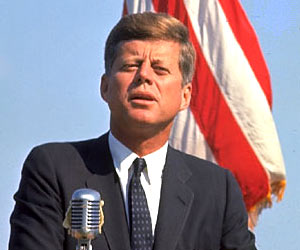
This week, as the 50th anniversary of the presidential assassination is observed, Leader readers shared their memories of where they were when they heard the news that JFK had been shot.
Myers, now 74, was an airman based at Eielson Air Force Base in Fairbanks, Alaska, when the sirens sounded. He and fellow service personnel at the base didn’t know what had happened more than 3,800 miles away in Dallas.
“The alert horns went off, raising everyone’s hair. The loud speakers shouted, ‘All pilots and crew members report to the flight dock immediately – this is not a practice alert!’” Myers recalled.
When the alarms sounded, Myers had been working in the photo lab at the base, where he was stationed with the 1352nd Air Photo and Charting Service.
“Our lab was located at the end of a long hall in the base operations building – a hall laced with many security doors for the Chrome-Dome KC 135 briefing and support systems,” he said.
“I looked out our lab door and saw pilots and crew with their grab bags and gear running down the hall toward the dock. Never before had we seen or had such a rapid movement of personnel. No one knew what or why. A couple hours later, as that moment of time stood still, we heard that President Kennedy had been shot.
“Our base training had proved itself, as within minutes, we had all planes airborne. We proved that our Armed Forces are ready to detour and protect our great country.”
Safely at her home in Festus, Marie E. Roth, now 84, of Festus heard the news of the president’s death and decided to document the newspaper stories published.
She started a scrapbook with an entry dated Nov. 23, 1963. In the 50 years since, the now tattered, yellowed newspaper stories have been read and re-read by family members.
Roth said she started the scrapbook because she knew at the time that the events that were rocking the nation would have lasting implications.
“I knew it was going to be historic,” she said. “It was a way of keeping track of that.”
Roth worried that over time people might forget the details.
So, each day she faithfully read the newspaper, clipped out the stories and photographs and mounted them on the pages of her scrapbook.
The scrapbook follows the police investigation, the funeral and the inauguration of a new president.
“Here’s a story about the priest who gave the president his last rites,” Roth said, pointing to a story from Nov. 29, 1963. “That priest was from Perryville.”
Roth said people, including her family, also spent many hours in front of the television watching as the story continued to unfold.
But for her, the newspaper accounts provided a lasting tribute to John F. Kennedy.
“I was a stay-at-home mom with three sons,” Roth said. “My sons (Gary, now 59, Tom, now 57, and John, now 53) can still remember.”
The scrapbook ends with a Dec. 19 newspaper story about the Jack Ruby trial and a column describing parallels between the assassination of Kennedy and that of Abraham Lincoln. “Interesting, huh?” Roth asked.
When the family recently cleaned out many of Roth’s belongings at her Festus home, she said the scrapbook was carefully placed aside so the memories can be passed on to future generations.
‘Always remember’
Zeda Hartter, 62, of Barnhart was in the seventh grade at a school in Peoria, Ill.
“We were sent home,” she says. “We waited for my Dad to get home from work, and my entire family went down to my aunt’s house. My aunt was president of the Peoria Democratic Party, and the delegates were all in the house. My cousins and my sisters watched the TV. I will always remember that day.”
Birthday memories
Ron Reiner, 70, of Imperial was at work preparing to celebrate his 21st birthday.
“I remember Friday, Nov. 22, 1963. It was my 21st birthday,” Reiner said. “I had been looking forward to that day for some time. I was at work in a training session at NCR Corporation offices in St. Louis.
“In late morning, we were interrupted by the announcement that President Kennedy had been shot at Dallas, Texas. The early information was sketchy and most of it inaccurate. The news that the president had died was quite a bit later and when we got that news, the rest of the workday was lost to conversations, conjecture and concern. Some thought it the first step in a planned series of events to attack the United States, Another group thought it related to the recent Cuba missile crisis, and most of the rest of us were too overwhelmed by the president’s death to project any further than the actual shooting and the events surrounding the shooting.
“Yes, the day of my 21st birthday will be a strong memory for me as long as I live.”
‘Pray for the president and the country’
Kathy Ellis, 58, of Festus was at school looking forward to her 8th birthday party.
“On Nov. 22, 1963, I was in Mrs. Sims' second-grade class at House Springs Elementary. I was eagerly looking forward to the weekend since my 8th birthday party was to be held the next day (even though my birthday was actually Nov. 25).
“It was a typical day, and shortly after lunch our principal tapped on the door and motioned for Mrs. Sims to come out in the hall. A few minutes later, she returned to the classroom with tears streaming down her face. We knew that something bad had happened when parents started arriving to pick up their children.
“My mother arrived and told me in the car that President Kennedy had been shot and that he had died. We drove to St. Martin’s in High Ridge to pray for the president and the country, and I remember sitting in the pew as a few people started to gather quietly in the church. A new organ was being installed, and I saw tears on the face of the man who continued with his work.
“Everything seemed to stop that weekend as a grief-stricken nation tried to understand the tragedy.
“Needless to say, my birthday party was canceled, and something about my childhood was forever changed. On Sunday, we watched the young man who killed the President shot by another man on live television. Life eventually got back to a semblance of normalcy, but that day is forever etched in my mind and is remembered more than I could ever imagine.”
Sad teacher
Mona Harris, 61, of Hillsboro was in the sixth grade at Roy E. Taylor Elementary School in Herculaneum.
“I remember very vividly the day I found out that President Kennedy had been killed,” she says. “It was a normal day in class when our principal, Mr. Freeman, a very large and authoritative-type man, came to our door. He requested to speak with our teacher, Miss. Mason, privately in the hall. Miss Mason was, in my opinion, a very attractive and polite lady. To me, she was much like Jackie Kennedy.
After what was probably just a few minutes, she returned to our room alone. I could tell she had been crying, and with a soft and shaky voice, she announced that our president had been killed. She was quiet and again cried a little for a short time at her desk. Our class remained quiet also, as we waited for her to speak. It wasn't too long before she composed herself and continued our day. The rest of the day was somber.
Even after I got home, my parents were also very touched by the day's event. My father said, ‘We have lost a very good man.’”
The loss of another family man
Annie Burgan, 56, of Festus was 5 years old on what she calls that “tragic day.”
“I was in afternoon kindergarten at Festus and Ms. Hazel Canepa was my teacher,” she says. “I remember the other kindergarten teacher, Mrs. McCormick, coming into our classroom and talking quietly to Ms. Canepa. They were both crying and then they told us what happened. I remember feeling very sad; especially since my last name was Kennedy.
My parents were Irish-Catholic and had a large family. I was number nine in the family and my youngest brother was number 10 in birth order. My parents just thought the world of President Kennedy and his large family. I remember how upset my mom and my Aunt Bea Cummiskey were when it happened. I will never forget that day!”
‘I cried’
Veronica Hammond Fields, 83, of De Soto says her memory may not be what is used to be, but she’ll never forget that day in 1963.
“I was in my beauty shop working. It (the shop) was in the back of my house at Second and Miller streets (in De Soto). I was doing a permanent, and someone came in and told us (about the shooting). So, I immediately went upstairs and turned on the television. After that, I kept running upstairs to see what they were talking about.
“I cried. I thought everything good about him.”
Fields said a lot of her memories have faded, but she’ll always remember the day JFK was shot.
“I’m losing too much of my memory, but I remember that. I can tell you names of people who came in to talk about it that day, but everything else is getting confused.”
Who could it have been?
Harold Walker of De Soto was in basic training at Ft. Jackson in South Carolina when he heard about the assassination of President Kennedy.
“The barracks was drowning in rumors of who could have been responsible,” he says. “The rumors went back to the Bay of Pigs disaster, to a country we just heard of called Vietnam. Fifty years later, it's still a mystery.”
History being made
Jeanne Cawvey, 65, of Pevely was a student living in Beeville, Texas, when she heard the news.
“I was a Navy brat,” she says. “I was in a Dairy Queen. A kid came in with a little transistor radio and told us the president had been shot. We thought he was messing with us, but then we found out he wasn’t and rushed back to school. The class was American history and my teacher went and got a TV, and that was unheard of at that time. First, Walter Cronkite had said he had been shot and later they announced he had died.
We immediately thought the Cubans had done it. We were all in tears because we thought he was the best.”
Cawvey said the memory “will always” stand out in her mind.
A sad day
Kathy Vierling, 67, of the Hillsboro area was home from Lindbergh High School, battling a case of strep throat, when the news broke.
“My dad worked nights, so he was home with me,” she says. “Mom was doing her job. My dad and I walked into the kitchen for some reason and turned on the radio. We heard someone say that shots had been fired from the bridge, (never heard anyone say that again). Then Walter Cronkite came on the radio and seemed very emotional. He told the nation, ‘President Kennedy is dead.’ I was stunned!
“My Dad and I were at odds at the time about (the president). I was idealistic and liked his policies. Within a few hours, I began to get phone calls from friends expressing their concern and seeing how I was feeling about the situation. I watched all the funeral arrangements for the rest of the weekend. Such a sad day for the United States of America!”
The end of Camelot
On Thursday, Nov. 22, 1963, Nancy Nicholson Wood was a senior at De Soto High School.
“My classmates and I were in Richard Bell's chorus class when they announced John F. Kennedy had been assassinated and died in Dallas, Texas,” she says. “All of us were just stunned, and couldn't believe this could happen in America. After I got home, my family sat glued in front of our black-and-white TV through Monday, when they had his touching funeral and burial. I felt sad for Jackie, Caroline, and John-John. My mother especially liked ‘Black Jack,’ the spirited horse that was unridden but led with boots backwards in the stirrups of his saddle. A courageous woman became a widow and her children left fatherless in an awful moment of madness that turned Camelot into a terrible tragedy.”
Vivid memories
Sally J. McDonald, 66, of Hillsboro says she remembers the assassination “like it was yesterday.”
“I just came home from the laundromat and turned on the TV when they announced that Kennedy had been shot,” she says. “I couldn't believe it. How could someone shoot that wonderful dynamic man?
“I cried and cried, and listened to the news that he had died and his wife, Jackie, was covered in blood. ‘My God!’ I thought, ‘What a tragic day this is.’ He was so loved by so many people and had little children waiting for him to come home.
McDonald says she watched everything that unfolded in the days that followed.
I watched as the funeral procession went down the street and little John saluted him,” she says. “I watched Jack Ruby shoot Oswald as they walked him down the corridor. I have a scrapbook with all the news clippings about this horrible day in American history. I shall never forget it.”
The world changed that day
Sharon Head, 66, of De Soto was at school.
“I was a junior at Cleveland High School in St. Louis and in Mrs. Murray's foods class,” she says. “A student opened the door and said loudly that President Kennedy had been shot. We were all stunned! Mrs. Murray had the good sense to send a student to the audio-visual room for a TV.
“We watched for the rest of the class. Many of us were crying. (It was an all-girl class.) Most of us were just stunned! Nothing like it had ever happened to us. For many of us, the world changed that day.”
Gloomy news to match the day
David King, 64, of Festus says he seems to recall that Nov. 22, 1963, was a gloomy, cold day.
“I was a freshman at Festus High School, sitting in Mr. Pryor's algebra class, when the announcement came over the intercom,” he says. “The mood became quite somber and disbelief was quite rampant. No one could believe that someone had just killed the leader of the free world. Discussions soon started as to who would do such a thing, and if the Russians or Cubans had anything to do with it. After all, we were in the Cold War with them. It hadn't been all that long since the Bay of Pigs fiasco (April 1961) and the Cuban Missile Crisis (October 1962).”
A not-so-happy birthday for Daddy
Terry Scott of Crystal City was 10 years old and in the fourth grade.
“We had just finished watching a movie,” she says. “I have no idea what the movie was about, but do remember walking down a silent hall and finding our (Festus Elementary School) teacher, Mrs. Burns, crying. We returned to our seats and she told us what had happened. Being so young, I really truly didn't understand how horrible and frightening this was for our country.”
Returning home from school later that day, Scott said she remembers her parents being upset and very interested about any updates on TV.
“It was also my father, Leroy Scott’s, birthday, so I never forgot that date,” she says. “I also remember the next few days, watching it all unfold on TV. Little John John saluting his father and the riderless horse, with reversed boots in the stirrups.
“The following year we visited Washington, D.C., and his burial place, with the eternal flame. To this day it is still a very interesting subject and an experience in history that I will never forget.”
‘Glued to the TV’
Nathan Myers, 60, of De Soto was in class when he heard the news.
“I was in the sixth grade when the principal came in our room crying, and I still remember her saying, ‘Class, I have some very bad news to tell you. President John F. Kennedy has been killed. Don't worry. We are all OK here. Vice President Johnson will be sworn in soon.’ She then turned on the TV and we watched with fear at the amazing pictures we were seeing. When they let school out, I went home and was glued to the TV for the next few days.”
Stationed in Germany
Robert A. Mullins, 68, of Crystal City was 18 years old and stationed in Germany with the 24th Infantry Division on Nov. 22, 1963.
“My unit – C Battery 2nd Bn. 7th Field Artillery – was at Grafenwoehr on maneuvers,” he said. “It was around 6 or 7 p.m. when we heard the president had been assassinated.
“They advised us that if there was evidence that a foreign government – Russia – had been involved, we would take a position on the border between Germany and Czechoslovakia. If no foreign government was involved we would return to our home base in Augsburg and prepare to fire a 50-gun salute at a memorial service.
“We packed all of our equipment in the trucks and hooked the Howitzers to the trucks and were ready to go, but we were told that we wouldn't know anything until morning. Most of us spent the night talking about the assassination and what might happen. It was a very scary time. In the morning, we were ordered to return to Augsburg.
“We spent the next several days sanding and repainting the Howitzers with a very glossy olive drab paint. On the day of the funeral, we fired a 21-gun salute at the memorial service and then a 50-gun salute at retreat that evening.”
‘In total shock’
Margie McCord Kennedy, 64, of Festus was in gym class.
“I will never forget Nov. 22, 1963. I was just having a usual day as a freshman at Herculaneum High School. I remember being in the ‘old’ gymnasium playing volleyball during P.E. class. The school principal, Rolla Herbert, came on the P.A. system (which didn't happen very often during the middle of the school day) and informed us that President John F. Kennedy had been assassinated in Dallas, Texas. The announcement brought silence to the gym. There were some tears. I remember I did not cry. I believe I was in total shock. I do know that I felt a strong desire to get through the remainder of the school day and get home to my family. We sat by the television for the next four days. I remember on the day of the funeral when the riderless horse came down Pennsylvania Avenue and that dreadful drum cadence. I could no longer hold my tears. Sad, sad day.”
Happy and sad
Henry Porterhouse, 76, of Hillsboro was in the waiting room at DePaul’s Hospital on Kingshighway in St. Louis on Nov. 22, 1963. His wife was preparing to give birth to their fifth child.
“The announcement came that I had a baby boy and that John F. Kennedy had been shot,” Porterhouse said. “Tom is now going to be 50 years old. He was born the minute John F. Kennedy was shot. I will never forget that day. Happy to have another son, and sad our president got shot.”
Catching a glimpse
Barb Rohm, 57, of Hillsboro was a second-grade student at Larimore Elementary School in Spanish Lake, Mo.
“There was an announcement by the principal. My teacher started crying. Then kids were crying because the teacher was crying. I wasn't sure what was happening, but I do remember being scared walking home that day. I went in to the house and my mom was crying. She explained President Kennedy had died. I couldn't stop the tears. I had never seen my mom cry. I knew this was bad.
“I went and sat outside and thought about the time I sat high on my dad’s shoulders so I could see Mr. Kennedy and listen to him give a speech. People cried that day, too, but they were tears of joy and laughter. My dad and uncle were so happy. Everyone was so excited. I didn't get to meet him, but I will never forget the wonderful feelings he seemed to radiate throughout the place that day.”
‘Silence and disbelief’
Bill Haggard, 62, of Herculaneum was a 12-year-old seventh-grade student at Roy E. Taylor Elementary School in Herculaneum.
“My classmates and I had just returned from lunch and were in Roscoe Brewington’s social studies class, which was just a short distance from the principal’s office. The weather on that day was gloomy and it had been raining.
“We were grading each other’s papers when Mr. Brewington was called out of the room by the principal, William Freeman. When he returned, my classmates and I could sense that something was wrong as our teacher appeared to be crying and was tapping his leg with his always present metal ruler. Another peculiarity was that on a typical day, Mr. Brewington would place the metal ruler next to the door hinge and close the door with the ruler. On this day, he closed the door using the door handle. This was just not normal for him! A little while later, he was once again called from class by the principal. This time he returned and was definitely crying and told us that the president had been shot.
“He did not tell us that President Kennedy was dead until a classmate asked him. He then told us that he was dead.
“Silence and disbelief fell upon the room and some of my classmates were weeping. Many started asking questions of our teacher and each other. I remember one classmate saying, ‘They can't do that.’ I am sure most of us did not know how to react as we all were all so innocent and protected.
“As a 12-year-old, I knew the assassination was a very bad event in our country’s history, but obviously did not fully understand the implications of such a terrible deed.
“Now as I think back on the events of that day and that November weekend, I realize that single event changed our country and the world forever. Furthermore, the assassination ‘robbed’ everyone of a future that will never be known.”
Following the news
Timothy J. Patterson, 72, of Hillsboro was a first-year social studies and history teacher at Hillsboro High School.
“We had just finished lunch and the custodian, Mr. Schroeder, met me at the door of the cafeteria. He said, ‘The president has just been shot.’ A number of us went directly to the gym where a TV had been set up. We followed the events there.
“I was also a part-time radio announcer at Radio Station KJCF in Festus. After school, I went there to follow the releases on UPI. I collected those teletype releases and put them into a scrapbook, which I still have. In looking at the scrapbook, I note that I also still have the Friday, Nov. 22, 1963, edition of the Daily News Democrat (6 cents a copy). It has the headline ‘ASSASSIN KILLS PRESIDENT KENNEDY.’ That is pretty quick newspaper reporting for a small-town newspaper considering the news of his death was only announced around 1 p.m. that Friday afternoon.”
‘Our president was shot’
Tom Bess-King, 57, of Herculaneum was a third-grader at St. Ferdinand Catholic School in Florissant on Nov. 22, 1963.
“The principal announced over the intercom that we were going home, that our president was shot, then a few minutes later said that President Kennedy had died,” Bess-King said.
‘I could no longer hold back my tears’
Patricia Southard of De Soto was arriving at the Greyhound bus station in downtown St. Louis when she heard about our president John F. Kennedy assassination.
“I graduated from high school in May 1963, went to live with my cousin Ann and her husband, Ross, in St. Louis. I got a job at Children’s Hospital. I decided to go visit my family in Washington County on my three days off. I was terrified upon hearing our 35th president was assassinated. Who could have done such a terrible thing? Then my thoughts turned to Jackie and the children and I was heartsick.
“When Vice President Lyndon B. Johnson was being sworn in as our president and I saw Jackie’s beautiful pink two-piece suit stained with her husband’s blood I could no longer hold back my tears for the family.
“Going back to St. Louis on that Greyhound bus and a 19-year-old away from a small town to a large city become aware how dangerous, harmful, and sick our society could be.
“I was privileged and blessed to have visited Washington National Cemetery grave site of John F. Kennedy on July 4, 1965, when my husband in the army stationed at Fort Bragg, North Carolina. Our baby was 5 month old.”
Shaking hands with JFK
Patricia Ryba of Pevely had the chance to meet and shake hands with Senator John F. Kennedy three years before JFK was shot and killed.
Ryba was a high school senior in Indianapolis, Ind., in the fall of 1960. she and a group of classmates went to Weir Cook Airport in Indianapolis met the Kennedy airplane that was coming into the city for a campaign stop.
“There was only a small crowd at the airport as the men de-boarded the plane and walked along the fence, shaking hands and greeting those of us who were there. They then went on to their scheduled dinner while we went back to the school and from there to our own homes for awhile,” she said.
“Later that evening we got together again at the Coliseum, where Senator Kennedy gave a speech while our little group distributed flyers and hats among the large crowd on his behalf.”
Ryba still has a copy of the dinner menu from the event.
“Three years later, he was a murdered, and I cried all the way home on the E-train in Chicago that evening,” she said.
“I was working in a district sales office for International Salt Company, located on the 19th floor of the Builder's Building at LaSalle and Wacker in Chicago, just across the river from the Merchandise Mart, a large building owned by the Kennedy family in 1963. That particular afternoon our staff was preparing for a regional sales meeting to take place in our small office. The participants were beginning to arrive and there was a pleasant atmosphere as we exchanged conversation with out-of-towners in the main office room. The switchboard operator was handling her phones as usual in our midst when she suddenly turned to look at us all with tears in her eyes and announced that the President had been shot.
“The conversation stopped as we looked at each other in disbelief. Then she turned around again a few minutes later and said, ‘The President is dead!’ The rest of the afternoon was very quiet as we went about our business with grief and shock.
That evening, and for the remainder of the weekend as I followed events on television, I cried and prayed. The flag was displayed at half staff for a month at the Merchandise Mart in Chicago.
The day President Kennedy was assassinated
Linda Datillo Vachalek, 62, of De Soto said thank you for the opportunity to share her memories of the day, and those immediately following.
She wrote:
“The day President Kennedy was assassinated and the days immediately following are so very vivid to me, even 50 years later. I was 12 years old, and a student at De Soto Junior. High. It was a sunny day and I was in algebra class when the announcement was made over the school’s intercom system.
“The moment was very surreal and the information conveyed seemed almost too horribly tragic to process on a visceral, emotional level. Perhaps it was shock – the kind which renders a person, and certainly a child of 12, unable to immediately exhibit an emotional response. We were dismissed and upon arriving home I found my mother watching television, tears streaming down her face. It was at that moment I suddenly realized the import of what had happened.
“In 1963, there was no 24/7 news coverage or 200 channels, but only three major networks, and yet, those three networks, and the anchors and reporters, particularly Walter Cronkite, created a sense of stability in a nation otherwise overcome by uncertainty and grief.
“For three days, we sat in front of the television, and these three days made an indelible impression which I can conjure up at will, just by closing my eyes – Jackie in her pink suit and pillbox hat, still covered in blood as Lyndon Johnson took the oath of office, ensuring a peaceful transfer of power, the arrival of the coffin in Washington and Jackie taking Bobby Kennedy’s hand, the precision of the honor guards as crying and grieving crowds paid their respects as they passed by the flag draped coffin in the rotunda, the rider-less horse Black Jack, the stoic dignity of Jackie, holding the hands of her children and, needless to say , the iconic image of John-John saluting his father’s casket and in Dallas, Ruby shooting and killing Oswald as he was being moved by law enforcement officers to a more secure location.
“The course of history was forever altered by this horrendous, unfathomable act. Had President Kennedy lived, would our country be different now? Would there have been an escalation in Vietnam, where so many of our young men died on foreign soil, in a war which was, in hindsight, so meaningless? Would Dr. King and Bobbie Kennedy have been felled by the same insane hatred pervading the country? Would the United States have been torn apart by riots and the emergence of a counter-culture which would change the landscape of America?
“These are, of course, moot questions, for it did happen, but I unequivocally believe that day – Nov. 22, 1963, in Dallas was one of the most pivotal moments in the history of this country and defined a whole generation. Our lives, which had seemed so Ozzie-and-Harriet innocent, uncomplicated and almost idyllic in the small, insulated town of De Soto vanished, along with the dream that was Camelot.”