
Don’t you wish your kids came with an instruction manual?
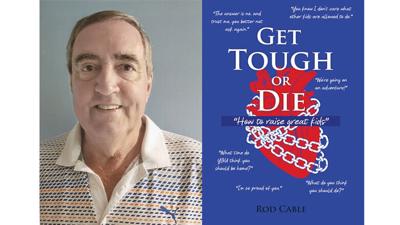
Well, Rod Cable, a longtime Jefferson County teacher, coach and high school counselor and father of three has written and released a 119-page book titled “Get Tough or Die: How to Raise Great Kids” that might provide parents with a few pointers.
Cable, 71, is in his 48th year as an educator – he returned this year as a part-time counselor with the De Soto School District after working there for 37 years.
“I really can’t tell you how it’s doing,” he said about how his book is selling, adding that he has gotten some interesting feedback, though.
“Many of the people who have read the book said they enjoyed the humor. I’ve found that the older people who have read it have said they really were able to identify with the way I grew up because that’s how they grew up in the 1950s and 1960s. They are able to connect that way.”
Cable said he hoped to reel in readers with tales about how he was raised and how he and his wife, Jane, who retired after teaching art in the De Soto Schools for 35 years, have raised their three daughters, Lindsey, Alex and Shelby.
“I’d be in stores and I’d see kids and their parents in the checkout line and the kids would beg for candy and the parents would say, ‘No,’ and they’d ask again, and after three or four times, the parents would give in, and I’d think to myself, ‘Oh no. That kid will be in my class in 10 years,’” he said. “They’ve already had it modeled that ‘no’ doesn’t necessarily mean ‘no.’ With my kids, if they asked me a second time, I’d tell them, ‘You’re not going to like the answer.’
“But you really can’t blame the kids. That’s the way they were raised.”
A book of stories
“In the book, I tell a lot of stories,” Cable said. “I’d tell them at parties, stories about my parents and the vacations we’d take. A lot of people would tell me that I needed to write a book. Later, I’d tell another story, and they’d say, ‘You need to put that one in the book.’”
Among the tales in the book is about his introduction to Jane, a Kentucky native who had just been hired to teach at De Soto and was attending a staff picnic the week before school started.
In an effort to strike up conversation with Cable, Jane pointed out a rose-colored 1976 Thunderbird on the parking lot.
“Isn’t that the ugliest car you ever saw?” she asked Cable.
“I told her that if we went out, she’d be riding in that car,” he said. “She looked like she was trying to get her foot out of her mouth, but we went out that Friday and then Saturday and Sunday, and she called her mom and said, ‘This is the one.’ Five months later, I agreed.”
His favorite story
“My favorite story is the very first story in the book about my youngest daughter, Shelby, and a gymnastics practice,” he said.
Cable wrote that he saw his youngest with an ice bag on her ankle after she hurt herself on a beam.
Cable wrote that he told her, “Either get back out there or we are going home” and explained on the way home that if she wanted to excel at gymnastics, she would have to deal with injuries.
“You picked the toughest sport there is on your body,” he told her. “To be successful, you will have to be able to perform with pain. Get tough or die.
“Now, I know you all think that was an extreme thing to do to a little 6-year-old girl,” he wrote, but said Shelby grew up to compete against future Olympians and was successful in other sports and academically as well, as were her sisters.
“I wanted to teach her at a very young age that there are no excuses, and that’s why it’s my favorite story,” he said. “If you want to accomplish anything in life, you have to overcome the barriers that are in your way. You help your children figure out the way to solve their problems rather than stepping in and solving it for them.”
‘Get tough or die’
Cable said the phrase, “get tough or die” – which crops up frequently in his book – is something of a personal mantra.
“It was never said while I was growing up, but it was definitely part of my upbringing,” he said. “My dad lived a hard life and had a tough job, and when he got home, he was spent. I was intimidated by him until I was 25 or 30 years old. My dad was always big on his kids solving their own problems. He’d tell us, ‘If I have to get involved, you’re not going to like it.’
“But I don’t know that I ever thought about ‘get tough or die’ as a philosophy until I started playing sports. I think that’s where it took shape in my head. In my house, my kids while they were growing up probably heard it five or 10 times a week.”
Cable was an all-conference power forward on the Central Methodist University basketball team, which he led in scoring his senior year.
“‘Get tough or die’ is kind of a way of life for me. I had it on a plaque on my desk at school,” he said, where as a counselor, he first listens, then encourages students to develop solutions to solve their own problems.
Cable said he also has worked with parents as well.
“I’d have parents in to my office early in their student’s senior year. I’d tell them that they had to give them some practice making their own choices, even though they might not be the best choices. Because this year, their senior year, they’re going to be around. Next year, when they go off to college, they’re going to be faced with making a lot of decisions for themselves and if they’re not used to making decisions, they’re likely to make bad ones and crash and burn. They need that practice before they go away.”
Cable stressed that no one approach is right for every family.
“This is not a one-size-fits-all philosophy. What ‘get tough or die’ looks like will be different from family to family. I’m not saying anyone should be as tough as I was with my kids. Some parents will do it more gently,” he said. “The style isn’t as important as the result – are you teaching your kids how to deal with what life is going to throw at them?”
“Get Tough or Die: How to Raise Great Kids” was published late last year by Dorrance Publishing and is sold on Amazon and other online stores. It costs between $23 and $28.