



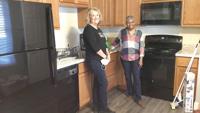
Two women saw their dreams for a safe, secure home for themselves and their children come true this holiday season with the recent opening of Mary’s House of Hope.
The first of three buildings in the transitional housing complex for victims of domestic abuse opened its doors to the two women and their children in early November.
“These two families are spending their first holiday in their own home without the fear of being beaten,” said Sue Curfman, chief executive officer of Comtrea, which runs Mary’s House of Hope and its associated domestic violence shelter, A Safe Place. “What a miracle to have for the holidays.”
“I’ve been here for 25 years,” said Lisa Rothweiler, chief operating officer of Comtrea. “I’ve seen us make a lot of inroads in that time, but this is so exciting.”
Curfman said the groundwork to get Mary’s House of Hope up and running started almost five years ago.
“This goes back to my first meeting with our board in February 2016, after I was named chief executive officer of Comtrea,” she said. “We discussed the very great need for this.”
She said the average stay in an emergency shelter like A Safe Place used to be two to three months, but over the years lengthened to as long as nine months, mainly because of the lack of resources in the community.
“In Jefferson County, often a woman will have no place to go other than back to the abusive situation she left,” Curfman said. “We have a shortage of rental housing, and it can take quite a long time to find a job and save up enough money to get a first and last month rental payment together.”
By moving some of the families into the new transitional housing, it will free up space at A Safe Place, which houses five families at a time.
Some women, after staying in A Safe Place for a couple of months, are “able to move to a life in the outside world relatively quickly,” Rothweiler said. “Others aren’t in that situation.”
That’s where Mary’s House of Hope comes in.
A place for change
Hopefully women who move from A Safe Place to Mary’s House of Hope can build on the gains they’ve already made, said Barb Tenholder, the director of both facilities.
“At A Safe Place, they learn to set goals for themselves, and they talk with our staff weekly about what they’re doing to reach those goals, what their obstacles are and how those obstacles can be overcome,” Tenholder said. They learn about money management, how to find a job and some start or continue with their education.
“The women who transition from A Safe Place to Mary’s House of Hope need more time to reach those goals. Maybe they need to return to school to complete a degree they had to stop work toward because they had kids and were in an abusive relationship where their partner didn’t want to see them get ahead.
“Here, they can learn while they’re working. They can do a part-time job and get paid while they’re going to school, or even have a full-time job. But they still attend our programs and we’re going to continue to meet with them and ensure they’re moving forward.”
The average stay at Mary’s House of Hope is designed to be about 18 months.
Norinee Thomas, manager of therapeutic services, said women who are unwilling or unable to commit to self-improvement programs are not good candidates for Mary’s House of Hope.
And, she said, the women who live in Mary’s House of Hope commit to paying a portion of their income as rent.
By following the program, the residents are building – or rebuilding – a record they can take out into that real world, Thomas said.
“Some of the women come in here with a poor employment record, and they haven’t been able to save any money,” she said. “We help them learn to do that, and help them start over with a clean slate. And we can provide a reference. When they are ready to leave us and go out into the world, we can vouch for them.”
One woman’s story
One of the first two residents of Mary’s House of Hope said she’s determined to make the best of her new start.
Michelle (not her real name), who is in her mid-30s, said she was being mentally abused by her boyfriend and the father of her two children, until an injury landed her in an emergency room over the summer.
“I was sitting in the ER, and I thought, ‘This can’t be my life. I can’t do this anymore to my children. They deserve so much more than this.’ In the hospital, I talked with a nurse who told me about A Safe Place. The nurse sent a social worker who helped me get there.”
She said the staff at A Safe Place helped her see a light at the end of the tunnel – if she wanted to work to get there.
“I thought, ‘Wow! There are so many options, options I never thought I had,’” Michelle said. “Everyone was so supportive, from the very first day.”
Over time, she decided to start her life over and made plans to go to college, which made her a prime candidate for Mary’s House of Hope.
“I want battered women out there to know they have options,” she said.
Curfman said that’s the point of both Mary’s House of Hope and A Safe Place.
“A lot of times, women who are victims of domestic violence don’t leave their situations because they don’t know they have options,” she said. “Their finances have been ruined, and their self-esteem has been devalued to the point where the victim doesn’t see any way out. What they see with A Safe Place and Mary’s House of Hope is there are options. They have advocates working for them. Once they discover that, the impact is huge.”
Michelle said she’s excited she and her children will be able to celebrate Christmas in their new home.
“Now we can have a real Christmas tree and presents, and we can celebrate the holidays together as a family, and be safe,” she said. “I’m so happy.”
More money needed
“To see our first two residents move in, it’s very emotional,” Curfman said. “It’s such a feeling of exhilaration. But the journey’s not complete. We have two more units to go.”
The three buildings are being funded through an ongoing campaign to raise $3.5 million.
Rothweiler said the first building, which has four living units plus a shared multipurpose room, cost about $800,000 to build and furnish.
“What we’re hearing is because of COVID, with the costs of materials going up, the next building will probably cost $50,000 more than the first one,” she said.
“We could not have gotten this far without some very generous donors,” Curfman said. “We hope now that they’ve seen tangible progress – we have a building up and running and making a contribution to the community – we’ll see more people come on board with donations.”
The complex is named for Mary Daniels, who was killed by her estranged husband in 2010.
Daniels’ mother, Sylvia Daniels, and Mary’s best friend, Kristy Neuman, got the campaign off the ground, Curfman said.
In addition to the $3.5 million capital campaign, a second one has started.
The Circle of Hope program is raising money to cover operating expenses for Mary’s House of Hope.
“The women who stay at Mary’s House of Hope are expected to pay toward the operating cost of their unit, based on their income,” Tenholder said. “But Comtrea has to make up the difference. That’s where Circle of Hope comes in.”
Donors can make a one-time contribution or pledge to make monthly payments, including sponsorships of a resident family.
“We’re hoping many families choose to include this in their Christmas gift-giving,” said Kim Elbl, Comtrea’s vice president of fundraising and development.
For information or to give online, go to comtrea.org/campaign. Donations for either the capital campaign or the Circle of Hope may be sent to Comtrea, 227 E. Main St., Festus, 63028. For information, call 636-232-2339.
Need help? Here’s who to call
Women who are in an abusive situation are urged to call the hotline for A Safe Place at 636-232-2301 or the National Domestic Violence Hotline at 1-800-799-7233. Both lines are available around the clock.