
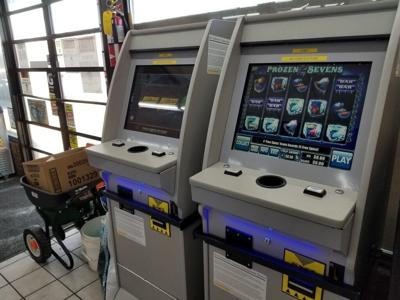
Across Columbia, people are hanging around gas stations and liquor stores, but not to purchase a snack for the road or a pack of cigarettes.
Instead, many spend hours gambling, hunched over flashing machines, chasing their next win.
The machines — often called “gray machines” because of their ambiguous legal status — are owned by Torch Electronics, a company that has faced mounting legal challenges from cities throughout Missouri. Springfield passed an ordinance banning the machines in February 2024, and Kansas City passed its own ban Oct. 16.
Even though the devices have been ruled illegal in cities across the state, they remain operational within Columbia’s city limits.
“Torch’s no-chance gaming machines are fully legal and compliant not just with the letter but also the spirit of Missouri law,” said Gregg Keller, a spokesperson for the company.
However, Columbia resident Tyler Travers described the machines as “predatory” and said they “prey upon the most vulnerable people in our community.”
He has been communicating with Columbia City Council members to voice his concerns about the machines, which have “quadrupled over the past couple years,” he said.
“Columbia didn’t vote to legalize 50 casinos in the state or in our city, but they’re here,” Travers said.
‘If I win, I feel good’
The gray machines that have taken up space in Columbia’s gas stations and liquor stores are more than just a controversial legal dispute, but rather a daily temptation that leads to financial consequences for some players.
Shontey Smith said she plays the machines “at least twice a week” at the Phillips 66 station on East St. Charles Road, even though she loses more often than she wins. The most she has ever won is $200, but her brother, Damien, has won thousands of dollars at multiple gas stations.
“If I win, I feel good, but when I’m losing, this is exactly what I say: These machines are rigged and took all my money,” Smith said.
She prefers purchasing lottery tickets and playing poker or blackjack, but because there is no casino nearby she finds herself playing the machines. When she visits Phillips 66, she said, she plays for 20 to 30 minutes each time, but when she goes with her brother, they can sit there for hours.
“The longer that person sits in their establishment, the more money people are spending,” Smith said.
A typical casino pays taxes and has protections to prevent those with gambling addictions from continuing to face financial consequences they cannot afford. Casinos also have dozens of cameras and security guards verifying both the age of the gamblers and the correct amount of money they win.
Lack of regulation means Torch Electronics’ machines are becoming more common in Missouri, said Marc Ellinger, an attorney for the Missouri Gaming Association. Gas stations and liquor stores are currently not held to the same standards as a casino, since the devices are unregulated and untaxed, he said.
“It’s a cash activity, so there’s a lot of free-flowing cash, which attracts criminal elements and contributes to the possibility of gaming addiction,” Ellinger said. “People don’t have any protection, and I think that’s something folks should be aware of. If they go to a casino, they know they have protection, and they know they have a government agency that monitors very heavily.”
Company fights back
The Missouri-based company that owns and distributes the machines has been in multiple legal battles with the state since 2019, when Missouri State Highway Patrol officers began investigating complaints about the machines and seizing them from multiple gas station and liquor store locations.
Torch Electronics filed a lawsuit against Missouri in 2021 alleging the crackdown on their gaming machines by Highway Patrol officers was a campaign of “harassment and intimidation.”
The lawsuit was tossed by a Cole County Circuit judge before an appellate court upheld the dismissal.
“Those instances are fairly rare,” Keller said. “When you look at the state, I will say that a lot of these efforts are misguided. Government is getting involved to harass mom-and-pop small businesses who are operating completely legal machines, taking police officers off the streets, when and where they should and would otherwise be combating crime.”
Ellinger said the machines are illegal because of the “element of chance” involved when a player decides to play. “In a courtroom, when they get tried, they’re found to be illegal every time,” because players continue to believe that they could make a profit.
Additionally, Ellinger said that Torch Electronics has donated its money to “a set of PACs (political action committees) controlled by their lobbyists” and “candidates” in hopes of having political influence over state officials who might make decisions barring its machines through legislation.
“They’ve been involved in political campaigns with the fear of, if you do enforcement activities, you’ll lose your job because the voters will vote you out,” Ellinger said. “So I mean, there’s no question that they have a coordinated use of campaign funds to continue their illegal activities.”
Torch Electronics machines are “no chance” devices that don’t require chance or skill to win. He added that the company operates as “an open book with law enforcement and prosecutors in the legal community” to explain to them why its machines are legal.
“Dozens of law enforcement officials and prosecuting attorneys across the state have agreed with us, which is why we have machines operating in every region of the state,” Keller said.
In October the Columbia City Council asked city staff to review Torch Electronics machines in local gas stations and liquor stores. Fourth Ward council member Nick Foster said he has not faced any political pressure from outside sources and that an ordinance to ban the machines in the city is “a desired outcome.”
“I anticipate receiving an update soon, but I am unsure as to just when this will come back to us,” Foster said in an email.
The Columbia Missourian contacted Tiger Liquor and Convenience, Midwest Petroleum Co., CENEX, ZX Zephyr Express and two Phillips 66 locations to ask how the devices they have in their buildings impact business and what practices are in place to regulate them. Managers at all of the locations declined to be interviewed.