



Voters who live in the 97th District of the Missouri House of Representatives can be excused if they feel like they’ve been through this before.
Residents of the district, which takes in parts of north and northwest Jefferson County as well as parts of Oakville in south St. Louis County, went to the polls on Feb. 6 in a special election to fill a vacancy created when John McCaherty resigned in the middle of his fourth and final two-year term.
Now they return in August and November to choose someone to serve a full two-year term.
When McCaherty stepped down in September 2017, he said he wanted to concentrate on his campaign for Jefferson County executive. However, McCaherty never filed for the office, saying he intended to work in the private sector.
In the February special election, Democrat Mike Revis defeated Republican David C. Linton by 110 votes.
A rematch of that race could happen in November. Revis is running for re-election, but faces no opposition in the Aug. 7 Democratic primary.
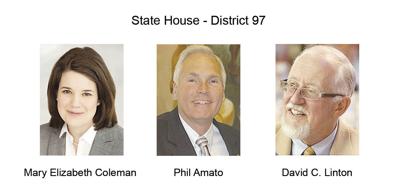
To get another shot at Revis, Linton must come out on top in the Republican Party’s primary, which also features Mary Elizabeth Coleman and Phil Amato, both former members of the Arnold City Council.
State senators and representatives receive a $35,915 annual salary plus mileage and $113 per day in expenses for each day the General Assembly is in session.
COLEMAN, 36, lives at 1020 Sable Lane, Arnold. She and her husband, Christopher, have six children. She is a stay-at-home mother who formerly was an estate planning attorney and CEO of the TuckerAllen law firm. She received a bachelor’s degree in business administration and management from St. Louis University and a law degree from St. Mary’s University. She volunteers in her parish and with a number of charities that focus on children and education. She serves on the boards of Arch Grants and the St. Louis Zoo. She represented Ward 2 on the Arnold City Council from 2013-2015.
Social media: Website: maryelizabethcoleman.com Twitter: @meaccoleman Facebook: Mary Elizabeth Coleman Instagram: maryelizabethcoleman
AMATO, 64, lives at 1119 Catskill Lane, Arnold, with his wife, Deb. He is a retired sales manufacturer representative for P. Lorillard and previously owned three small businesses. He has an associate degree in sales and business from St. Louis Community College-Meramec. He is vice president and past president of the Jefferson County Library District’s board and is president of the Arnold Food Pantry.
Amato was a member of the Jefferson County Charter Commission, chaired a stormwater task force and headed committees to establish the city’s tornado siren warning system, the Jefferson County Library District and the Arnold Recreation Center. He served on a statewide task force to review state laws that affect cities. He is a former member of the Jefferson College Foundation Board of Directors, the Meramec-Arnold Elks, Arnold Rotary and Arnold Jaycees.
Amato was a Ward 3 councilman from 1980-1982 and again from 2001-2009 before giving up his seat for an unsuccessful run for mayor. He returned to the council from 2011-2017, leaving again to run unsuccessfully for mayor.
Social media: Website: AmatoForMO.com Facebook: Phil Amato for MO 97
LINTON, 59, lives at 314 Romaine Spring View, Fenton. He and his wife, Judy, have three children and seven grandchildren. He is an attorney for McCarthy, Leonard and Kaemmerer. He has a bachelor’s degree in chemical engineering from Missouri University of Science and Technology, a master’s degree in exegetical theology from Covenant Theological Seminary and a law degree from the University of Missouri in Columbia. He was involved with the Missouri Bar Association, was a member of Hope Evangelical Lutheran Church, was a ruling elder and board president for Providence Christian Academy, was a Boy Scout and was named to a task force that developed a statewide energy plan and negotiated settlements with the federal government.
How will you vote on Proposition A and why?
Coleman: I am proud to come from a union family. My grandfather had a third-grade education and through the opportunities afforded to him working as a laborer on the railroad, his daughters were the first in our family to graduate from high school, then college. We watched our family’s dollars go to support causes like Planned Parenthood and support candidates like Hilary Clinton. No worker should have to decide between his job and supporting such things. That is why I am voting for Proposition A.
Amato: Right to Work Proposition A is part of collective bargaining, which is a private contract between business and labor. The state interfering with a private contract is government overreach. This issue should be important to everyone, whether a union household or not. Government interference with private contracts in my mind is a bad precedent that eventually could affect more than organized labor. We need less government in our lives, not more. I am opposed to Right to Work Proposition A, and will be voting no.
Linton: As a public servant, I will respect the outcome of the popular election on Proposition A. However, as a private citizen, I will vote for Proposition A, believing liberty grants the right to work without regard to any organization to which a person may belong or doesn’t belong.
What are your thoughts on how to protect insurance coverage for Missourians who have pre-existing conditions?
Coleman: Federal laws protect Missourians with pre-existing conditions. I support these provisions.
Amato: I have been recognized for my funding efforts on behalf of multiple sclerosis. Because of my interest in those struggling with a pre-existing condition like MS, I will help work to find a solution.
Linton: The public policy question is how best to take care of those who need care. Our government has usurped power to direct the health care system. While we must protect people who have been compromised by government edicts by maintaining insurance coverage for a time, we must also explore options on how we can create incentives for families, the free market and charitable institutions to get more involved. Tax dollars should be returned to people so they can invest in compassion wisely rather than give that money to government, which spends it on political agendas.
Higher education has been hit by funding cuts to balance Missouri government's budget. In regard to Jefferson College, how would you address this?
Coleman: Community colleges like Jefferson College are vital. They offer cost-effective workforce training and development, the backbone of attracting businesses and maintaining good-paying, quality jobs. I will work to make sure they get the resources to continue serving our community.
Amato: Proposed cuts of $68 million for higher education were recently restored by Gov. Mike Parson in May 2018, stabilizing college budgets.
Linton: Government has inappropriately taken to itself the setting of priorities for private family policy issues. Government spends money ineffectively on political value rather than private economic education value. By returning tax dollars to those who will spend it based on personal educational need, money will be invested more efficiently and produce a better, more economic outcome.
Why should voters elect you to this position? List your goals, if elected.
Coleman: Like many conservatives across Missouri, I watched with disappointment in February when a special election put our district in Democratic hands for the first time in a decade. Friends and neighbors approached me about running because they want to see the strongest Republican candidate on the ballot in November. Having run a small business, I understand the need for consistency in tax laws and regulations. On the Arnold City Council, I was able to use my legal experience and practical approach to spearhead economic development. Together, we can win this election and I can help bring some common sense to Missouri government.
Amato: Making our schools safer will be my top priority. We are all frightened when hearing about another school shooting. Today, school officials indicate the root cause for safety concerns is student mental health issues. Currently, it can take six months to a year for a student to see a professional for an evaluation. If this situation is not treated as a top priority, how long will it take before the unthinkable happens in our schools? My top priority will be safety construction grants that include mental health as part of safety currently not available in Missouri.
Linton: Voters should elect me because my goals are dictated to me by the Declaration of Independence and the constitutions of the United States and Missouri. My goals are to secure the God‐given rights of life, liberty and property for every citizen. I have the knowledge, experience and ability to pursue these goals effectively. We should fear legislators who have goals beyond these basic precepts, because they typically require the confiscation of life, liberty and property to achieve their goals.