


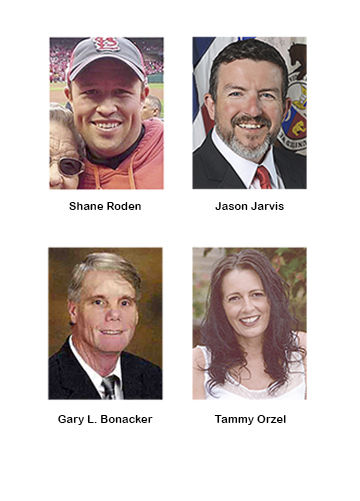

Shane Roden of Cedar Hill is seeking a second term representing District 111 in the Missouri House of Representatives, but faces competition from four of his fellow Republicans in the Aug. 2 primary election: Ryan Jones, Jason Jarvis, Gary L. Bonacker and Tammy Orzel.
The winner will square off in November against Del Vieland of Cedar Hill, who is running unopposed for the Democratic Party’s nomination.
Roden defeated Jarvis in the 2014 Republican primary election, then won against incumbent Democrat Michael Frame in the general election.
The district covers northwest Jefferson County.
State representatives serve two-year terms. The pay is $35,915 per year, a weekly allowance for miles traveled going to and returning from meetings, and expenses for each day the General Assembly is in session.
RODEN, 33, lives at 6153 Brookton Oaks Drive, Cedar Hill, with his wife, Shannon. He received an associate’s degree in paramedic technology from East Central College, a bachelor’s degree in fire science management from Lindenwood University and a master’s degree in public administration from Arkansas State University. He is a volunteer firefighter and paramedic for the Boles Fire Protection District, a reserve deputy for the Camden County Sheriff’s Department, is a member of the Missouri Task Force One Heavy Recue Team, the St. Louis Metro-Franklin-Jefferson Heavy Rescue Team and has been a part of the Commemorative Air Force Missouri Wing since 2009.
Social media: Website: www.shaneroden.com Facebook: State Representative Shane Roden District 111 or Shane Roden Twitter: @RepRoden111
JONES, 25, lists his address as P.O. Box 997, Fenton. He is single and is a manager of a grocery store on in St. Louis. A Hillsboro High School graduate, he received an associate’s degree from Jefferson College and a bachelor’s degree in political science from the University of Missouri in Columbia. He works with the homeless in St. Louis with God’s House Ministries.
Social media: Facebook: Ryan Jones for State Rep District 111
JARVIS, 44, lives at 8915 Shur Lee Lane, Dittmer. He and his wife, Esmeralda, have five children and one grandchild. He works with Triple Canopy, a security firm. He has worked for the Leadwood Police Department and the Washington County Sheriff’s Department and served in the U.S. Army National Guard from 1995 to 2006. He is a 1991 graduate of Potosi High School, a 1996 graduate of the Mineral Area Police Academy and has a bachelor’s degree in criminal justice from American Military University with certificates in forensics, terrorism and the U.S. Constitution. He received a Purple Heart in 2004 in Iraq. He is member of the Cedar Hill Elks and Big River VFW, the National Rifle Association and the Alpha Phi Sigma Criminal Justice Honor Society.
Social media: Website: www.jasonjarvis4staterep.com
BONACKER, 60, lives at 3535 Byrnesville Road, House Springs. He has a son. He is a lifelong farmer. He graduated from Northwest High School in 1974 and attended University of Missouri in Columbia and the University of Missouri-St. Louis. He is vice president of both the Northwest R-1 Board of Education and the Jefferson County Soil and Water Conservation District board.
Social media: Website: www.Bonackerforstaterep.com Facebook: Gary Bonacker for State Representative District 111
ORZEL, 40, lives at 8140 Woodcliff Drive, House Springs. She and her husband, Robert “Bob” Orzel, have one child. She is a disabled paramedic-firefighter. She has attended Maryville University, Hannibal La-Grange College, Mineral Area College and Southeast Missouri State University and has a bachelor’s degree in organizational leadership with a minor in nursing. She has been a volunteer in school parent groups, Girl Scouts and in Protecting God’s Children.
What role, if any, should the General Assembly take on regulating abortion?
Roden: The General Assembly should continue to ensure education is provided for alternatives to abortion, reduce the burden for adoption, and ensure abortion facilities are held to the same standard as other medical facilities.
Jones: The General Assembly should regulate abortion clinics the same way that other medical facilities are. Also, the assembly should guarantee that clinics are not targeting specific minority groups.
Jarvis: I am 100 percent pro-life. Programs like Planned Parenthood have failed the citizens. This organization has now become the example of big government operating without checks and balances. Meanwhile, the Supreme Court has ruled that additional requirements passed by state legislation toward abortion clinics are unconstitutional. The meaning of “undue burden” from a 1992 Supreme Court case has been redefined. It now opens an expressway and fast-track easier access to abortions. What can we do in Missouri to stop this? We can stop the state Medicaid program from reimbursing Planned Parenthood. That would cut off 75 percent of its funding and invoke our 10th Amendment right of state sovereignty.
Bonacker: Abortion being a medical procedure should have guidelines to ensure a safe and successful procedure, thus the need for the General Assembly to create guidelines missing from the federal mandates. I think the facilities as well as the staff performing the procedure need the regulations to create a safe environment for clients. Clients should be required to know they have choices and options. Staff should be educated in all aspect of those options and how they can be used. The General Assembly should hear expert testimony to know how this business is conducted.
Orzel: Abortion is a very sensitive subject and should always be handled as such. As a woman, I understand how a woman owns her own beliefs and how sacred they can be. As a mother, I see how a child is the most blessed gift that anyone can receive. The U.S. Supreme Court recently struck down provisions in a Texas abortion law that could have implications in Missouri since those two states have similar abortion restrictions. I am a supporter of pro-life and hope Missouri will fight to defend abortion laws that we currently have in place. We must stand together and defend the rights of the born and unborn while placing no more burden on taxpayers.
What should be done to address partisan nastiness in the Legislature?
Roden: There are going to be fundamental differences between each party and each person. While there are going to be times we do not agree on a certain issue, there are other times we can work together to make a bill better. Respect goes a long way and relationships matter. I am proud to be able to reach out with many on both sides of the aisle and find a common ground on which we can have a civilized discussion.
Jones: I will work with both people from the opposite party and people I disagree with from my own party to get opposing views and input. We need to focus on representing our state. There is no place for personal vendettas and pettiness.
Jarvis: The Legislature is dominated by a Republican supermajority. Most of the nastiness comes from within the Republican Party itself. There is a thought among some representatives that each member should all vote alike, no matter what the circumstances. But they should be voting for their constituency and not necessarily the party agenda. The only way to help correct this problem is to have a more involved electorate and vote out established candidates more frequently. A good representative should always have a good working relationship with the community, local law enforcement, and county government. That’s why we need a change. We need investment toward the community from our state representative.
Bonacker: This is something that led me to run for this office. If we can vote in, little by little, level-headed representation with common sense to allow compromise, the Legislature can move toward solving our state’s issues. I hope to become one of those representatives. I believe as a school board member, I have proved that describes me.
Orzel: As a supporter of the Republican Party, I can speak of the “nastiness” that I witness, election after election. First and foremost are the smear campaigns and the horrible things that candidates say about each other. This is absolutely out of hand and has to stop. We must elect people who believe in our Constitution and the principles on which our country was founded. We need to place people into office who embrace new ideas and use each other’s differences to build bridges among our party, not walls. It is time to start holding our Legislature accountable for its actions.
What programs or services should be cut to balance the state budget?
Roden: Before we start cutting programs or services, we need to hold directors more accountable for their departments. Some agencies such as the Department of Transportation have stated they need more revenue, but we have seen time and time again the government waste that occurs. With revenues increasing each year, I do not see programs needing to be cut.
Jones: It is important to take a critical look at all government programs. Balancing the budget can be accomplished through private sector co-operation with government services and local government sharing burdens such as the Department of Transportation.
Jarvis: The state constitution requires a balanced budget. The House Committee on Oversight and Government Reform was recently formed to combat any threats to an unbalanced budget. It is a step in the right direction. Missouri does have issues within its budget, but not to the extent our neighbor on the other side of the Mississippi has. The state fiscally is in a position to cut taxes for the first time in decades. Most fiscal issues are solved by economic growth. Missouri is ranked 47th in job growth. If we don’t fix our economic growth issue, we will have budget issues in the future. For now we must continue to find the programs that don’t work and cut them.
Bonacker: The method we use at Northwest School District is to cut the fat. Each department needs to self analyze itself to tighten the belt. Every employee should be aware of excess and cut it. Becoming efficient is a must. Cross-training employees can allow a position to be taken over by another employee as positions are vacated. Programs should have checks and balances to ensure that public dollars are being used wisely. The staff needs to buy into balancing their department’s budget. Great leadership can create an environment to slowly achieve these goals. It starts at the top.
Orzel: Having never before held a state office, I have not been privileged to sit and take the time to study our state budget. The best I can do at this time in suggesting programs or services to cut to balance the budget would only be an educated guess, and I will not do that. What I can do is reassure people that one of the first things that can be done is to make sure that duplicate expenditures are not happening, and if so, cut those immediately. Our people deserve to be informed and have input of what is happening with our budget before it is approved.
Explain your position on Medicaid expansion.
Roden:We should be putting the priorities on bringing quality, family supporting jobs back to Missouri. With a federal deficit at $19 trillion and fears that Social Security is going to run out, I’m not sure how the government can keep writing checks with money it doesn't have. At some point the credit card is going to hit its limit. Expansion sounds great but over time when the federal government stops paying, what programs are we going to have to cut?
Jones: Focusing on crucial medical attention is important. However, we must not create more unfunded liabilities for our state. Through creating new quality jobs, we would reduce dependence on government health care. We should focus on creating opportunities for individuals to provide for themselves the health care they require.
Jarvis: The state Medicaid program should not be the first thing that needs to be dealt with. In Jefferson County, we have more than 17,000 veterans, many of whom are disabled physically and mentally from their service. Then there are other veterans who are even more severely disabled who will never have the ability to lead normal lives. I want to propose a bill in the Legislature that would exempt veterans with 100 percent disability from ever having to pay state taxes again. The percentage itself is flexible. I believe that’s the least we could do for our heroes who are missing limbs.
Bonacker: Medicaid expansion is tied to how we feel about the Affordable Care Act. I don’t know which way to lean. Medicaid expansion is said by some to be a short-term fix for a long-term problem. That is how I see it at this point. This is why I want to become involved so that I can find a solution to this. I would look for ways to give health care to all ages as best we can, especially to those who qualify for Medicaid. Competition is the key here.
Orzel: Medicaid expansion is something that the state can’t afford to do. The risk is just too high. If Medicaid is expanded, who is going to pay the bill? Does Missouri, once again, allow more big government money to come in? Do we pull money from places that can’t afford to be cut such as our already failing school system? Or are the overtaxed citizens left to pick up the tab and pay even higher taxes? The answer is no.
Should the General Assembly impose limits on donations to political campaigns? What changes would you advocate, if any?
Roden: With the creation of super PACs, I’m not sure what changes to political donations it would have. If limits were put in place for single contributors, you would see more super PACs created to get around that system.
Jones: While I do not believe there should be imposed limits on what individuals can contribute, we need comprehensive ethics reform. Our political system in Jefferson City is in large bought and paid for. Politicians need a better system to inform the public of unsavory practices and to enforce restrictions on the personal gains of politicians.
Jarvis: There needs to be an overhaul to the state’s ethics laws. The Missouri Ethics Commission lacks the manpower and teeth to enforce the current laws we have. So if the policemen are not around, the crooks have ample opportunity to be on the take without consequence. Secondly, If a candidate loses his or her election, or does not intend to seek another office. Their campaign accounts must be closed with a zero balance 30 days after the election. Candidates should not be allowed to maintain their campaign accounts when they leave office. There are many other ways to reform our ethics laws. We need more leaders who will not take a back seat to corruption.
Bonacker: Yes. Campaigns have gotten so much about who has the most money for marketing. Marketing is what is getting the votes and money gets marketing. Let’s limit donations to level the field. Let’s limit donations to make the candidates have to stand by their records. Let’s get back to grass-roots campaigns that allow a new leader to surface. The good leaders will get the votes. Let’s limit donations so we are not blinded by dollar signs.
Orzel: Absolutely. Missouri ethics reform has started, but has a long way to go. Candidates need restrictions and donation limits set. I not only say this, but practice these beliefs as well. My campaign has accepted zero dollars from special-interest groups and accepted little from supporters. If limits are placed on campaigns and ethics are followed, there is a reduced chance, when elected, that our representative positions can be bought. High-dollar endorsements and false promises need to stop. I encourage voters to ask candidates about their endorsements. With so much recent scandal, I am hopeful such restrictions will help gain the trust of the people again.
Why should voters elect you to this position? List your goals, if elected.
Roden: After two years, I have worked to build relationships on both sides of the aisle. As a first responder, I have made sure we have increased funding for training for agencies to better do their job serving you, increased pay for deputy sheriffs across the state to a minimum of $30,000 a year and stopped legislation that would tie the hands of our officers from doing their jobs. I will continue to work to streamline government, reduce the burdensome regulation that has hampered growth and continue to make sure we do everything we can to help veterans and first responders.
Jones: My top priority is to create new jobs by:
1. Improving the efficiency and quality of our infrastructure.
2. Lowering the state income tax by one-third.
3. Promoting higher education through course sharing, competitive wages and encouraging parental involvement.
Jarvis: My three goals:
1. Pass stricter penalties for drug dealers and suppliers. Hard-core drugs are a plague to our society. I would work with our Sheriff’s Office local awareness groups and County Council to identify areas of need and fight this problem.
2. Take care of our heroes as I have outlined above with tax relief and medical help.
3. Create an environment in District 111 that creates jobs. We have a group project called “From Battlefields To Farm Fields” project in the works. It teaches veterans agricultural skills and other mechanical skills. We have set this up with a county councilman and school district officials.
Bonacker: I am using a slogan of “Honesty, Integrity and Commitment with Common Sense.” I know my shortcomings enough to know when to ask for help. I would do the research to make sure I know the questions to ask. I would talk with experts from both sides of an issue. I will focus on doing what's best for the 111th District. As a lifelong farmer, I know what hard work is. As a lifelong resident of this part of Jefferson County, I have a good feel for who we are. Availability is a goal I expect of this position and that’s what I promise to give.
Orzel: I am a wife, mother, daughter, sister, friend and above all a conservative Christian. What I am not is a politician. I was raised in southeast Missouri, but my maiden name is known by many in Jefferson County, a name shared with my great-uncle, J.W. “Preach” Thurman, founder of the Thurman Law Firm in Hillsboro. Passed down from the same raising as Uncle Preach is honesty and compassion and knowing that a person’s word is still something to believe in. I’m running for representative to do just that – represent. My first goal is simple. To actually reach out to people for their ideas and opinions, not my own or those of lobbyists. It’s time we take our state back, together.