


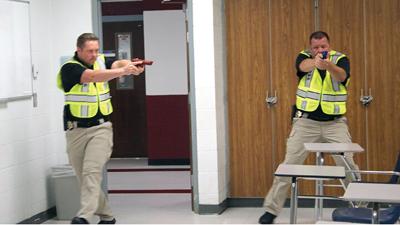

Jefferson County Sheriff’s Office deputies spent two and a half weeks this summer at Northwest High School in Cedar Hill training for the worst – an active shooter.
First the deputies spent time in a classroom learning about how to work as a team, clear hallways and make safe entrances into school rooms. Then they divided into two-person and four-person teams and practiced what they learned, with instructors asking them to respond to different active-shooter scenarios.
“When you come into a room, expect that there is a bad guy in every corner and be surprised when that doesn’t happen,” one of the instructors, Sgt. Brian Rossomanno, told 14 deputies during training on July 26.
The training, which started on July 21 and was expected to be finished on Aug. 4, was specific to different deputies’ roles.
For example, school resource officers received four more hours of training than other deputies, and supervisors received command training related to active shooters.
In all, 144 of the Sheriff’s Office deputies received the active-shooter training, spokesman Grant Bissell said.
Deputy Mark Gibson, a Fox C-6 school resource officer and K-9 officer who was part of a role-playing team, said the training helps prepare the deputies for a situation they hope they never encounter.
“God forbid, something happens like this, but you have your training to fall back,” he said. “The Sheriff’s Office is setting a baseline, saying this is what we’re going to do. This is how we’re going to handle it.”
One scenario had two-person teams enter a room and make sure it was clear. A second scenario had a four-person team make their way down a hallway where an active shooter and victims were inside a classroom.
“You are going directly to the source of violence,” Rossomanno said. “Every gunshot is another life.”
After every scenario, Rossomanno went over the deputies’ responses, explaining what worked and what didn’t and how to accomplish their goals quicker.
“Ten seconds can be an eternity,” he said. “Every scenario that we do we are going to nitpick apart because if we see anything is not right and we don’t talk about it, there is no point to us being here,” he said.
Deputy Marcus Biggins, who has worked in law enforcement for seven years, said this was the first time he had trained for an active shooter since joining the Sheriff’s Office a year ago.
He said the mental aspect of the training, like exploring what the shooter might be thinking, was the most important for him.
“But, it’s also about how we are thinking and moving forward to address the situation that’s ever fluid,” he said. “We have to really work on our ability to keep our feet physically moving forward.”
Biggins said he is glad the whole Sheriff’s Office is receiving the same training.
“It’ll help us work together quickly so there will not be any discrepancies in training,” he said. “We don’t necessarily work together on a daily basis if that makes sense. We all do the same job in different capacities, but when there’s a situation like an active shooter or high-level high-emotion scenarios, we often need to be able to come together as one and do the job as one.”
Deputy Roger Waeckerle said the last time everyone in the Sheriff’s Office completed active-shooter training was in 2020.
“A lot of the COVID restrictions kind of slowed us down, but the SWAT team was still keeping up with all the training,” he said.
Waeckerle said he hopes to see active-shooter training held twice a year.
He said the Sheriff’s Office hopes to have deputies practice their training in all the county schools at some point.
“We actually have a blueprint of every school in our system that we can look up at any time and print it off, and that’s a resource for us. But, it’s important to train (at the schools) as well because each layout is different,” Waeckerle said.
Bissell said deputies regularly receive other types of training, like yearly firearms, taser, pepper spray and use of force training.