


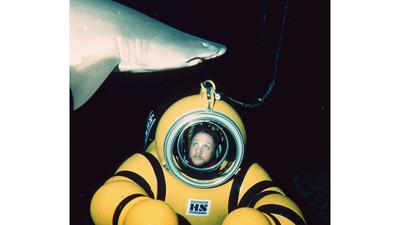

A man with ties to Jefferson County has gained national notoriety because of his insights into the recent tragedy involving a vessel that imploded on its way to explore the Titanic wreckage, killing the five people onboard.
Robert Mester, 72, who grew up in the Hematite area, has some informed thoughts about the subject since OceanGate Inc., which offered passengers the chance to view the wreckage for $250,000 each, had invited him for an expedition on the Antipodes, a predecessor to the Titan, which imploded last month.
Mester now lives in the Tacoma, Wash., area and has spoken about the tragedy with Anderson Cooper on CNN, Piers Morgan on Fox News and on MSNBC, and his thoughts about it have appeared in several newspapers around the country.
Mester was interviewed about the catastrophe because he has worked all his adult life in the maritime industry and owns a company called National Maritime Consultants, which specializes in marine damage surveys, salvage operations, accident investigations and other undersea technology issues.
What Mester saw when he toured the Antipodes more than a decade ago was enough for him to decline the offer to venture underwater on it.
“In 2011, the owner of OceanGate (Stockton Rush) invited me on the Antipodes, a predecessor to the Titan,” Mester said. “We were going to take a quick trip down 240 feet, which can be just as deadly as a much deeper dive. I took a peek at it and wasn’t impressed. The equipment wasn’t certified, and the electronics, they had bought at a local store. It had a Game Boy controller. I politely told the owner that I couldn’t go.
“A lot of people over the years, including my company, told them that their vessels were not suitable for the kinds of depths they were talking about.
“You can’t just charge people a quarter-million dollars and hope they make it down and make it back up again.”
Mester believes the Titan, which began its descent on June 18, imploded about an hour and 45 minutes into its journey, about the time the submersible lost communication with its mothership.
In addition to its inadequate equipment, Mester said the Titan was not built for deep-sea exploration.
He said the ends of the vessel were made of titanium, a metal well suited for the purpose, but the middle body was crafted of carbon fiber.
“Carbon fiber does not expand and contract as a strong metal like titanium does,” Mester said.
That property is vital, he said, because of the high pressures involved in underwater work.
“It’s not an easy task to go undersea,” he said. “It’s easier to go into space. At the surface, air pressure on your body is 14.7 pounds per square inch. You go down 33 feet, and that doubles. By the time you’re 12,500 feet under the surface, the pressure is 5,565 pounds per square inch. That’s a long way from 14.7, and the human body (and many materials) is not built to withstand that.”
Mester said he believes the implosion was spontaneous and instantaneous, so the five people onboard likely never suffered.
“This is a tragedy,” he said. “You can’t say it was a con job because the owner was on the Titan and died along with the other people.”
Not a cheap hobby
Mester said he has first-hand experience with submersibles like the Antipodes and Titan.
“I’ve had submersibles since 1980. Each one of my three costs about $1 million a year to keep them certified. And $900,000 of that is to make sure a human can be on board. That’s the strange thing about humans, the vanity. We want to say we’ve been someplace very few people have been. That’s the draw of these private space trips, and what we’ve recently seen with the Titan. We have the technology to collect all the data we need without sending people down deep.
“But if there is a positive to this, it’s that the world’s attention is now drawn to the issue. Someone who lives in the middle of the Sahara Desert and has never seen the ocean knows about the Titan tragedy. This event is going to start a new era, one in which people are going to be very careful and make sure it’s not repeated.”
Mester’s early life in Jefferson County
Mester said he spent much of his teenage years in the Festus area and living on his family’s land in Hematite. He went to Festus R-6 schools but didn’t graduate from Festus High because he transferred to Berkeley High during his senior year in 1969.
His family still lives in Jefferson County.
“I grew up in a family-oriented type of environment, and I enjoyed living in Jefferson County,” he said. “But there was something in me that I figured I wasn’t where I was going to be my whole life. While my brother, my sister and my whole family have Missouri accents, I never had that and I don’t know why. But I knew that there was something else out in the world for me, and that was the ocean.”
After graduating from high school, Mester enlisted in the Marine Corps.
“My father was a Marine, my grandfather was in the Marines and my great-grandfather was in the U.S. Marine Corps,” he said. “I never thought when I was in high school about going into the service, but I guess there was something inside of me that I really hadn’t thought about. Once I got a look at the ocean, something clicked. From the first time I got into the water, something inside me just grew and grew.
“In the Marines, I did a lot of underwater diving. I would say that got my feet wet in the profession I would be in the rest of my life.”
Mester worked for several companies, mostly on the West Coast, that dealt with maritime salvage and other water-related issues.
“That sent me all over the world,” he said. “ I eventually ended up in Washington (state), where I met this girl (Janet, his wife of 43 years), and we got married in the ’80s.”
Working for himself
Mester eventually started his own company, the now defunct Underwater Atmospheric Systems, that “could locate submerged resources for our clients.”
In addition, Mester’s company represented its clients in court to secure the ownership of whatever was below the water’s surface before proceeding with the actual salvage work.
The company also offered restoration of what it brought up.
“We found World War II combat aircraft from all over the world,” he said.
Mester also compiled a database of all Allied air crashes over the seas since World War I.
“You have to be a different breed to get involved in this kind of work. Most people work their normal job, go home and grab a drink and then think about their dreams. And that’s where it ends,” he said. “But for some people, that’s where it begins. And I’ve been doing this for 30 years.”
His company also did work for law enforcement (“finding dead bodies in the ocean”), the Federal Aviation Administration (investigating airplane crashes at sea), the Navy and the Coast Guard.
“Some things we did (for law enforcement and the military) I’m not at liberty to talk about,” he said.
Mester said he’s gone on at least three deep-sea expeditions that took him at least a mile under the surface, and has almost died twice, only to be revived.
What’s it like under there?
“It’s hard to describe,” Mester said of life under the sea. “Most people have a preconceived notion of what the ocean is, but it’s not like that at all. Because more people have been in space than have been deep in the ocean, it’s kind of like describing what the dark side of the moon is like. No one’s ever seen it, and that’s strange, considering this planet is four-fifths water. But I can tell you that the ocean is very much alive and endlessly interesting.”
In 2004, Mester said he had an epiphany of sorts and started Northwest Maritime Consultants.
“I was getting to be 45 or 50 years old, and I had some physical close calls,” he said. “I figured out that I could get paid a lot more money by using my expertise in consulting rather than putting myself in danger. That risk is a young man’s game. Everyone was afraid of me hurting my right hand, which is the one that signs the payroll checks.”
Still, he said, no matter how deep or how far away his work takes him, he still regularly visits his family in Hematite.
“I’m glad I grew up in Jefferson County,” he said. “It’s where my roots are. I’ll be a Missouri boy no matter what, even if the ocean is flowing through my veins.
“You know, most people never have a chance to live their dream. I have. I’ve been very fortunate.”