
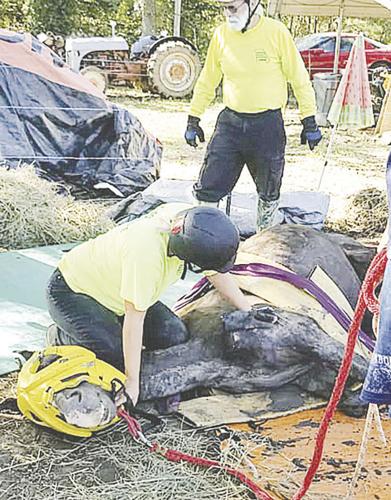
A horse named Maverick had to be put down Sunday in rural De Soto because he could not be saved, but it was not because people didn’t try.
The horse owners, along with firefighters from the De Soto Rural Fire Protection District and volunteers from the Missouri Emergency Response Services Large Animal Rescue Team, did what they could to try to save the horse, Assistant Fire Chief Tom Fitzgerald said.
Over the weekend, the 16-year-old animal, who was sick and weak, was found stuck in about a foot and a half of mud near his barn in the 3400 block of Upper Plattin Road. The owners, who struggled to get the horse up on its feet and back into the barn, were successful, but it was short-lived.
A veterinarian came and checked out the horse on Saturday night, but by the next morning, the horse had gotten out of the barn and “rolled back down in the mud,” Fitzgerald said.
The De Soto Rural Fire Protection District received a call for help at 8:20 Sunday morning.
“The owners and a friend were trying to use the tractor and a sling to pull him out of the mud,” he said.
The fire district has equipment and resources, Fitzgerald said.
Firefighters are trained in technical rescue skills in order to reach and rescue people who are trapped in tight and dangerous places, he said.
“They are equipped and trained for this exact kind of thing,” Fitzgerald said. “We utilized our technical rescue skills.”
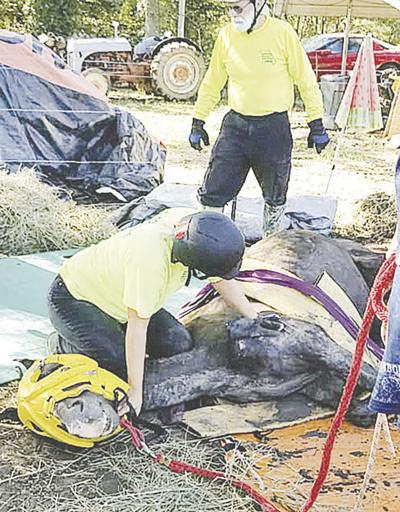
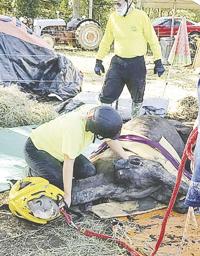
Firefighters set up ropes and hauling equipment and worked to move the horse. The goal was to get the horse onto a thermo plastic sheet and slide him up out of the mud.
“We were successful in moving the horse up out of the mud onto a dry area,” Fitzgerald said.
The district called the MERS Large Animal Rescue Team, which is based in St. Clair and works to rescue horses, cows and other large animals when they are trapped, sick or in dangerous situations.
By the time firefighters had the horse out of the mud, the seven or eight MERS volunteers had arrived.
“Our plan was to make the horse as accessible to them (the MERS volunteers) as possible,” Fitzgerald said.
The group set up a large A-frame steel structure with a harness assembly and a winch lift to get the horse back on its feet, he said.
However, the horse was too weak to stand on his own for long.
Another veterinarian came out to examine the horse.
When firefighters left the scene, the horse “was showing positive signs” and trying to eat, Fitzgerald said.
But the animal was too sick to be saved, he said.
“Sadly I have to report that they had to put the horse down. They buried him on Monday,” Fitzgerald said.
He said lactic acid had built up in the horse’s system and he was too weak to recover.
Fitzgerald said it was a sad outcome.
“We like animals here,” he said.