



This is the first in a three-part series on the offender reentry services at the Missouri Eastern Correctional Center.
To read the second part, click here:
To read part three, click here:

Marc Rath, who has been incarcerated for the past 12 years at the Missouri Eastern Correctional Center in Pacific, is eligible for parole this month.
He said he doesn’t plan to return after his release and believes the prison’s recently opened offender reentry center will help him stay on the right side of prison walls.
The center is designed to provide skills and opportunities to those preparing for release, making it easier for them to blend back into society.
Rath, 50, was sentenced in 2009 for second-degree robbery, resisting arrest and tampering with a motor vehicle.
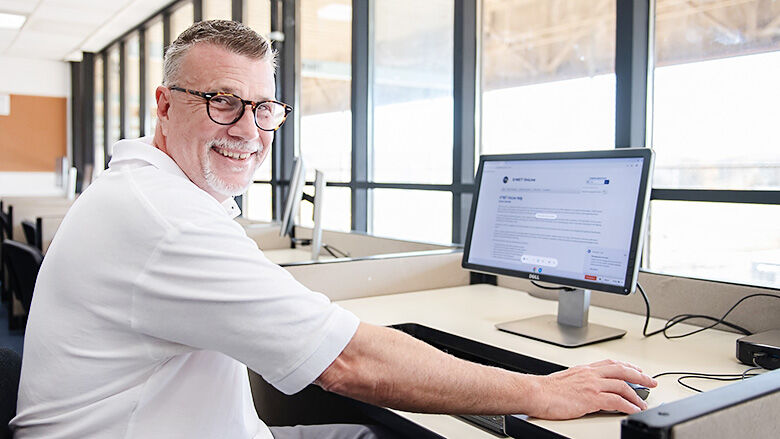
In his remaining days in prison, he often can be found in front of a computer at the offender reentry center, escaping the noise and the distraction of the facility by focusing on finding a job or earning another certificate to put on his resume.
“It’s actually phenomenal for us to be able to come here, use the computers and remove ourselves from the stigmas around us for a short time,” he said. “If I have other issues in the institution, I can go to medical, but I have to go back there (to the housing unit). I don’t know what you can imagine, or what you can fathom, but it’s not nice. You’ve got overdoses and other bad stuff. Here (at the center), we’re separated from that lifestyle. We can work on bettering ourselves here.”
The MECC is a few miles west of Eureka on Old Hwy. 66, and the reentry center allows people serving prison sentences to apply for jobs, conduct video interviews with potential employers and further their education with job-specific certificates.
The center opened in July.

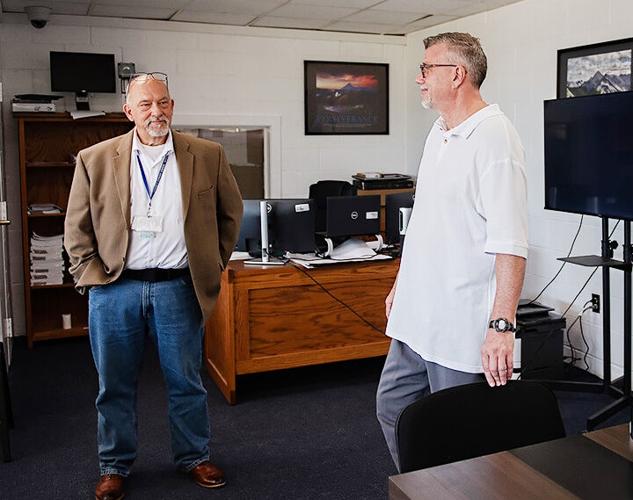
MECC reentry progam manager, Kenneth Korpecki, left, and Aaron Watkins inside the program’s center.
Institutional Reentry Coordinator Kenneth Korpecki said he has seen a positive effect on the prison’s population.
“Everybody needs to realize that these people are going to get out eventually,” Korpecki said. “In my 38-plus years of being in this mess, I’ve learned that if you can’t give a guy a livable wage and a job, they’re going to go back to the same stuff they did to get in here.
“We need to provide them with the necessary tools to make them productive and to make sure we have a safer community for you and me.”
Korpecki started as the reentry coordinator on June 1. Before coming to Pacific, he was a superintendent at several Missouri correctional facilities.
He said an average of 200 to 250 of the inmates use the center’s resources each month, with 396 visiting it in a recent month.
MECC has about 1,100 people serving prison sentences, and 303 were released in 2022.
Korpecki said he encourages any inmate to take advantage of the reentry center.
“I don’t care if you’ve got two weeks left or 12 years left,” Korpecki said. “I want them to come in and start seeing what we have. I encourage everybody to come up because the population that we have up here (in the reentry center) is a whole other population (from the rest of the prison).”
According to the Missouri Department of Corrections, 23,000 people are serving prison sentences in 20 institutions across the state. An additional 62,000 people are on probation or parole.
The department states that 96 percent of people who enter the prison system are ultimately released.
Korpecki said the maximum amount of time served at MECC is 12 years – all but guaranteeing that most of the men in the facility will one day be looking for work and housing after release. He said without assistance, those men are at risk of returning to the correctional system.
The Missouri General Assembly dedicated $1.8 million for the Department of Correction’s reentry program in the 2023-24 budget year.
Karen Pojmann, communications director for the Department of Corrections, said the program funding covers operational expenses, travel, professional development opportunities, technology expansion, workforce training initiatives and the costs for documents like birth certificates and Social Security cards.
The Department of Corrections’ overall budget is $925,740,777 for 2023-24.
In April, Missouri joined the Reentry 2030 national initiative. As part of the initiative, the state Department of Corrections promises to provide career services for all incarcerated persons, ensure that 85 percent of offenders are employed within 30 days of release and 80 percent of offenders maintain their employment for at least nine months. The state has until 2030 to reach these goals.
Warden Gregory Hancock said proof of the reentry center’s success could be seen at a recent resource fair held at MECC, where employers, social service agencies, and outreach programs could set up booths and speak with inmates.
“People are interested in coming to these resource fairs and hiring these guys,” he said. “There were offenders who were interviewed and hired by a company that had no initial interest in working with us. Hopefully, that’s just one of many to come.”
The center
On Nov. 8, Rath was browsing O*Net Online for job listings in the re-entry center. The closed network provides information for offenders at the center on what qualifications are needed for a job and whether an employer hires felons.
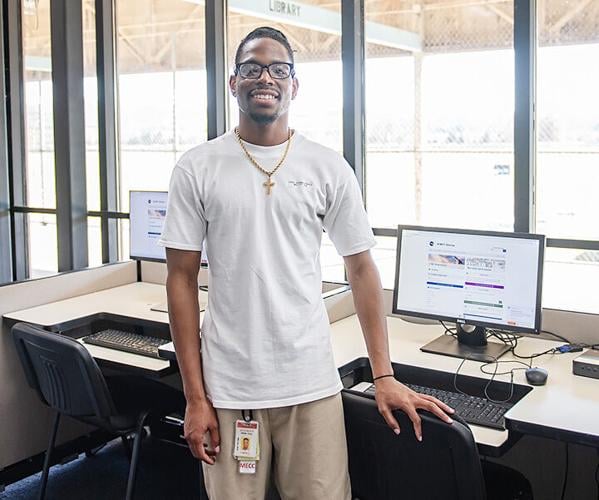
The center is clean and air-conditioned. A row of desktop computers faces toward a window overlooking the yard. The room smells like new paint, and when the door closes, the center is so quiet one could hear a pin drop. It’s a big difference from standing in the hall, where dozens of inmates constantly walk back and forth to the canteen, recreation area and their vocational work areas.
Rath said once he finds a job he’s interested in and thinks he’s qualified for, he will ask Korpecki to apply for him.
After checking out O*Net, Rath works on a few educational courses through Coursera. The website offers free courses on thousands of subjects. Once completed, the degrees or certificates can be added to a resume.
“(Coursera) shows your completion, what university you completed it with and your certification,” Rath said. “One of them I did was on a golf ball retrieving device, which is a product we make (at MECC). So, I learned about building a product and building a brand.”
Rath said he would like to work in the import and export trades. He’s also interested in becoming a commercial truck driver but said his parole will place limitations to where he can travel.
Rath said he finds completing each course to be rewarding.
“I can choose what I want to learn,” he said. “We don’t have a choice in here on anything, in any other aspect of our lives. We can’t choose when or what we eat. We can’t choose when we’ve got to line up for count.
“Instead of engaging in the nonsense, I’m enabling and empowering myself. You can’t take any of this (education) away from me, whereas everything else, you can.”
Counseling
Aaron Watkins, 53, has been incarcerated for 31 years for forcible rape. He said after being in prison for so long, he’s observed that many of his fellow inmates lose the ability to learn.
Korpecki said Watkins often helps others learn how to use the computers or navigate O*Net at the center.
“When some guys first come in here, they hate it because they don’t know what they’re doing at all,” Watkins said. “But when they let go of their fears and you give them a little bit of a ‘Great job, what are you working on?’ they light up a little bit.”
Watkins said he will be released in two years. At that time, he said, he wants to work to improve the counseling services offered to prisoners.
“I dreamed of this type of service being in prison,” Watkins said of the re-entry center. “I want to help guys who are getting out of prison, help them out. They can do a lot when you’re on the inside and they just don’t.”
Korpecki said he creates a plan with every offender who comes to the center. He said having a solid plan for what happens once the offender is released is the best way of getting approval from the parole board.
“A majority of people here are on parole status,” he said. “What ends up happening, I’ll ask them, ‘So, what are you going to tell the parole board?’ And a lot of the guys have no idea what to say. They’ll say, ‘I’ll stay at my girlfriend’s, I’m gonna get a job.’ How do you plan to get from here to there? He says, ‘I don’t know, I’ll figure it out.’ Then he’s not prepared for the parole hearing.”
Every offender starts at the center by building a resume of skills and experience, Korpecki said. In preparation for their parole hearing, Korpecki will make sure the offender has a birth certificate, Social Security card and the address of a place to stay if they are released from prison.
“I give them a resume template and have them bring it up (to the center), I don’t care if they write it on toilet paper. It’s a start,” he said.
Hope
Orlando Young, 29, has been in prison for 10 years for first-degree statutory sodomy. He said he has five more years before he is eligible for parole.
“(The reentry center) has become the light for a lot of people,” Young said.
He said once he is released, he would like to work in human resources. He said he can see himself doing what Korpecki does or working for a nonprofit organization that helps others who are serving prison sentences.

Orlando Young is an inmate taking part in the reentry progam at the MECC.
“I feel like for a lot of us who are young – still in our 20s – I think for us it’s hard when we see or hear our peers on the streets,” Young said. “For instance, I have a friend of mine who has a master’s (degree) in biology, and she’s working in a lab. I think a lot of us are like, ‘Where can we go from here?’ It’s hard even for people without a felony to get a job; it’s 10 times harder for us who have a felony.”
According to the National Institute of Justice, about 44 percent of people released from prison return. In Missouri, 46 percent of people released from prison return within five years, according to a 2019 Department of Corrections report.
“Our win is you not coming back (to prison),” Korpecki said. “Your win is taking care of your family, getting a job and paying your taxes.”
“I don’t want to be a statistic on recidivism,” Young said. “I think this (the center) has become almost that light at the end of the tunnel for being incarcerated.”