


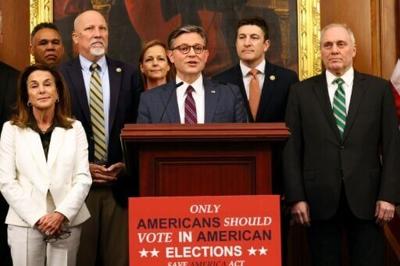
US President Donald Trump is pressing Republicans to pass a sweeping overhaul of voting rules that critics say is less about election security than trying to block millions of people from casting ballots and avoid defeat in the midterms.
Trump's Republicans in the House of Representatives have already passed a version of the Safeguard American Voter Eligibility (SAVE) America Act, but it faces steep obstacles in the Senate, where the party lacks the votes to overcome Democratic opposition.
Trump has nevertheless made the proposal a central political demand, urging lawmakers to pass it before congressional elections in November that could see the president's agenda hamstrung in a Democratic takeover.
Here is a guide to the legislation and the debate surrounding it.
- What is the SAVE America Act? -
The bill would require Americans to prove their citizenship when registering to vote in federal elections and present identification when casting a ballot.
Under the legislation, voters would have to provide documents such as a passport or birth certificate, along with a valid photo ID, to demonstrate they are US citizens.
Supporters say the measure would strengthen confidence in the integrity of elections.
Critics argue it would impose burdensome requirements on millions of eligible voters who may not have easy access to such documentation.
- Why is Trump pushing the bill so hard? -
The president has repeatedly argued that tighter voting rules are needed to protect elections from fraud.
He pitched House Republicans at a conference on Monday, arguing that the legislation would "guarantee the midterms" and insisting that he won't sign any other bills until it gets passed.
"The people are demanding it," Trump said.
Critics, however, say the political calculation is clear.
They argue the administration hopes stricter voting requirements could reduce turnout among groups that traditionally lean Democratic, giving Republicans a better chance of avoiding heavy losses in upcoming midterm elections.
- Is voter fraud a problem? -
No. Studies of US elections have repeatedly found that fraud occurs at very low levels, particularly when it comes to non-citizens voting.
A review by the Brookings Institution of decades of data collated by the right-wing Heritage Foundation turned up only 39 cases of fraud among more than 100 million ballots cast in 32 elections spanning three decades.
The picture was similar in the hotly contended battlegrounds of Arizona, Georgia, Michigan, Nevada, North Carolina and Wisconsin.
Because it is already illegal for non-citizens to vote in federal elections, critics of the bill describe the legislation as a solution looking for a problem.
Supporters counter that even isolated cases can undermine public trust and argue that stricter rules would reassure voters.
- What challenges does the bill face in Congress? -
The legislation has already cleared the House of Representatives but faces far steeper hurdles in the Senate.
Under Senate rules, most legislation requires 60 votes to advance -- a threshold the chamber's 53 Republicans do not currently meet.
Senate Majority Leader John Thune has indicated there are not enough votes to change the chamber's "filibuster" rules to push the bill through with a simple majority.
Republican leaders are nevertheless planning a marathon Senate debate in the coming days, partly to force Democrats to publicly oppose the measure.
Even if the bill ultimately fails, the vote could become a major political flashpoint heading into the midterm campaign.
- Why are Democrats and civil rights groups opposed? -
Even if voter fraud were a real problem, opponents say the SAVE America Act is not the answer as it would make it harder for many Americans to vote.
They warn that millions of people -- including elderly voters, lower-income Americans and people whose names have changed after marriage -- may not have immediate access to documents proving citizenship.
Civil rights groups argue the requirements could lead to eligible voters being turned away from the polls.
They also criticize Trump's attempts to add unrelated provisions to the legislation, including restrictions on mail voting and policies targeting transgender issues.
ft/sms