





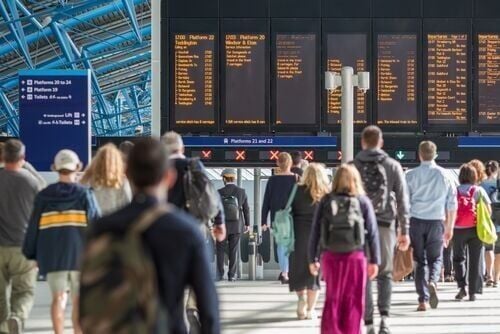
A crowd of commuters walking toward the platforms, with the train timetable above at Waterloo Station. Image Credit: Shutterstock/I Wei Huang
I was on my way to Amsterdam Centraal when the email arrived. My Eurostar to London had been canceled due to a “power cut,” along with every other departure from Amsterdam that day.
What should have been a straightforward journey quickly became a scramble. With no workable rail route to London, I booked a last-minute flight to Manchester, rented a car and drove to London, paying considerably more than I had planned to get where I needed to be.
That disruption came on one of Eurostar’s fastest-growing routes. The company carried 20 million passengers in 2025, its highest total yet, with traffic on the London–Amsterdam route up 18.3 percent.
The Case for Taking the Train
When train travel works, it can be one of the simplest ways to get around Europe. Stations sit in the middle of cities, and there is no need to arrive hours early or factor in an airport transfer.
That was certainly the case in Switzerland, where my family traveled with a Swiss Travel Pass. In Britain, Omio provided first-class round-trip tickets from London to Swansea, turning what could have been a complicated family travel day into a comfortable few hours watching the countryside slide past the windows.
The numbers suggest others have reached the same conclusion. In the European Travel Commission’s 2026 long-haul travel research, 40 percent of respondents planning cross-border trips within Europe said they preferred traveling by train with a pass, and 38 percent preferred individual or return train tickets. Among Canadian visitors, rail was on par with low-cost flights at 39 percent.
Switzerland’s rail tourism numbers tell a similar story. Swiss Travel System reported record revenue of CHF 460.6 million in 2025, a 13 percent increase, and Switzerland Travel Center said demand for rail tours and Swiss Travel Passes helped propel the company to its most successful year ever.
Christelle Dillon, sales and marketing manager at Travel Switzerland, said rail has become more than a practical way to get around.
“There’s a broader global shift toward train travel right now: sustainability concerns, flight fatigue, and a real cultural moment around ‘slow travel’ have made rail a genuinely aspirational way to see a country, not just a practical one,” Dillon said. “Switzerland is uniquely positioned to benefit from that, because the network itself is the attraction.”
Booking has also become less fragmented. Omio, which now operates in 48 countries, lets passengers compare trains, buses, ferries and flights in one place. Its proposed acquisition of Rail Europe would create a group that sells 22 million train tickets annually and works with more than 28,000 transport operators and travel sellers.
The company says the global rail market is projected to exceed $300 billion by 2032, as governments continue investing heavily in rail infrastructure and capacity.

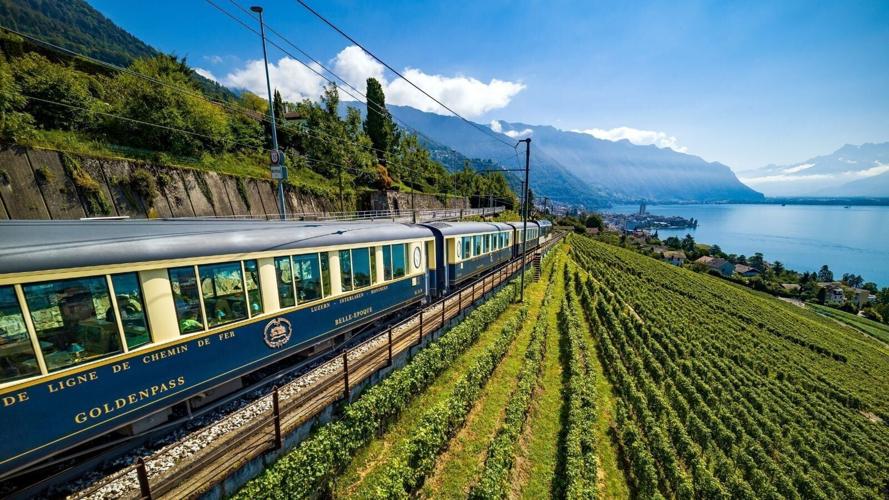
Chocolate Train - GoldenPass Belle Epoque at Lake Geneva, Montreux Riviera. Image Credit: MOB GoldenPass
Switzerland Makes It Look Easy
In Switzerland, the Swiss Travel Pass removes much of the guesswork by covering trains, buses and boats across more than 90 towns and cities. It turns a complicated web of individual fares into a single pass for visitors trying to see several regions on one trip.
More importantly, the travel time does not feel wasted. Dillon said travelers are also staying longer and choosing longer-duration passes than they did a few years ago, with more opting for eight- or 15-day passes rather than three- or four-day passes.
“Longer stays also mean people are weaving in smaller towns and regional routes they wouldn’t have bothered with on a tighter itinerary,” she said. “It’s less ‘get from A to B efficiently,’ and more ‘the train ride is the experience.’”
“There’s also a real wish from travelers to experience the country the way locals do, not just as a tourist passing through,” Dillon said. “And honestly, what’s more Swiss than traveling by train in Switzerland? The Swiss use their trains every day; it’s woven into daily life here, so hopping on that same network is a way for visitors to feel like they’re living the country rather than just visiting it.”
The same was true on our Omio-booked trip from London to Swansea. First class gave the four of us room to spread out, and instead of spending the day negotiating traffic on the M4, we boarded in central London and arrived in Wales a few hours later. For a family trip, that ease counts for a lot.
Booking it was equally straightforward. I could compare the options in one place, and once the tickets were purchased, our travel details stayed in the Omio app where I could pull them up quickly during the trip. When several people, bags and connections are involved, being able to pull up every ticket quickly matters more than it might seem.
Japan Joins Omio’s Rail Expansion
Omio is also expanding into rail-heavy destinations. The company launched in Japan in March 2026, its 47th market and first in East Asia, with Shinkansen tickets, regional trains, buses, ferries and Japan Rail Passes available through the platform. Travelers can also use Omio Advance to book certain Japanese train journeys up to 12 months in advance.
“Japan is the gold standard of modern mobility,” Omio founder and CEO Naren Shaam said in announcing the launch. “Its high-speed rail, dense regional networks, domestic aviation and ferry systems operate at a scale and precision that few countries can match.”
Japan welcomed more than 40 million international visitors in 2025, and Omio says it is already seeing demand not only along the familiar Golden Route but also in mountain regions, on sacred routes, and in coastal communities.
When Easy Becomes Impossible
The appeal is obvious, but rail travel can unravel quickly during a major disruption. A canceled train becomes a much bigger problem when an entire network is affected and the alternatives disappear with it.
That is exactly what happened to me on June 30. Eurostar canceled all departures from Amsterdam Centraal that day, and trains for the following day were already sold out. I was given no workable alternative.
Finding another way to London was not simple. Same-day airfares were obscenely high, and rental cars in Amsterdam were sold out when we tried to book one for the drive to London. I eventually found a flight to Manchester, then rented a car and drove south. What should have been a routine train journey became an expensive, frustrating detour.
The problems did not end once I reached London. Eurostar’s customer service was virtually nonexistent. I emailed repeatedly asking for a refund and received no response. The online system gave me the option to request a credit, but not the refund I wanted. It was not until August 10, more than five weeks after the cancellation, that I finally received an email confirming that my refund would be issued.
Most rail journeys are uneventful. The problem is that a major disruption can leave travelers with surprisingly few ways to continue the trip.
My Eurostar experience made me more cautious, not less interested in train travel. I now leave more room around important connections, check cancellation and refund policies before booking, and make sure my travel insurance covers transportation disruptions. I still prefer arriving in the middle of a city with my luggage beside me and the journey already behind me.
For now, the biggest challenge may be coming home and remembering that “take the train” is rarely the obvious answer on this side of the Atlantic.
The author received complimentary first-class train tickets from Omio and Swiss Travel Passes for travel in Switzerland. Neither company reviewed or approved this article.