
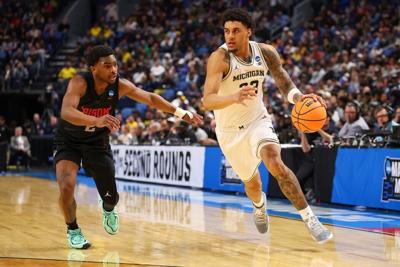

With all the talk of busted brackets, game-winning shots, point spreads and Cinderellas, it was easy to miss the eye-popping offer University of Michigan star forward Yaxel Lendeborg claimed to have received during the first weekend of March Madness.
Lendeborg told The Associated Press that the University of Kentucky had dangled between US$7 million and $9 million to entice him to transfer there in 2025.
Though University of Kentucky head coach Mark Pope called it “100% false” in a subsequent interview, the numbers being thrown around show just how big a business college sports have become. CBS and Turner are paying the NCAA about $1.1 billion annually through 2032 to air March Madness games. Recent court decisions, settlements and NCAA policy changes have opened the door for top college athletes like Lendeborg to earn millions of dollars.
Yet athletic departments are still operating as tax-exempt nonprofits, even as a growing chorus of voices, from academia to politics, is wondering whether this designation should be reevaluated.
The nonprofit mission
Most private universities operate as 501(c)(3) organizations under the tax code. This IRS designation means it is a nonprofit that serves a public or charitable mission. These nonprofits don’t have to pay federal taxes and can receive tax-deductible donations.
Because public universities are already government entities, they don’t need to apply for 501(c)(3) status. However, their affiliated fundraising arms – including those supporting athletics – are set up as separate nonprofit foundations and typically need to apply for and receive that designation.
According to the IRS, nonprofits can receive this tax-exempt status if they advance the following missions: “religious, educational, charitable, scientific, literary, testing for public safety, fostering national or international amateur sports competition (as long as it doesn’t provide athletic facilities or equipment), or the prevention of cruelty to children or animals.”
This designation means that universities will reinvest any leftover funds after expenses – they don’t use the word “profit” – into programs that advance the university’s mission. These include facilities, research, academic departments and scholarships.
Donors to a university are able to receive tax deductions for their support. They can usually direct their donations toward funding a specific mission – perhaps in memory of a favorite professor, supporting cancer research or to support extracurricular activities such as sports.
In March 2025, for example, philanthropists Maurice and Carolyn Cunniffe gave $100 million to Fordham University to support STEM education, and in December 2025, Acrisure CEO Greg Williams and his wife, Dawn, gave $401 million to Michigan State University, designating over 70% of their historic donation to Michigan State athletics.
A windfall for some college athletes
I want to return to one phrase from the IRS’ requirements for being designated as a tax-exempt nonprofit: “fostering national or international amateur sports competition.”
In 2026, there’s very little about college basketball and football – and, increasingly, sports such as golf and ice hockey – that could be considered “amateur,” which technically means that athletes are not paid salaries or wages for playing and do not compete as their primary profession.
In recent years, the NCAA has allowed athletes to earn money through endorsements and sponsorships. Meanwhile, the recently approved settlement in House v. NCAA allows schools to share roughly 20% to 22% of its revenue from licensing, media rights and ticket sales directly with athletes, further complicating the traditional definition of amateurism.
The compensation college athletes can receive happens on top of a five-year scholarship that covers the full cost of attendance for some athletes. At the University of Denver, where I teach, five years of attendance is valued at over $435,000.
Schools argue that athletics are part of their educational mission, with revenue from football and basketball funding sports that make far less money, such as swimming and gymnastics.
But it’s gotten to the point where playing certain college sports can be as lucrative – if not more so – than being a professional athlete.
Chicago Bears quarterback Caleb Williams reportedly had to take a pay cut as a rookie after leaving the University of Southern California.
Former Notre Dame women’s basketball standout Olivia Miles passed up likely being the second pick in the WNBA draft and instead transferred to Texas Christian University, where, according to a recent ESPN E60 report, she is earning over 10 times what she would have been paid in the WNBA, through a mix of sponsorships and direct payments.
Eligibility extensions
Some college athletes, such as quarterback Diego Pavia, who most recently played for Vanderbilt University, have sued the NCAA to extend their eligibility beyond the current limit of four seasons and five calendar years. It isn’t unheard of for a player to get seventh, eighth and ninth years of eligibility.
Meanwhile, student athletes are routinely playing for two, three or four different schools during their collegiate years. The so-called “transfer portal” – a period when college athletes make it known that they are willing to switch schools – operates like a free agent market in pro sports leagues.
This is a far cry from college sports in the 1970s and ’80s, when student athletes were expected to earn their degrees in four years. Until 1968 – and 1972 for football and basketball – freshmen weren’t even allowed to play at the varsity level. The thinking went that they needed a year of adjustment to get a handle on their coursework.
For some of today’s college athletes, school isn’t in the picture. Before the 2026 College Football Playoff national championship, a reporter asked University of Miami quarterback Carson Beck, a transfer from Georgia, whether he had to worry about class that week.
“No class. I graduated two years ago.”
A business separate from the university?
This isn’t to say college athletes definitely don’t deserve to be compensated beyond the value of their scholarships. Perhaps they do. But the idea that athletic departments and their associated fundraising arms should be classified as tax-exempt nonprofits promoting education and amateur sports strains credulity.
In November 2025, U.S. Sen. Maria Cantwell submitted a letter to the chief of staff for the U.S. Congress Joint Committee on Taxation.
“Given the evolving market dynamics of college sports,” she wrote, “legitimate questions have been raised about whether it is time to rethink the tax-exempt regime under which college sports currently operates.”
At this point, college sports strike me as a business only loosely tied to the university. Education scholar John R. Thelin has pointed out how athletics can function like a separate corporation, tied to the university only through scholarships, logo licensing and marketing.
So what might happen if athletic departments lost their tax-exempt, charitable status?
For one, the government would treat them as businesses, and businesses pay taxes. And their donors and boosters would no longer be eligible to receive tax deductions for gifting money to a program, just like a regular customer at a restaurant doesn’t receive a tax break for regularly dining there.
This isn’t unheard of: Some universities already have taxable, for-profit arms, whether it’s in real estate development, hospitality or startup incubators.
To some donors, their love for their alma mater may outweigh any tax benefit. But others may find themselves more willing to fund other causes – in or outside a university – that more closely align with the nonprofit mission.
This article is republished from The Conversation, a nonprofit, independent news organization bringing you facts and trustworthy analysis to help you make sense of our complex world. It was written by: Andrew Urbaczewski, University of Denver
Read more:
- Nonprofit news outlets are often scared that selling ads could jeopardize their tax‑exempt status, but IRS records show that’s been rare
- NCAA will pay its current and former athletes in an agreement that will transform college sports
- The man responsible for making March Madness the moneymaking bonanza it is today
Andrew Urbaczewski does not work for, consult, own shares in or receive funding from any company or organization that would benefit from this article, and has disclosed no relevant affiliations beyond his academic appointment.
