


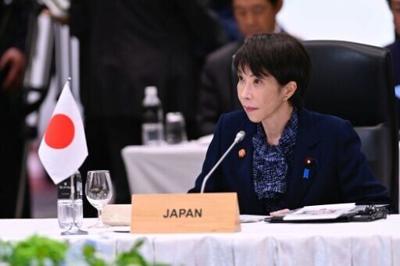
Japanese Prime Minister Sanae Takaichi called on South Korean President Lee Jae Myung Tuesday to help "ensure regional stability", as Beijing pressures Tokyo over its stance on Taiwan.
The two leaders met in Takaichi's picturesque home region of Nara in western Japan, days after Lee visited Chinese leader Xi Jinping in Beijing.
They agreed to strengthen cooperation on economic security, regional and global issues, as well as artificial intelligence, according to South Korea's presidential office.
Looming in the background of the meeting was Japan's heated diplomatic spat with China, triggered by Takaichi's suggestion in November that Japan could intervene militarily if China attacks Taiwan.
China, which regards Taiwan as its own territory, reacted angrily, blocking exports to Japan of "dual-use" items with potential military applications, fuelling worries in Japan that Beijing could choke supplies of much-needed rare earths.
Takaichi said she told Lee that "while advancing Japan-South Korea relations, both countries should cooperate to ensure regional stability and fulfill their respective roles".
"As the environment surrounding both of our countries becomes ever more severe, our bilateral relations, as well as the cooperation among Japan, South Korea and the United States, are assuming greater importance," she later told a news conference.
At the beginning of his meeting with Takaichi, Lee said that cooperation between the two US allies "is more important than ever".
"In this increasingly complex situation and within this rapidly changing international order, we must continue to make progress toward a better future," Lee added.
They agreed to continue their "shuttle diplomacy" of regular meetings, according to Takaichi, as well as work towards the complete denuclearisation of North Korea.
Lee and Takaichi, who both took office in 2025, last met in October on the sidelines of the APEC regional summit in Gyeongju, South Korea.
It is Lee's second visit to Japan since August, when he met Takaichi's predecessor Shigeru Ishiba.
- Bitter memories -
Lee and Takaichi will have dinner Tuesday, before visiting one of Japan's oldest temples in Nara on Wednesday.
"Behind closed doors, the leaders will certainly discuss the current Japan-China crisis, as Beijing's retaliatory measures, including export controls, will have an impact on Korea as well," Benoit Hardy-Chartrand, an East Asian geopolitics expert at Temple University's Tokyo campus told AFP, with the supply chains of the three nations deeply intertwined.
Lee said in an interview with Japanese public broadcaster NHK aired on Monday that it was not his place to "intervene or get involved" in the Japan-China row.
"From the standpoint of peace and stability in Northeast Asia, confrontation between China and Japan is undesirable," he said. "We can only wait for China and Japan to resolve matters amicably through dialogue."
Hardy-Chartrand said he believed "the South Korean government felt that it was necessary for President Lee to visit Japan not too long after going to China, in order to demonstrate that Seoul is not favouring one side over the other".
Lee and Takaichi were also expected to discuss their relations with the United States because the unpredictable Trump "has put in doubt old certainties and highlighted the importance of strengthening their ties", he said.
On the bilateral front, bitter memories of Japan's brutal occupation of the Korean peninsula from 1910 to 1945 have cast a long shadow over Tokyo-Seoul ties.
Lee's conservative predecessor Yoon Suk Yeol, who declared martial law in December 2024 and was removed from office, had sought to improve relations with Japan.
Lee is also relatively more dovish towards North Korea than was Yoon, and has said that South Korea and Japan are like "neighbours sharing a front yard".
hih/aph/abs