



As local and national news outlets continue to disappear across the U.S., I’d always thought that the military newspaper Stars and Stripes offered one model for a partial solution: government financial support.
But this approach only works if those who believe in the free press – including elected officials – offer unconditional support.
Defense Secretary Pete Hegseth has not.
On Aug. 21, 2026, the Pentagon fired the publisher, editor and a reporter at Stars and Stripes, citing insubordination and unauthorized media appearances. But the firings took place after the outlet ran a string of articles that cast the Pentagon in a poor light.
A view from the front lines
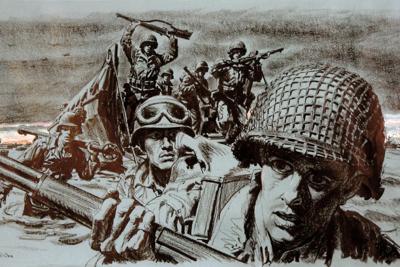
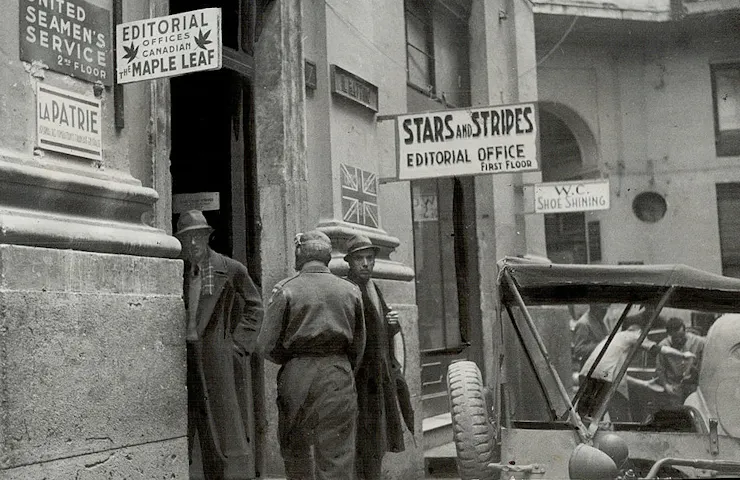
The newspaper, which is often simply called Stripes, has served overseas military forces and their families since 1918, with a 23-year break between World War I and World War II.
It has continuously remained in print since World War II, providing Americans serving overseas on American military bases everywhere from Okinawa to the Azores with news on topics ranging from high school football games to troop deployments.
When I was a reporter at Stars and Stripes in the late 1990s, I covered both the good and the bad from Bosnia and Kosovo during the NATO peacekeeping missions: the armed unit that doled out cash to Bosnians after the military ran over their farm animals; the soldiers who guarded a school so that the children of separate ethnic groups could attend together; and the military contractors who received no-bid contracts.
While some big stories are also written about in other news outlets covering the military, many of them are only discovered because Stars and Stripes’ civilian and military journalists work and live alongside service members in Europe, the Middle East and the Pacific.
It’s the very same premise behind good local newspapers: There’s little meaningful journalism about local issues without journalists who live and work in the communities they cover.
Stripes was able to provide the only eyewitness account of the negotiations that led to Germany’s surrender in 1945 because its reporter was in the schoolhouse in Reims, France, where Allied and German officials hashed out the terms.
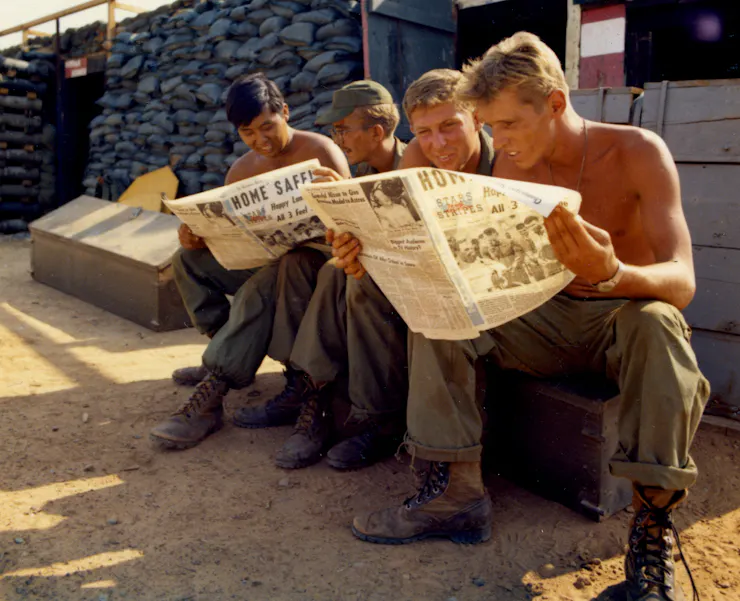
Stripes journalists were also on the front lines of the Vietnam War, with The New York Times describing Stars and Stripes as the only military information outlet giving American troops in Vietnam a candid account of the war’s progress.
More recently, a Stripes reporter based in Bahrain was able to report how U.S. military families were experiencing Iranian drone attacks in Manama, which hosts the headquarters of the U.S. Navy’s Fifth Fleet. She was able to report on the attacks firsthand because she was right there, evacuating alongside them.
Reporters clash with the Pentagon
It was another Stars and Stripes journalist who first reported on the problems aboard the USS Abraham Lincoln in July and August 2026.
The aircraft carrier was in the midst of an exceedingly long deployment due to the U.S.-Iran war. There had been food and water shortages, disrupted mail service and long, grueling workdays with little time off. Some sailors were experiencing mental health struggles, and at least one jumped overboard.
The reporter, Alison Bath, who is based at the headquarters of the U.S. Navy’s Sixth Fleet in Naples, Italy, had interviewed active-duty sailors and family members of sailors aboard the ship. She explained how she had reviewed “dozens of public social media comments and posts by crew members.”
Bath’s story and the follow-up accounts from other media outlets clearly angered Hegseth, who said it “completely misrepresented” the situation.
The media frenzy over the USS Lincoln largely overshadowed the work of another Stripes journalist, Lara Korte, who reported on the hardships, confusion and financial costs endured by military families who had to suddenly evacuate from U.S. Central Command headquarters in Bahrain starting on March 2, 2026.
Like Bath, Korte had interviewed several military family members, one of whom shared with Korte the audio recording of a virtual town hall meeting that the military held for the families. A Navy admiral said on the recording that the military “was in uncharted territory” and had little guidance for families who didn’t know where to live or how to retrieve their cars and belongings.
Though the Pentagon didn’t dispute Korte’s reporting, she was fired for “insubordination” alongside the editor-in-chief, Erik Slavin, and publisher, Max Lederer, on Aug. 21.
Bath is still employed by the paper.
You can’t manufacture credibility
Unlike most shuttered or shrunken news outlets whose advertising model was upended by the internet, Stars and Stripes has long been shielded from market forces thanks to a subsidy from the Department of Defense that covers roughly half its budget.
While this funding could be seen as anathema to journalistic independence, the U.S. government has mandated since the 1950s that the paper have editorial freedom.
Even before then, U.S. military leaders protected the newspaper’s independence. Gen. John J. Pershing, who commanded the American Expeditionary Forces in Europe during World War I, and Gen. Dwight D. Eisenhower, who commanded Allied forces in Europe during World War II, each ordered military commanders not to interfere with the newspaper. So did Navy Adm. John S. McCain Jr., father of the late Sen. John McCain and the commander‐in‐chief of U.S. Pacific Command during the Vietnam War.
That’s not what’s happening under the Trump administration.
In March 2026, the Pentagon instituted new guidelines requiring that Stripes content be “consistent with good order and discipline of the military.” The following month, the department fired Jacqueline Smith, the newspaper’s ombudsman charged with protecting its editorial independence.
Chief Pentagon spokesperson Sean Parnell described the moves as part of an effort to “refocus” the outlet away from “woke distractions that siphon morale.”
There’s always been a struggle between military leaders who want to control the reporting at Stripes and those who recognize that freedom of the press is exactly the kind of right that the U.S. military fights for.
Many current and former military commanders see a real benefit in the outlet’s editorial independence because of the values it communicates and the information it provides
Retired Army Lt. Gen. Mark Hertling is one such supporter. In an Aug. 25, 2026, article in The Bulwark website, he described the ways in which he relied on the newspaper’s reporting when he was a commander in Europe.
“Every major military command has an extensive communications apparatus,” Hertling wrote, “but none of those organizations can manufacture credibility. Credibility comes from readers believing that when something goes wrong, somebody will tell them. That’s why Stripes’ early reporting on the USS Abraham Lincoln was so important.”
Public media only works with no strings attached
On Aug. 27, the fired publisher, editor and reporter filed a lawsuit against Pentagon spokesman Sean Parnell, the Defense Department, Defense Secretary Pete Hegseth and another public affairs official, Andrew Brey, alleging that they were fired in retaliation for news coverage that was unflattering to the military. The suit argues that this violated both their protected rights to free speech and Department of Defense policies and regulations.
The department hasn’t specifically responded to the allegations, but it did agree to a one-week reprieve of paid administrative leave as a federal judge considers the lawsuit.
The three journalists are being represented by the same legal team that represents the fired former employees of Voice of America, another government-funded news source that the Trump administration attempted to dismantle in 2025. Like Stripes, Voice of America received government funding even as it sometimes reported unfavorably on the government. And like journalists at Stripes, Voice of America reporters have died doing their jobs.
But despite the Trump White House’s unrelenting attacks on public, nonprofit and for-profit media outlets, the government funding model is having some success at the state level. The organization Rebuild Local News estimates that states will spend US$74 million supporting local journalism in 2026 via fellowships, media training, tax credits and more.
While the group’s leaders say these initiatives demand constant scrutiny to ensure there’s no creeping government interference or political strings attached to the funds, many supporters of local journalism see promise in this model. Government funding for independent media has long existed in Europe, Australia, New Zealand and elsewhere. Some of these outlets are widely trusted by the public.
But that trust doesn’t come easily. It requires political and military leaders to repeatedly reaffirm the ideal of a free and independent press – even when the coverage doesn’t go their way.
This article is republished from The Conversation, a nonprofit, independent news organization bringing you facts and trustworthy analysis to help you make sense of our complex world. It was written by: Cindy Elmore, East Carolina University
Read more:
- Trump targets NPR and PBS as public and nonprofit media account for a growing share of local news coverage
- Clawback of
 .1B for PBS and NPR puts rural stations at risk – and threatens a vital source of journalism
 - As goes CBS Radio News, so goes the idea that news media should serve the public interest
Cindy Elmore was a reporter/photographer for The Stars and Stripes from 1996-2000.
