


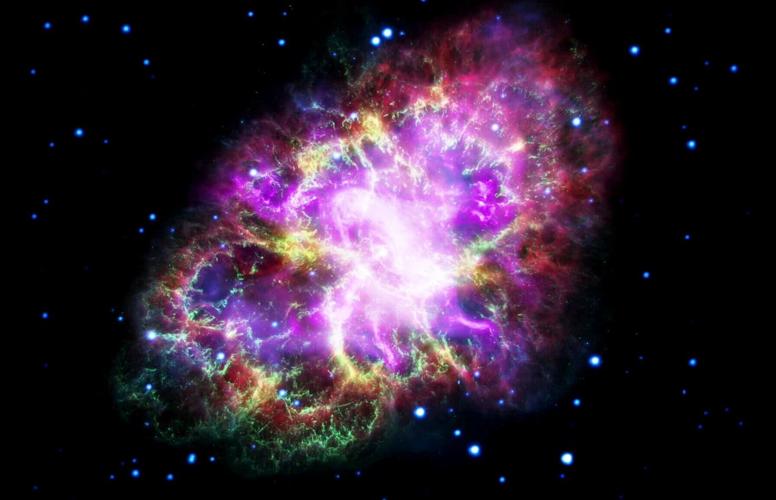



Crab Nebula in the Taurus constellation. (NASA / ESA / JDePasquale(STScI) via SWNS)
By Stephen Beech
A “forgotten” particle could answer the mystery of why we exist, say physicists.
A new theory on the birth of the cosmos has been unveiled, suggesting the early universe was shaped by an ancient particle that has been overlooked for decades.
The research, published in the journal Physical Review Letters, tackles one of the greatest conundrums in modern physics — how matter triumphed over antimatter in the aftermath of the “Big Bang”.
According to current theories, both should have annihilated each other after a colossal explosion — leaving nothing but an empty universe of pure energy.
But physicists at the University of Southampton and the Indian Institute of Technology Kanpur say they found a clue in a neutrino, one of the lightest particles in the universe.
The research team discovered that an often-ignored relative of the particles — known as a “decoupled” heavy neutrino — could have helped matter dominate over its counterpart.

Study author and University of Southhampton researcher, Dr. Rishav Roshan. (University of Southampton via SWNS)
Study author Rishav Roshan said: “This decoupled heavy neutrino has long been dismissed as an irrelevant background detail in particle physics.
“However, it decays incredibly slowly.
“As the cosmos cooled after the Big Bang, the particle lived long enough that it temporarily took over the energy density of the universe and triggered a matter-dominated period.”
Roshan, from the University of Southampton, says most theories on why matter won over antimatter ignored the decoupled heavy particle because experts deemed it too weak to have any impact on others.
However, the Southampton and Kanpur researchers found that the forgotten particle could affect the particle-antiparticle asymmetry essential for our existence.
Roshan said: “The fact that we are here at all proves that an asymmetry between matter and antimatter occurred.

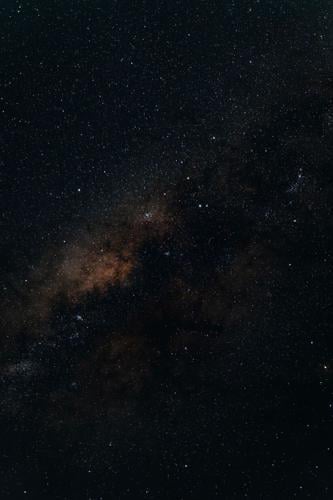
(Photo by Talha Resitoglu via Pexels)
“The decoupled neutrino shifted the temperature in the early universe at which fundamental particles — like electrons and other leptons — interacted with their antiparticles with the help of Standard Model Higgs boson.
“This temperature acts like a switch that shapes how the matter-antimatter imbalance was built up.”
Paper co-author Sudipta Show says the findings change our understanding of how the early universe expanded so quickly after the Big Bang.
He said: “It offers us a new explanation for how matter won.
“The dramatic shift in the early expansion of the cosmos leaves distinct but detectable imprints of changes, for example on primordial gravitational waves.”
Show, from the Indian Institute of Technology, added: “These gravitational wave signatures open up new avenues for us to unravel the evolution of the early universe after the Big Bang.”