


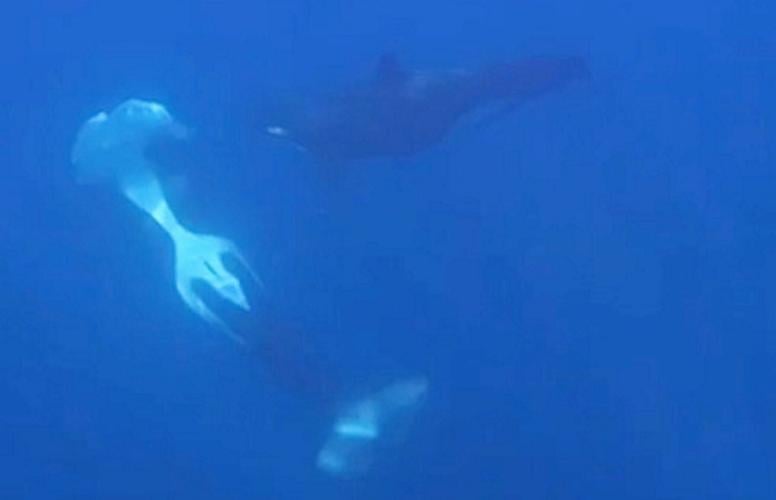
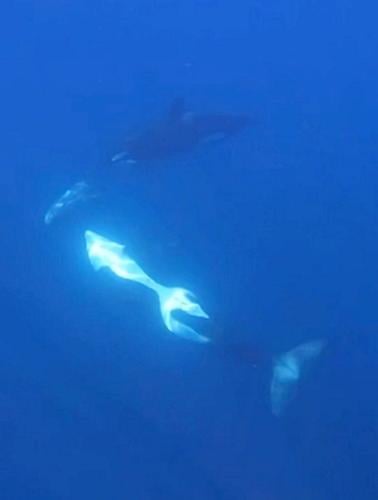
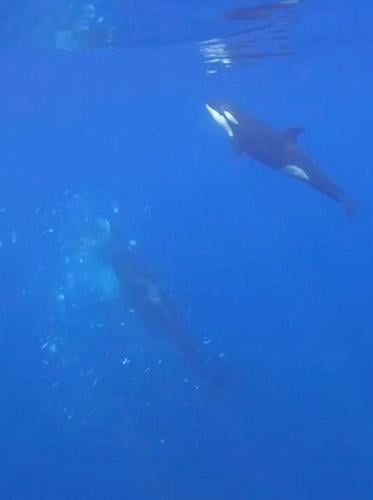
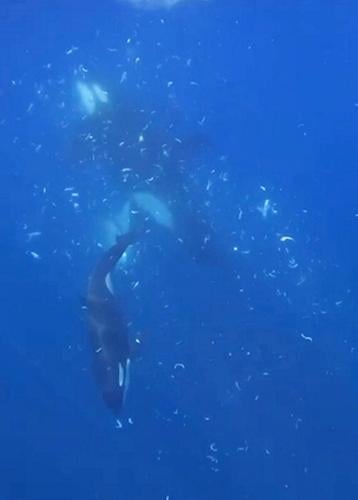

A group of orcas in the Gulf of California has been observed applying a hold-to-ram strategy to process a sharp-tail sunfish. (Kathryn Ayres via SWNS)
By Stephen Beech
Killer whales have been caught on camera ramming one of the world's heaviest fish so hard it exploded.
Scientists say the previously undescribed behavior by orcas in the Gulf of California may just be the apex ocean predators having "fun."
Orcas, or killer whales, are known to be smart and ruthless hunters.
They've been observed hunting a variety of prey, with some species — such as other whales — larger than them.
Orcas use a wide range of strategies to hunt and kill prey, but the "hold-and-ram" method observed in the Gulf of California had never been described before.
Study first author Kathryn Ayres said: "We document how one orca holds the sunfish and lets go just before another orca hits it at high speed, causing the tissue to break apart into thousands of pieces.
"We think this may help younger orcas feed more easily or it could also just be for fun.
"Orcas are known for playing with their food."
She said sunfish can grow over 3 meters (9.8 feet) long and weigh up to 2,000 kilograms (4,400 pounds).
They move through various depth layers but come to the surface to rest and thermoregulate — seek parasite removal.
But in surface waters they are vulnerable to attacks by predators.
In the Gulf of California, they are one of the species most commonly hunted and eaten by orcas.

(Kathryn Ayres via SWNS)
The current observations, published in the journal Frontiers in Ethology, are based on two independent hunting events that occurred a little more than one year apart.
In July 2024, Ayres observed how a group of orcas, including a juvenile, interacted with a dead sharp-tail sunfish, which they had killed previously.
A female orca held the sunfish by its large tail fin — an effective point of grip — while a male orca accelerated and swam toward both.
Shortly before impact, the female released the sunfish.
Ayres, of Beneath The Waves — a nonprofit organization promoting ocean health based in Boston, said the ramming caused the sunfish's tissue to fragment and float in the water.
The juvenile of the group then began consuming smaller bits of sunfish.
The adults fed on what remained of the body, but didn't consume the smaller fragments.
In September 2025, a similar event, filmed by Héctor Franz, followed the same hold-to-ram and feeding behavior.

(Kathryn Ayres via SWNS)
Ayres said: "The high-impact ramming behavior caused substantial disintegration of prey tissue.
"Ramming has not been previously described as a predation strategy by orcas.
"Both events suggest that the orcas followed a coordinated and cooperative strategy, with one orca stabilizing the carcass so the other could hit it more precisely.
"The sunfish were already deceased in both events, so the ramming is thought to be a processing technique rather than a means to deliver a killing blow."
She says the gelatinous layer that covers sunfish, known as capsule, and their skin host a distinct microbiome.
If the tissue is shattered, the microbial taxa inhabiting it are dispersed into the water where they alter the nutrient composition.
Ayres said: "Tissue fragmentation could therefore facilitate contact between sunfish and orca microbiomes, which could provide nutritional or other benefits, such as immune regulation."

(Kathryn Ayres via SWNS)
She says the observed behavior could be interpreted as a form of "parental investment" — dividing the carcass into more manageable pieces for the calf aligns with previously observed behaviors.
Ayres said: "Orcas often tear apart prey and share it with other members of the group, including calves and juveniles."
But she says that doesn't mean that the interaction could not also have served other social purposes: it could simply have been a game for the killer whales.
Ayres said it was unclear if the same orcas were involved in both events, highlighting the need for more high-quality footage — especially of orca's dorsal fins and eye patches — to be able to identify individuals.
She added: "Collecting good identification photographs whenever possible is key: we are still seeing new techniques of how orcas hunt and process their prey.
"They're one of the most iconic marine predators in the world, yet they continue to surprise us."