


Seeking to bring down Iran's Islamic republic, the United States and Israel could see a path by exploiting ethnic tensions, a strategy attractive to military planners but fraught with long-term risks.
Just over half of Iran's population is Persian, but the country of 90 million has seen less strife along ethnic lines than many of its neighbors, despite plenty of discontent against the clerical Shia government that cracked down ruthlessly on protests weeks ago.
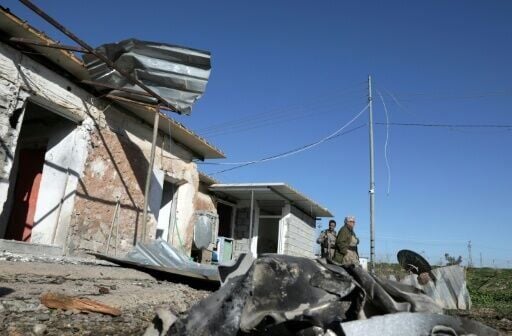
Since Israel and the United States attacked Iran on Saturday, killing supreme leader Ayatollah Ali Khamenei, Tehran has launched missiles and drones across the region and specifically targeted Iranian Kurdish groups across the border in Iraq.
One guard was killed in a strike on a camp Wednesday, Khalil Sanani, spokesman of the exiled Kurdistan Freedom Party, told AFP.
CNN reported Tuesday that the CIA was working to arm Iranian Kurdish forces with hopes of fomenting an uprising.
White House Press Secretary Karoline Leavitt called the story "completely false" but confirmed that President Donald Trump had spoken to Kurdish leaders.
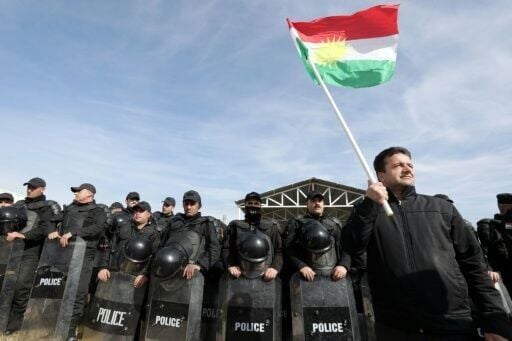
Iranian Kurdish fighters are attractive for the United States as "they really are the most organized segment of the broader Iranian opposition movement," said Mohammed Salih, a non-resident senior fellow at the Foreign Policy Research Institute's national security program.
Reza Pahlavi, the son of the late shah toppled in the 1979 Islamic revolution, has "brand recognition" but lacks an armed faction on the ground, Salih said.
"The direction that things seem to be taking in Iran is that the US and Israel seem to be really needing boots on the ground, in the absence of being willing to send in their own troops," Salih said.
Another option would be the People's Mujahedin Organization of Iran (MEK), an armed group known for rallies around the world and its aggressive courtship of Western politicians.
But the MEK was long considered a terrorist group by Washington and enjoys little support inside Iran, where it is reviled for allying with Saddam Hussein's Iraq during the devastating 1980-88 war.
- Opportunity for special forces -
Kurdish fighters could serve a similar function as Afghanistan's minority-dominated Northern Alliance in 2001 by creating a zone in which US special forces can operate, said Stefano Ritondale, a former military intelligence specialist.
A successful Kurdish offensive could also "enable a spreading of discontent" that overwhelms the Islamic republic, said Ritondale, now chief intelligence officer at Artorias, a global risk intelligence provider.
"What is interesting in the thought process from the administration is using the Kurds as an armed opposition to really challenge authority, and then causing a cascading effect where people go back out in the streets and protest," he said.
Kurds have allied with the United States for decades, with mixed results.
US support helped bring de facto autonomy to Kurds in Iraq and Syria. But Washington recently dropped support for autonomy by Syrian Kurdish fighters who battled the Islamic State group, as Trump backs the new government in Damascus.
Kurds, while mostly Sunni, share cultural and linguistic affinities with Persians and have historically had less friction with the Iranian state than with fellow Kurds in Iraq and Turkey.
Kurds make up about nine percent of Iran's population, while the largest minority group is the Azeris, a Turkic people near Azerbaijan, though they are highly integrated in Iranian society.
Khamenei was Azeri and President Masoud Pezeshkian is of mixed Azeri and Kurdish origin.
Other geographically concentrated minorities include Arabs, Turkmens and Baluchis, whose militants have waged a violent insurgency across the border in Pakistan.
- Fears on splitting Iran -
Some observers warn of deep risks to an ethnic strategy, which could set off new sorts of conflict.
A reliance on Kurdish fighters could also put the United States and Israel on a collision course with Pahlavi.
Just days before the US and Israeli attack, five Iranian Kurdish groups announced a joint coalition with the goals of "Kurdish self-determination" and toppling the Islamic republic.
Pahlavi accused them of threatening national unity and said "Iran's territorial integrity is the ultimate red line."
Arash Saleh, the US representative of one of the groups, the Democratic Party of Iranian Kurdistan, said his movement was seeking a federal Iran.
"We see ourselves as a kind of Iranian force that wants to keep the territorial integrity of Iran," he said.
"But we believe the best solution to keep this territorial integrity as strong as possible is to come up with some mechanisms so that all Iranians feel like they're the members of this country."
sct/js