


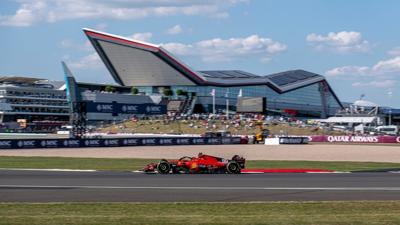


Charles Leclerc competes for Ferrari. Practice for the 2023 Formula 1 British Grand Prix
For four days each summer, a quiet stretch of Northamptonshire becomes Britain's largest temporary city. The historic British Grand Prix is projected to draw a record-shattering 570,000 fans over four days this year, eclipsing last year's total of 500,000.
Like the legendary British music festival Glastonbury, the Grand Prix abruptly transforms a quiet patch of the English countryside into a sprawling, rain-or-shine pop-up city. It is an authentic, grit-meets-glamour British experience where elite international hospitality sits alongside 60,000 campers trudging through mud in waterproof ponchos.
The event features massive nightly concert stages headlined by global music acts, turning a sporting event into a full-scale music and entertainment festival. But as the grid expands, so does the logistical headache for attendees attempting to navigate a rural English countryside entirely consumed by the largest event on the F1 calendar.
With ticket prices skyrocketing—average general admission tickets have surged 123% since 2019—the battle to watch the world’s fastest cars is now won or lost weeks before the lights go out on the Hamilton Straight. Racegoers are no longer just fighting for grandstand seats; they are employing automated digital software just to secure a hotel room.
“Hundreds of users are setting up automatic website monitors on hotel pages around Milton Keynes and Towcester the moment their tickets are confirmed, watching for price drops and last-minute room releases as the July race weekend fills up,” said Serge Salager, CEO of website monitoring platform Visualping.
According to Salager, desperate fans are tracking everything from the on-track Hilton Garden Inn to the official F1 ticket pages, where unexpected “Mystery Seats” can drop at a moment’s notice. “Airlines and hotels algorithmically update prices constantly… if you aren’t monitoring, you’re essentially playing a slot machine with your budget.”
The intense demand has triggered a 15% year-on-year increase in all-inclusive travel packages, forcing a stark divide between the traditional trackside camper and a new wave of high-net-worth spectators. While budget-conscious travelers deploy technology to find affordable rooms, another segment of the audience is taking the opposite approach entirely.
“The savvy move is basing just outside the immediate circuit zone,” advises Michelle Zelena, founder of luxury travel advisory Zelena Travel. Zelena notes that the handful of properties closest to the track sell out a year in advance while tacking on heavily inflated minimum-stay rates. Instead, high-end clients are opting for boutique country houses like Fawsley Hall or The Langley in Buckinghamshire, trading a 45-minute drive for fine dining and spa amenities.
The window to secure these premium spots, however, is notoriously narrow. “Even when we locked in a client this past February for a summer race, inventory was already tightening,” Zelena adds. “Near the circuit, it disappears faster than almost any UK event outside Wimbledon, and prices only climb the longer you wait.”
Yet, once travelers arrive in Northamptonshire, they hit the ultimate equalizer: brutal, gridlocked traffic. On race weekend, local roads become completely saturated.To move this half-million-strong pop-up city, the circuit must deploy an armada of 600 double-decker buses for park-and-ride schemes.
For industry insiders and corporate partners, bypassing the bottleneck has become a multi-thousand-dollar necessity.
“Helicopter transfers cost around $1,800 round trip from London. I've seen corporate clients save 4 hours doing it,” said Thomas Oldham, founder of WebMotion Media and a frequent trackside operator. “It sounds ridiculous, but it works.”
For those on the ground, experts warn against treating the event like a typical stadium experience. Walking distances from the outer parking lots to the grandstands often exceed 30 minutes, and the temperamental British summer makes heavy downpours a perennial threat.
“Traffic is the thing people underestimate,” warns Fabien Champroux, CEO of Chauffeurs & Services, who manages high-touch transfers during the Grand Prix. “Keep a dedicated chauffeur for the whole stay instead of arranging cars trip by trip. That is what makes the difference between watching the race and watching the traffic.”
The changing landscape of the event also reflects F1’s evolving fanbase. Driven heavily by the sport’s modern digital boom, female attendance at Silverstone has soared to an unprecedented 43% of overall sales. At the circuit’s expanded, 20,000-capacity “Landostand”—dedicated to British driver Lando Norris—women now make up more than half the crowd.
The weekend ultimately pours an estimated $126 million USD into the local economy. But as single-day race tickets clear the $400 USD mark and regional hotel prices spike by 40% after January, the British Grand Prix is a prime example of F1’s modern paradox: an unforgettable sporting spectacle that requires military-grade planning—and a deep wallet—to fully survive.