

(RICHMOND, VA) This article contains spoilers from popular horror movies and shows.
Imagine you’re in the movie theater watching 2018’s “Hereditary.” During one of the film’s most unsettling sequences, the main character, Peter, wakes up in bed disoriented. As he sits up, you hear a couple of gasps from others in the audience. The camera stays locked on Peter as he moves through his house and enters the dim living room.
You hear it again: more gasps. The lighting is low, a droning score builds tension, and your heart rate climbs. The people around you continue to audibly react. You haven’t seen anything scary yet, so what is everyone else responding to?
The camera slowly pulls back, and then you see her: Annie, Peter’s possessed mother, crouched on the ceiling in an unnatural way.
Watch the scene again and you might notice that Annie was in the shadows on the ceiling the whole time, following Peter through the house.
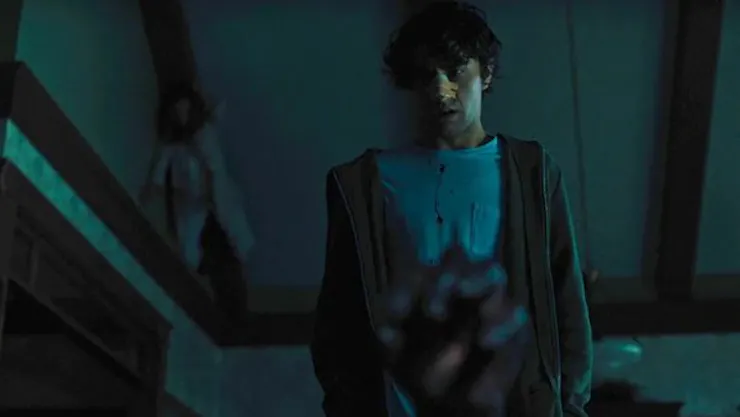
How could you have missed a human being on the ceiling, in plain view?
As a cognitive psychologist who studies visual perception, I’ve noticed that horror movies often exploit the gap between what’s in front of your eyes and what you consciously see. Directors and cinematographers act like folk cognitive psychologists, intuitively drawing your attention exactly where it needs to be to create a scare.
Directing your attention
Horror movie fans have pointed out numerous examples of spooky figures and other unnoticed details in the background of scenes.
These blind spots exist because your visual system can’t process everything in a scene at once. You extract detailed information only from wherever your attention is directed. Anything outside the spotlight of your attention may go unnoticed, no matter how strange.
Inattentional blindness is the failure to notice something in plain view because your attention is engaged elsewhere; it’s the phenomenon behind the infamous invisible gorilla experiment, in which about half of participants busy counting basketball passes failed to notice a person in a gorilla suit strolling through the middle of the game.
Horror leans on inattentional blindness frequently, from the ghost boy in “Insidious” to the background ghosts scattered through Netflix’s “The Haunting of Hill House.” Something is plainly visible, though you often don’t notice it until a rewatch, and this delayed discovery can make the scene even creepier.
A related effect, change blindness, is the failure to notice something changing right in front of you. The difference can be as simple as a shirt color, or something drastic like the possessed girl Janet in “The Conjuring 2” morphing into an old man during her interview with Ed Warren. The camera stays on Ed while Janet sits slightly blurred in the background, making the transformation easy to miss until she abruptly changes back.
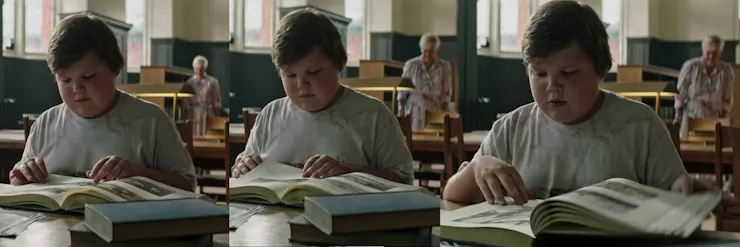
Directors also steer your attention to set up a scare, pulling your focus away from something creepy, or putting it in exactly the right spot just before a jump scare.
Eyeline match is a perfect example of this strategy. In “The Conjuring,” a girl sits up in bed, her fearful eyes fixed upward. The film cuts to reveal she’s staring at the ghost Bathsheba, crouched atop a wardrobe.
This editing technique works because it’s similar to something your visual system does: When someone near you looks sharply in one direction, your eyes follow automatically. Psychologists call this tendency gaze cueing, a reliable effect in attention research. Editing just mimics the real-life version to create tension, which resolves the moment you finally see what the character sees.
Sometimes directors do the opposite, giving your attention nothing to follow at all. The opening sequence of “It Follows” is a wide shot of a panicked girl running in and out of her house. With no eyeline or cut to guide you, the wide framing forces you into visual search, scanning corner to corner for a danger that may not even be there yet. Will something appear in a window? Follow her out the door? The uncertainty and the search build the tension.
The split between detecting and identifying
Your visual field isn’t equally good at everything: Some parts of your visual system perform the initial detection, others identify what was detected. For example, the fovea, a tiny pit in the retina that processes the spot you’re looking directly at, contains photoreceptors called cones that process fine detail and color.
Beyond that central spot is your peripheral vision, dominated by photoreceptors called rods that are sensitive to motion and low light rather than detail. In a sense, your peripheral vision is set up to help you quickly answer the question “Did something just move?”
When there’s motion at the edge of your vision, your peripheral system detects it almost instantly. Your eyes make a saccade – a rapid eye movement – to place the fovea onto the target to identify it. That gap between detecting and identifying can create a feeling of unease because something registered, something is there, but you can’t yet say what.
Playing with peripheral vision is almost a trope in horror movies now. Think of any hallway or mirror scene where you’re focused on a character and something moves behind them, grabbing your attention before you can figure out what it is.
Faces where there are none
Human beings evolved to quickly detect, identify and respond to potential threats, such as moving animals. That’s one reason vision is so sensitive to detecting movement.
It also explains why people are prone to pareidolia: the human bias toward detecting faces even where none exist. Have you ever seen a face in your curtains or toast? Missing a real face is potentially far costlier than perceiving a fake one, so our brains likely evolved to respond even to patterns that vaguely resemble faces.
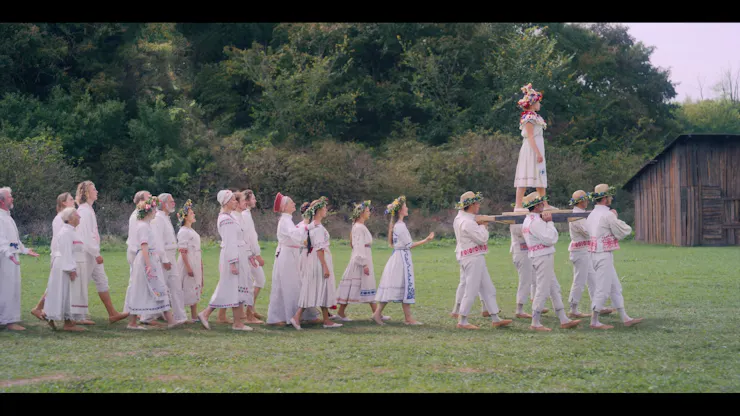
“Midsommar” exploits pareidolia directly. As Dani is carried toward the feast after her crowning as May Queen, viewers have noticed a face in the trees. “The Night House” uses a similar trick, where ambiguous object configurations resolve into figures and faces that capture your attention. The 1963 film “The Haunting” does the same with a wall pattern during a particularly creepy scene.
Directors decide what you get to see and what they leave hidden, from ambiguous shapes to sudden movements to shadowy figures in the background. They seem to understand how your visual system works, and they use this knowledge to create tension in that space between perception and recognition, as your brain tries to determine what, exactly, you’re seeing.
This article is republished from The Conversation, a nonprofit, independent news organization bringing you facts and trustworthy analysis to help you make sense of our complex world. It was written by: Arryn Robbins, University of Richmond
Read more:
- ‘Teenage Sex and Death at Camp Miasma’ winks and blows a blood‑soaked kiss at horror films of queer past
- AI‑generated images can exploit how your mind works − here’s why they fool you and how to spot them
- Why is it fun to be frightened?
Arryn Robbins does not work for, consult, own shares in or receive funding from any company or organization that would benefit from this article, and has disclosed no relevant affiliations beyond their academic appointment.
