


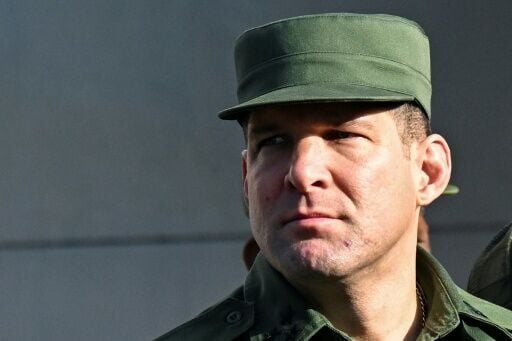
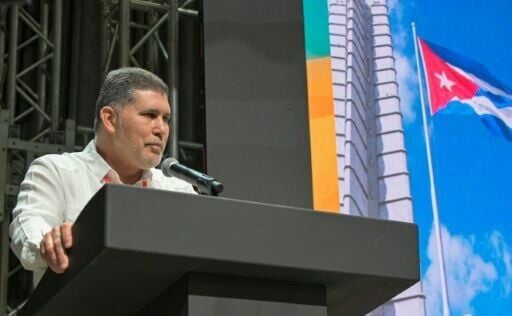
A new cast of Castros is emerging in Cuba: a grandson and a great-nephew are moving up the corridors of power, while another is an eccentric Instagram influencer declaring that Cubans want capitalism.
US President Donald Trump's administration is putting pressure on Cuba, demanding change and restricting oil exports to the country, but the Castro dynasty still holds sway on the communist-run island.
Raul Guillermo Rodriguez Castro, a colonel and grandson of 94-year-old former president Raul Castro, has reportedly taken part in recent talks with US officials.
Oscar Perez-Oliva Fraga, the son of Fidel and Raul Castro's elder sister, was promoted to deputy prime minister in October.
And then there's the wildcard: Sandro Castro, a 34-year-old bar owner and grandson of late Cuban revolution leader Fidel Castro.
With almost 160,000 followers on Instagram, he posts satirical videos about Cuba's blackouts and other hardships.
He caused a stir last week when he told CNN, with beer in hand in his Havana apartment, that President Miguel Diaz-Canel "is not doing a good job" and that "the majority of Cubans want capitalism, not communism."
State media commentators have criticized him while Cuban exiles see him as the face of a privileged elite in a nation where the average salary is 6,680 pesos (around $14) per month.
In a recent video, the sunglass-wearing Castro interacts with a Trump impersonator, who tells him he wants to buy Cuba.
The sketch was posted the day Diaz-Canel confirmed talks between US and Cuban officials had occurred.
Lillian Guerra, a professor of Cuban history at the University of Florida, said Sandro Castro was part of a "well-staged and seductive" plot to convince the US public that the Castro regime is not a threat.
"The Cuban state has always been a spectacle state," Guerra told AFP. "Half of their energy if not more goes to creating distractions and false narratives."
Andres Pertierra, a historian at the University of Wisconsin, said he did not think that Sandro Castro was a distraction but that he should also not be taken "as seriously as someone who has a more senior role in the government."
Contacted by AFP on Instagram, Sandro Castro referred an interview request to his "manager," who did not reply. On CNN, he described himself as just "another citizen."
- A serious contender? -
While Sandro Castro courts online audiences, his older relatives occupy more prominent roles.
The presence of Raul Guillermo Rodriguez Castro, who is his grandfather's bodyguard, on the front row when Diaz-Canel disclosed the US-Cuba talks raised eyebrows as he holds no official government title.
According to US media, the man known as "Raulito" and "El Cangrejo" (which means "The Crab" -- his nickname for being born with six fingers on one hand) has acted as a messenger in the negotiations.
But it is the rapid rise of Perez-Oliva, 55, that has fueled speculation about a possible leadership shuffle.
"Perez-Oliva seems like a much more serious contender for a new generation who is linked to the family and probably has their trust, but at the same time has the benefit of not having the (Castro) surname," Pertierra said.
He was named foreign trade minister in 2024 and, a year later, deputy prime minister. Perez-Oliva was also elected to the National Assembly -- a prerequisite to becoming president.
Last month, he appeared on US broadcaster NBC News to reveal government plans to allow Cubans living abroad to invest on the island.
But US Secretary of State Marco Rubio said it was not enough, insisting that both economic and political change are needed.
- Here to stay? -
The emergence of the younger Castros amid US tensions raises questions about the future of Diaz-Canel, who succeeded Raul Castro in 2018.
Raul Castro remains an influential figure, with Diaz-Canel himself acknowledging that the "historical leader of the revolution" was guiding the US talks.
The Cuban state has "different fiefdoms" and "the top fiefdom is that of the Castro family to this day," said Ricardo Herrero, executive director of the Cuba Study Group, a Washington-based nonpartisan policy group.
The New York Times reported last month that Trump administration officials were seeking to push Diaz-Canel from power during the talks.
But Washington was not, as yet, pressing for any action against Castro family members, the Times said.
Rubio dismissed the article as "fake."
"I don't think the Cuban government can jettison Diaz-Canel without it being kind of a humiliating process that would be bowing to the United States," Pertierra said.
"The Castros are going to be playing some kind of role in the Cuban political system for a very, very long time, even when the Castros don't necessarily have the surname Castro anymore."
lt/sla