


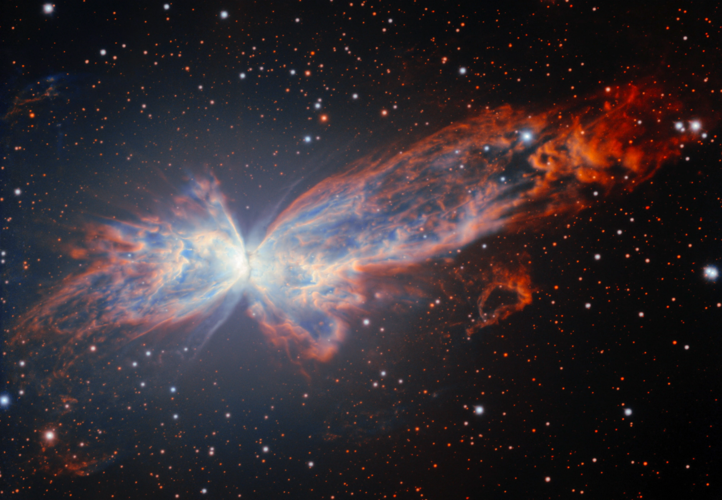




(NOIRLab/NSF/AURA/T. Matsopoulos via SWNS)
By Dean Murray
Astronomers have revealed a cosmic butterfly to mark 25 years of a powerful space telescope.
Students voted for the Gemini South telescope in Chile to image NGC 6302, a billowing planetary nebula, to celebrate the completion of the International Gemini Observatory.
The International Gemini Observatory is partly funded by the U.S. National Science Foundation (NSF) and operated by NSF NOIRLab.
NSF NOIRLab said: "The glowing 'wings' of the Butterfly Nebula appear to be bursting out of the interstellar medium in this image.

(NOIRLab/NSF/AURA/T. Matsopoulos via SWNS)
"You may notice, though, that the Butterfly Nebula does not resemble a round planet, but instead a winged creature caught mid-flight.
"The formation of this unique structure is driven by a star at the nebula’s center that is casting off layers of gas and dust as it nears the end of its life."
"As the star continued evolving, it unleashed a powerful gust of stellar wind that tore through the ‘wings’ at more than three million kilometers per hour (1.8 million miles per hour).
"Interactions between slow- and fast-moving gas further texturized the ‘wings’ into expansive landscapes of cloudy ridges and pillars."
The Gemini South telescope is located on Cerro Pachón mountain in the Chilean Andes, at an elevation of over 2,700 meters (8,900 feet).