



(Brian Engh via SWNS)
By Stephen Beech
The discovery of a "botanical Pompeii" has rewritten a long-held theory that flowering plants only flourished after the dinosaurs.
The "unique" fossil find shows they were in fact blooming 10 million years before dinosaurs were wiped out, say American scientists.
They explained that the plant fossils found in volcanic deposits in New Mexico contradict the common narrative that flowering plants were minor players in Earth’s forests until the extinction of the dinosaurs 66 million years ago.
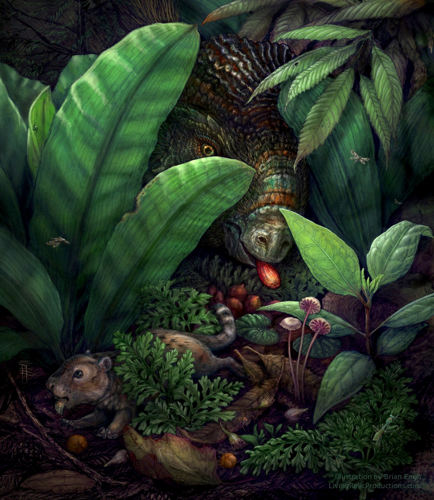
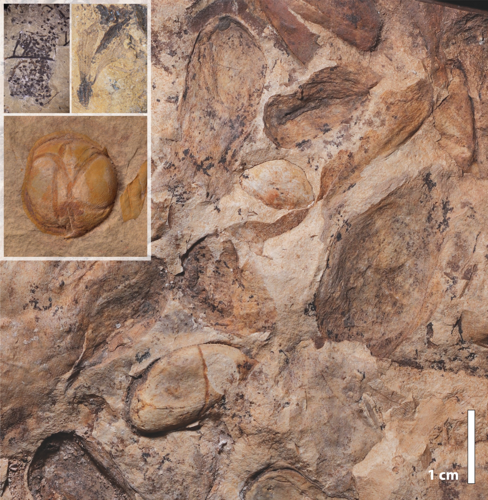
Based on analysis of large seeds buried under volcanic ash around 74.6 million years ago — nearly 10 million years before a catastrophic asteroid impact wiped out dinosaurs — researchers reconstructed a thriving, mature forest dominated by flowering plants, many of which produced relatively large and fleshy fruits, or diaspores.
They say the new discovery, published in the journal Science, calls into question the view that flowering plants, or angiosperms, only took over the planet in the wake of the dinosaurs’ extinction.
Following their demise, mammals such as rodents and bats made it energetically favorable for plants to produce large, fleshy fruits which mammals could help disperse.
Study lead author Jaemin Lee, of University of California, Berkeley, said: “Our results show that, at least in some hot and humid environments during the Late Cretaceous, well before the extinction boundary by 10 million years, angiosperms were already investing more resources into individual diaspores and forming dense forests.”
He says flowering plants arose about 135 million years ago in the Early Cretaceous period and were initially small, weedy and inconspicuous, producing small seeds that dispersed unassisted or with a slight wind.
The old theory was that by the Late Cretaceous they had already diversified their size, leaves and flowers, but in the shadow of the dinosaurs, the way they dispersed their seeds didn't change.

(CindyLooy/JaeminLee/UC Berkeley via SWNS)
Contradicting that scenario, the newly discovered ancient fossilized forest includes large-trunked flowering trees, such as laurel relatives and palms, and a diversity of other flowering plants.
The research team says that, unlike other Cretaceous floras where angiosperm diaspore size, on average, were comparable to a poppy seed, the average diaspore size in the fossil forest is comparable to a large blueberry, showing over a hundred-fold increase in volume.
Berkeley Professor Cindy Looy says the New Mexico site is "unique" in capturing an ancient environment at a single moment in time, when an ashfall buried an inland forest.
She says most fossil plant sites consist of material that ended up in lake, river or coastal sediments, which are conducive to fossilization but often represent a mash-up of material from different times and habitats.
Looy says: “This ash came down within days, because ash doesn't stay in the air very long.
"It's really a snapshot in time.
“At the base of the solidified ash layer you can still find ground cover plants.
"And then a little bit higher up you just see leaves in all kinds of orientations because they were brought down by the ash.”
Lee, a doctoral student, added: “You can think of it as like a botanical Pompeii, where ashfall deposits preserve everything in position and we can reconstruct the forest structure.
“These diaspores are preserved together with various leaves and flowers, brought from the canopy down to the forest floor, by the ashfall.”
The solidified ash deposit, referred to as Dori’s tuff, is about three-quarters of a mile long and part of the Jose Creek Formation in New Mexico.
While dinosaurs — including a large Tyrannosaurus species — have been discovered in the area, Dori’s tuff is best known for its abundant fossilized plants.
Other fossil sites from the Late Cretaceous led scientists to believe that many angiosperms were still low growing, formed open vegetation, and produced small seeds that were dispersed without assistance.
One theory was that dinosaur disturbances, such as trampling, kept angiosperms from forming dense forests and suppressed the evolution of mammals that eat and disperse diaspores.

Photo by David Correa Franco via Pexels
But the research team found that the tuff contained large fruits from flowering trees — many of which formed the canopy, based on the remains of fossilized trunks — growing alongside mature conifers.
Lee said: “This is the first record of pretty sizable fruits and seeds at the assemblage level — with a total of nearly 80 distinct types including several forms reaching about an inch in length — in the Cretaceous.
"This suggests that plant-animal interactions and the formation of angiosperm-dominated dense forests likely evolved before the end-Cretaceous extinction and subsequent ecological restructuring."
Looy said: “That animals were eating large fleshy diaspores during that time is not a surprise because other seed plants, such as ginkgos, were already producing them and had been for a very long time.
“This fossil flora suggests that these animals were already moving over to eating bigger seeds produced by angiosperms 75 million years ago.
"This is a surprise, because people thought they didn’t exist yet. And here they are.”
Lee said: “We still don't know what drove the initial rise in angiosperm diaspore size.
“It was probably multifaceted ecological factors, and different groups of angiosperms may have developed larger diaspores for different reasons.
"But at least now we know that it wasn't the end-Cretaceous extinction and the following emergence of more modern groups of frugivores that led to the diversification of angiosperm reproductive strategies.
"This gives us a new view of the evolutionary ecology of angiosperms that represent 90% of today’s land plants, and their potential ecological interactions with animals before the age of the mammals.”
He added: “The instantaneous preservation of everything, just with the minimal transport from the forest canopy to the bottom — really enabled the reconstruction of landscape in high detail.
"It's bringing more light into the complexity of ecological interactions in groups that we no longer have.”