


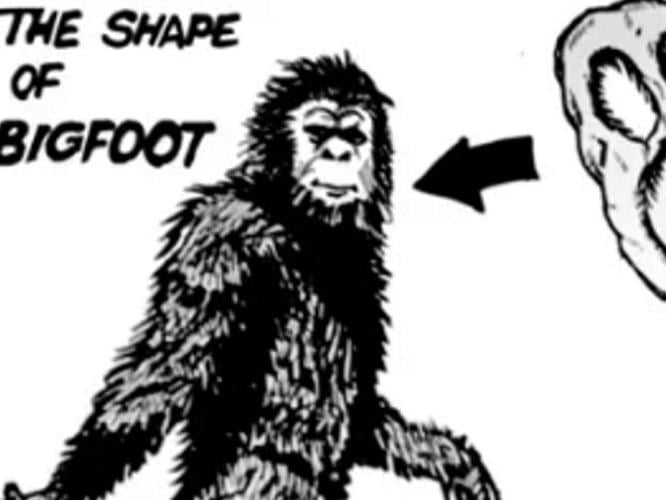




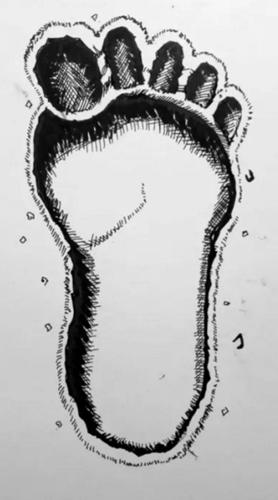
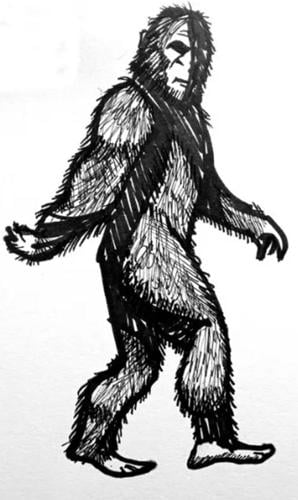
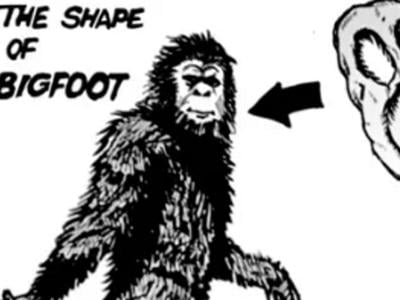

Illustration of Bigfoot, which features in the book. (Mike Roberts via SWNS)
By Stephen Beech
Bigfoot hunters are employing state of the art technology as they bid to solve one of the world's greatest mysteries.
They are using sophisticated techniques for collecting and validating evidence, drawing on scientific methods to try and prove the mythical beast's existence.
Bigfoot has long been depicted as a large ape-like creature, standing up to 10ft tall, with a barrel chest.
It is usually reported as being covered with thick, coarse, dark hair, and having a relatively small, conical head, and long, powerful arms as well as the iconic large feet.
Sightings have been reported across continental North America, with the greatest concentration in the forests of the Pacific Northwest of the United States and Canada.

Illustration of Bigfoot, which features in the book. (Mike Roberts via SWNS)
Evidence claiming to support the existence of Bigfoot includes hundreds of witness statements as well as grainy photographs and video, plaster casts of footprints and recordings of unexplained sounds.
Research suggests that the number of North Americans who believe in Bigfoot is growing.
Now people trying to prove the creature is real - known as "Bigfooters" - are turning to technology to aid their quest, the author of a new book on the phenomena has discovered.
Dr. Jamie Lewis, from Cardiff University School of Social Sciences, spent three years conducting more than 150 interviews with Bigfooters and those interested in the creature, also known as Sasquatch.
He says Bigfooters are members of a "passionate" community of cryptozoologists, with many going to great lengths searching for evidence of a creature which has never been confirmed by conventional science.
Working with Sheffield University's Dr. Andrew Bartlett, Dr. Lewis has used the interviews to explore the ways in which Bigfooters make and contest mainstream knowledge claims.

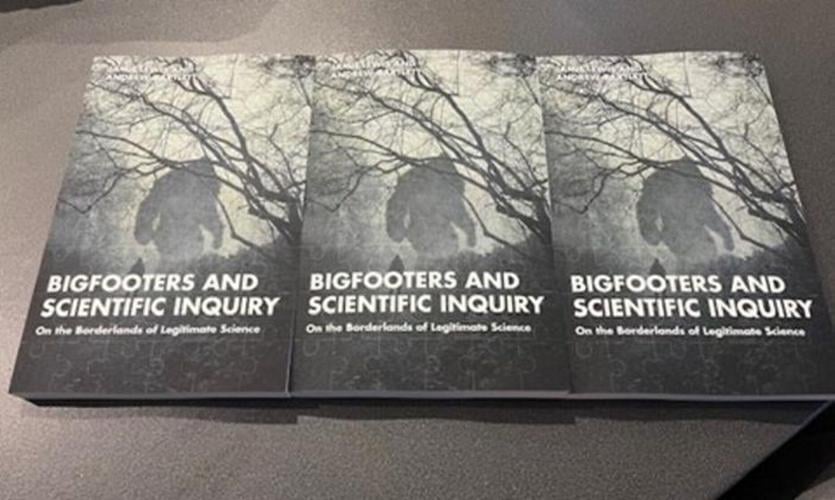
Cover of the new Bigfoot book. (Cardiff University via SWNS)
Among those interviewed were leading primatologist Dr. Jane Goodall, who died last month, anthropologist Professor Jeff Meldrum and Professor Todd Disotell, plus Canadian survival expert Les Stroud.
The presenters of "Finding Bigfoot" – Matt Moneymaker, James ‘Bobo’ Fay and Cliff Barackaman - were also interviewed as well as Ronny LeBlanc and Bryce Johnson, from the TV show Expedition Bigfoot, and Peter Byrne who was heavily involved in early Bigfoot and Yeti expeditions.
Dr. Lewis said: “As a sociologist of science, I’m really interested in the ways that ordinary people create knowledge, using scientific rhetoric and technologies in attempts to prove their theories.
"As well as drawing from scientific practices, Bigfooters use a suite of modern technologies such as drones, thermal imaging, and parabolic dishes in their investigations.
“They spend weekends, weeks, and even months in the field.
"This work is skilful behaviour, as they need to detect, collect and analyse the merest traces, remnants and residues of the presence of an unknown-to-science animal.

Illustration of Bigfoot, which features in the book. (Mike Roberts via SWNS)
"Sceptics might believe that Bigfooters are rejecting science by chasing an animal whose existence has never been proved.
"But what my interviews showed were the ways in which Bigfooters draw on their idea of scientific practices to piece together fragments of what they believe is tangible evidence.
“They might find what they believe is a footprint, or a disturbed areas of woodland understood to be characteristic of a Bigfoot having passed through, or hear a sound that they argue can’t be explained as being that another animal.
"It’s around these absences that many Bigfooters structure their arguments.”
Though a minority of Bigfooters believe that Bigfoot is extra-terrestrial, other dimensional, or supernatural in origin, Dr. Lewis says the overwhelming majority believe that it is a biological creature which simply needs formal discovery and classification.
Dr. Lewis and Dr. Bartlett were most interested in that group of Bigfooters - known as “the Apers” - as they are making claims that are, in essence, compatible with mainstream science.
Dr. Lewis became interested in Bigfoot during lockdown, when time at home allowed him to watch some of the many Bigfoot documentaries and ‘reality’ programmes.
Intrigued by their approach to collecting evidence and making knowledge claims, he began contacting Bigfooters who, he found, were eager to share their experiences.

Illustration of Bigfoot, which features in the book. (Mike Roberts via SWNS)
He and co-author Dr. Bartlett’s findings are recorded in their new book, "Bigfooters and Scientific Inquiry: on the borderlands of legitimate science."
Dr. Bartlett said: “For this work, we adopted a stance that we jokingly call, ‘methodological credulity’, but the point behind that is serious.
"If we are to understand how people outside of the institutions of science attempt to collect evidence and make knowledge claims – and this applies much more widely than just to Bigfooting – we are not going to get very far if we dismiss their efforts a priori.
“In taking the time and care to understand their knowledge world and their rationality, we can see just how much their activities are not ‘anti-science’ but an attempt to be scientific as they see it.
"Some of the problems that we face in this moment – in which all kinds of knowledge claims are contested in public, by the public – is that the asocial, individualised stories that we tell about science downplay the role of communities of expertise, of the value of consensus and continuity; they promise, or perhaps demand, that each of us can engage directly with evidence and to judge things for ourselves.”
Dr. Lewis added: “Bigfoot exists.
"Not necessarily as a biological creature, but certainly as an object around which thousands of Americans organise their lives, collecting and analysing evidence, and making knowledge.
"The idea of Bigfoot has captured the imaginations of people for decades.
"Prominent and passionate Bigfooters generously gave their time for interviews, explaining their motivations, methods and beliefs about the creature’s existence.
"We are extremely grateful for their contributions.”