


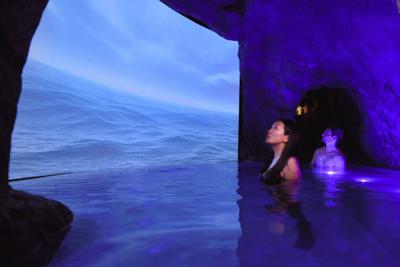
Situated in the coastal rainforest near Courtenay, the Healing Caves guide guests through a 90-minute timed circuit of dimly lit grottoes. Water, extreme temperatures, massive LED projections of natural wonders, aromatherapy, and mineral-rich pools create a “wellness-art-tainment” journey that promotes detoxification, circulation, immune support, and deep relaxation.
“We’re incredibly proud of the impact this experience has had on our guests, who have eagerly embraced a new wellness journey following two decades of our renowned Hydropath, said Inès le Ricque, Marketing Manager at Kingfisher Pacific Resort & Spa.
“What began as a vision to create a guided, sensory-rich wellness circuit has become a meaningful ritual for so many—one that invites true release, restoration, and presence. This milestone is a celebration of innovation, intention, and the trust our visitors place in us to redefine experiential wellness.”
Complementing the resort's established Pacific Mist Spa hydrotherapy paths, featuring hot-cold Kneipp circuits, the Healing Caves exemplify a hot 2024 trend identified by the Global Wellness Summit in its TRENDIUM report: high-tech, multisensory experiments in spas and wellness are gaining popularity across museums, hospitals, hotels, and spas worldwide.
Classic Ritual Meets Multisensory Innovation
Guests at Kingfisher can choose between two distinct hydrotherapy experiences, ideally on separate days to allow the body to fully recover and achieve deeper benefits.
The Pacific Mist Hydropath, the resort’s signature water circuit for over two decades, remains a guest favourite. The 75-minute lightly guided journey moves through eight serene stages in candle-lit caves. The sequence begins with a pulsating Swiss shower, then shifts to a mineral massage pool with targeted jets for initial surrender; next, a series of waterfalls at varying intensities targets the neck, back, and shoulders.
A steam cave facilitates toxin removal before a glacial waterfall jolts the senses. Two laps of the hot-and-cold Kneipp pebble walk lead into a hotter mineral pool for renewed softening, and the ritual ends in a rock-carved single bath filled with warm water and a clamshell of wild-harvested seaweed scrub.
Guests exfoliate at their own pace, then drift into stillness. This is the point where many guests drift into sleep, gently awakened by a spa attendant at the end of the sequence. A cleansing rainfall shower and access to the silent waterfront relaxation lounge, sauna, steam room, outdoor mineral pool and oceanfront hot tubs complete the ritual.
By contrast, the newer Healing Caves, launched in December 2024, elevate hydrotherapy into a guided, high-tech spectacle lasting 75 to 90 minutes for up to 4 guests. Divided into Release and Restore phases with temperatures ranging from minus 10 to plus 82 degrees Celsius, the circuit features six themed chambers and more than 335 square feet of high-definition screens for immersive visuals.
“Guests have responded enthusiastically to the projection screens and high-tech elements in the Healing Caves,” le Ricque noted, pointing to particularly strong feedback in the Astral Cave with red-light therapy blankets, described as “one of the most loved moments of the journey.”
It begins in the Desert Cave for thermotherapy with infrared heat, hot stone sauna, and visuals of Utah's dramatic red rock slot canyons, including Kingfisher Tower near Moab. Next comes the Mystic Cave, a fragrant steam sanctuary with lush jungle and aromatherapy to enhance mood and breathing.
The Ice Cave follows with cryotherapy, glacial air, and striking footage of British Columbia's mountain peaks for inflammation relief and energy boost. In the Astral Cave, guests relax, cocooned in a red-light therapy blanket under celestial northern lights and forest scents.
“This is the first cave where guests fully lie down and surrender, moving into the ‘Restore’ phase,” le Ricque explained. “Earlier caves focus on release, tension relief, and detoxification, reflecting the intentional progression of therapies designed for maximum benefit.”
The Salt Cave, with a walkable salt floor, offers halotherapy via a halogenerator that disperses breathable micro-particles to soothe the lungs and boost immunity. The journey culminates in the Storm Cave, an infinity-edge mineral pool infused with 104 trace elements while a cavern-spanning screen cycles through tropical storms or rainforest scenes.
Spa attendants accompany each guest, timing transitions and offering electrolyte infusions tailored to individual needs. Together, the two paths offer a rare continuum. One rooted in quiet, timeless water ritual, the other pushing the boundaries of immersive wellness technology that allows visitors to experience both the origins and the future of hydrotherapy in a single stay.
Experts Embrace High-Tech Multisensory Wellness Trend
Industry leaders view experiences like the Healing Caves as prime examples of a transformative shift in spa and wellness design. The Global Wellness Summit's 2024 trends report highlights a new era where technologies such as generative AI, projection mapping, and spatial sound create multisensory art installations.
“What differentiates the Healing Caves from traditional Nordic Spas is not only the timed, guided, and private journey, but also the integration of technology, including projection screens displaying natural environments and animations,” le Ricque observed.
As this type of wellness expands, Dawn Ferraro, Spa Director at JW Marriott Desert Springs Resort & Spa, who oversees one of Marriott’s most advanced multisensory wellness environments, emphasizes the “importance of choice, pacing, and staff guidance. Not every guest wants maximum stimulation; providing adjustable intensity, clear explanations, and optional enhancements is key. Accessibility and sensory sensitivity are also central considerations, ensuring guests feel supported rather than overwhelmed by the technology.”
The Global Wellness Institute's Hydrothermal Initiative echoes this for 2025, identifying "immersive wellness" as a powerful frontier. Multisensory environments — engaging sight, sound, scent, and temperature — induce deep parasympathetic restoration and evoke awe, enhancing emotional connection and overall health.
For guests who struggle with traditional meditation formats, technology can serve as a bridge. “The visual projections and guided sensory cues encourage mindful presence, especially for guests who find it challenging to access deep meditative states independently,” le Ricque added, while sound, aromatics, touch, and subtle taste elements combine to create “complete sensory immersion for individuals or small groups.”
Yet experts urge balance. Creative agency VML's "Sensory Techtopias" report reveals that while 64 percent of people expect virtual experiences to activate all senses, 54 percent find multisensory overload challenging, particularly for those prone to migraines.
As spas experiment with AI-generated art and layered soundscapes, the focus shifts from how much technology to add to how deliberately it gets used. Multisensory wellness succeeds or fails on restraint, pacing, and guest trust. Marissa Mosseri, co-founder of Set the Mood, put it simply: “When done well, multisensory spa experiences feel immersive, intuitive, and deeply memorable.”
The writer was hosted by Kingfisher Pacific Resort & Spa. It did not review or approve the story before publication.