
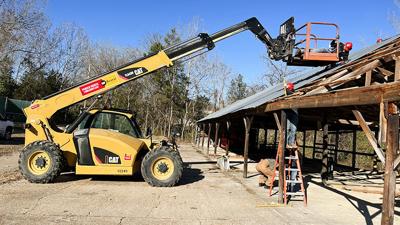
For the second year in a row, high school students enrolled in the Jefferson College Area Technical School (ATS) program got to tear down a pavilion-like structure on the college campus.
Students in Rob Rodden’s metal fabrication program recently spent more than two weeks of class time tearing down the old wooden structure near the softball fields along Farm Road on the Hillsboro campus.
The structure had been used for storage and was torn down to make way for the construction of a new burn area for the fire science program, which has been using the college’s old tennis courts for an outdoor training area, ATS director Suzanne Richardson said.
She said the school received state funding to build a better, more usable burn area for fire science training.
Rodden said college administration asked him if his students could deconstruct the old structure.
“We had an old building or structure that needed to come down and these kids have experience with (deconstruction) because they did it last year with an old (metal) maintenance building,” Richardson said. “The (burn area site) will eventually have structures for our fire science program to utilize for their classroom and outdoor training.”
Rodden agreed to let his students tear down the structure and prepare the site for a new use.
He said he tried to mimic what would happen on a real construction site as much as possible. The students were assigned tasks and had to overcome obstacles like rotten beams and a rotten roof.
Rodden told the students what the expectations were for each day of the project.
“When they didn’t meet them, we had a meeting before we started the next day and talked about what we were doing well and where we weren’t,” he said.
Richardson said she was impressed with the process.
“They are assigned a crew, they have a crew leader, it’s not always the same person,” Richardson said. “He rotates them. He prepares them for what their daily activities are while they’re here. The kids really strive to meet those goals in their teams. It’s a bunch of small teams making up one large team where everyone is accountable to each other.”
Hillsboro sophomore Shelby Litterst said she enjoyed the assignment and is looking forward to similar work-based learning projects in the next two and a half years.
“You get a lot of onsite experience, working with others, making your own decisions,” she said. “It’s a lot of self-building and team-building.”
Litterst said she knew in middle school that she wanted to be a welder.
“My cousin is a welder,” she said.
Even though welding was an option during her junior and senior year, she applied for a spot in metal fabrication, which is a three-year program.
“There’s welding and then there’s metal fab,” she said. “I saw in metal fab we can do everything. I figured I might as well do it, instead of just learning one skill, learn them all.”
According to the college’s website, the course provides students with specialized learning experiences in metal work, training them to fabricate and assemble a variety of metal products for many industries. The program comprises three components: sheet metal, machining and welding.
Third-year student Skyler Bruyere, a Hillsboro senior, said he likes that he can earn several certifications by completing the program.
“This looks really good on a resume,” he said. “I didn’t know what I was going to do at all my entire life until I took this class. Then after that, I figured this is a pretty good idea. I can get a lot from the class. This is definitely what I’d like to do for the future, something along the lines of welding. Machining would be interesting maybe, but for sure welding.”
Caleb Sanning, another third-year student who attends Fox High School, said he signed up for the class because he wanted to be a welder but didn’t want to wait until his junior year to start learning. His original plan was to study metal fabrication the first year and then try a carpentry class just to “experiment with everything.”
But Sanning, who has a job lined up with the Boilermakers union, didn’t want to miss out on any of the projects and specialized training offered through Rodden’s class.
“What’s great about Rob’s program is that kids can start with him in 10th grade and then come back for year two in 11th grade and then we have a built-in year-three program,” Richardson said. “And he’s really working on bridging those kids into (Jefferson College) for their post-secondary experience either welding or precision machining.
“After they’ve done three years with him, they are ready for either program. Those kids are also prepared to go into the workforce. Rob has an outstanding advisory council and those industry partners want kids who have been through his program because many of them are graduates of his program.”
Last year, metal fabrication, HVAC and building repair students tore down a metal maintenance building to make room for what will be the new vet tech facility, Richardson said.
She said Rodden saved all the metal from the building and hopes to use it on another project.
“I want to have a building that we can put up and take down so they can experience how to rig material, how to pick it up, how to work safely in the air, how to weld when they are 10 foot off the ground so they can get that experience for when they go out in the real world,” Rodden said.
Fourteen programs make up ATS: automotive technology; biomedical sciences; building repair technology; culinary arts; digital media technology; early childhood and elementary education; fire science; health information technology; health services; HVAC; metal fabrication; precision machining technology; residential carpentry and welding technology.
Eleven programs offer college credit and other certifications. Some programs offer internship or apprenticeship programs.
All of the public high schools in Jefferson County send students to ATS. Tuition is covered by the students’ high school. About 470 students are enrolled in ATS programs.
“ATS enrollment has increased by more than 100 students since 2020,” Richardson said.
She said students who take the applied communications course through health services, building repair technology, residential carpentry and metal fabrication earn OSHA 10 certification.
She said 35 percent of ATS’ class of 2023 earned the Career and Technical Education Certificate, a prestigious recognition given by the state to high school graduates earning specific criteria.
“The ATS application for 2024-2025 is currently open and can be accessed at jeffco.edu/ats/apply,” she said.