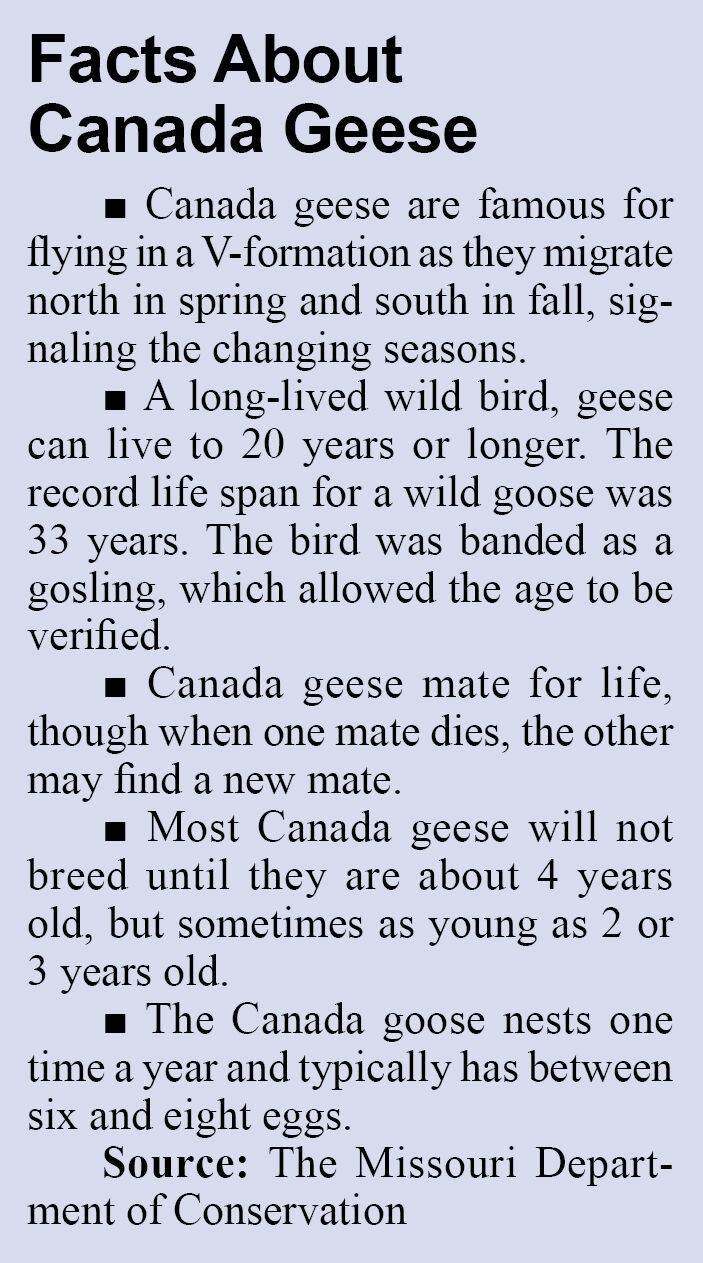


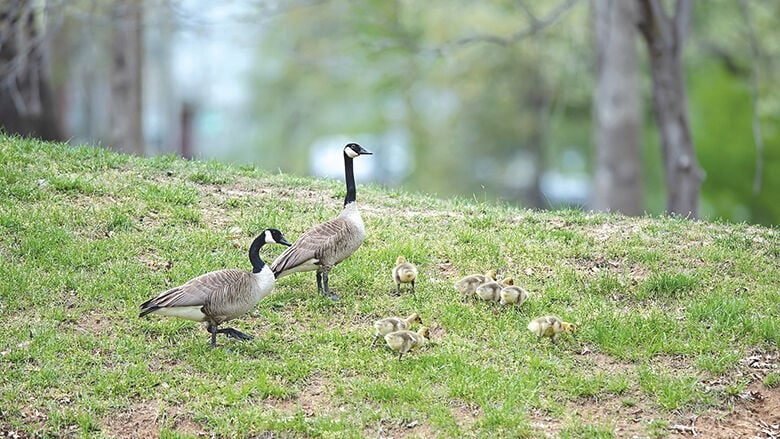
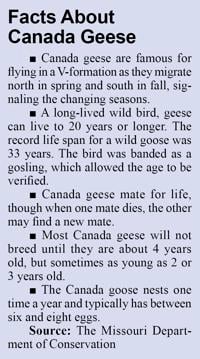
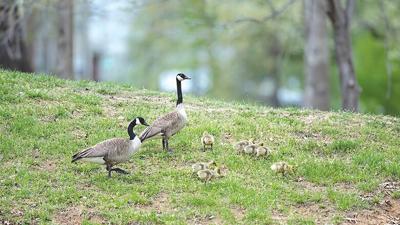
The recent return of a small flock of Canada geese to the Jefferson College campus in Hillsboro signaled an annual rite of passage – the arrival of a goose and gander that had come home to nest and six young geese that were likely hatched at the college in previous years.
During the week of April 10, seven goslings were hatched and joined the family group.
The goose-friendly campus posts signs along its main entrance on Viking Drive that read “Goose Crossing. Drive Slowly Please.”
Flashy strips of mylar ribbon on wooden posts and black metal silhouettes of German shepherd dog decoys are spaced out across the parameter of high-traffic areas to help establish boundaries for the geese.
“Geese have always been on campus, but in the spring of 2020, they moved into places that ordinarily would have been close to people, except no one was here due to the pandemic,” said Charlie Roberts, professor of veterinary technology.
“The next spring in 2021, the geese returned to nest in high-traffic people areas close to a building doorway, near sidewalks and a parking lot. The ganders were guarding the nests, and they can get cantankerous.”
While protective of their nesting area and goslings, the geese are mostly unfazed by people, cars or outdoor sports events, and want to stay around the campus, which offers ample habitat and amenities, including a pond and a couple of creeks.
After two particular encounters with geese, Jefferson College officials became concerned about the safety of people on campus and organized a Wildlife Task Force in April 2021 to look at ways to deter the birds from high-traffic areas. Sanitation issues related to geese droppings close to buildings also were a concern.
Roberts and Kim Garzia, a library specialist, co-chair the committee.
“We did a lot of research about Canada geese and worked with the Missouri Department of Conservation,” Garzia said.
As migratory birds, Canada geese are protected by the U.S. Fish and Wildlife Service. They also are protected by the Missouri Department of Conservation, which provides technical advice on deterrents and issues a permit called the Canada Goose Egg and Nest Depredation Order. The permit allows for the oiling of eggs so they don’t hatch. The permit also allows for euthanizing geese in a roundup if necessary.
“We don’t want to exterminate the geese,” said Roberts, who has fondly named the gander Stanley and the goose Phyllis. “Many people enjoy seeing them.”
“Spring goose population surveys and banding data give us a rough estimate of approximately 50,000 to 80,000 geese in Missouri,” said Erin Shank, urban wildlife biologist with the Missouri Department of Conservation. “The population in Missouri peaked in the late 1990s, then declined and is steady at our current range.
“We get a lot of calls from mid-March to the end of June related to droppings and public safety. Canada geese will nest in approximately the same location year after year as long as they are successful at that location.”
The Jefferson College Wildlife Task Force aimed to limit the geese to a 1-acre area away from people and across from the fine arts building. The task force members began using a mix of deterrents in 2021 that included volunteers shooing the geese away and bringing their dogs to chase them. In the spring of 2022, they added mylar flags, fox urine, plastic spike mats and radio-control cars.
“One nest was hatched on campus in 2022 behind the entrance marquee away from human traffic areas,” Garzia said. “Although one egg was laid in the orange parking lot median, we removed it per the Conservation Department and blocked the area with visual and physical deterrents.”
This spring the dog decoys were added.
Joe Candela, Jefferson College professor of welding, worked with students to create eight decoys as a service learning project. Made of scrap metal, the dog decoys are secured on a swivel base that allows them to move with the wind.
“The geese are smart, and they get used to static deterrents, which is why we move the dog decoys every few days around the prohibited populated areas,” Garzia said.
An awareness campaign included emails to students and posters on campus with a QR code to scan to report concerning geese behavior and proximity to buildings and landscaped areas. Lauren Murphy, a task force member and graphic designer in the marketing and public relations department, designed the emails, poster and goose crossing signs.
In other parts of Jefferson County, Canada geese are considered a minimal problem, though in years past, that was not always the case, parks and recreation officials said.
“We get about the same number of complaints each year about goose droppings, and I do not think our parks are overpopulated,” said David Crutchley, director of the Arnold Parks and Recreation Department. “Ten years ago, we had a problem with droppings on trails and some geese attacked people. Dogs were our best deterrent.
“This spring for the second year when workers went into the Arnold Recreation Center, they found goslings near a bush inside the pool area by the lazy river. We opened the gate, and the geese and eight goslings were gone two days later.”
Festus parks also has seen its share of geese.
“Although we had about 50 birds four or five years ago at Larry G. Crites Memorial Park (in Festus), a dozen birds would be a lot today,” said Joshua Whaley, director of the Festus Parks Department. “We brought in trained dogs that bullied them. There also are bald eagles at the park. We haven’t had issues since then.”
Tim Pigg, director of the Jefferson County Parks and Recreation Department, said most of the parks in the unincorporated portions of the county are in fairly wooded areas.
“The geese fly in and out of the Northwest Sports Complex in House Springs, but it is a park in the woods with predators. It is rare to have geese at our parks, and no one complains about them.”
At Jefferson College, neither Roberts nor Garzia are too concerned about the geese overrunning the campus.
“We are keeping an eye on the population,” Garzia said. “Natural losses tend to reduce the number of offspring that survive to return to the nest site. Also, the geese tend to establish a territory around their nest site limiting the number of geese that can comfortably nest in the area we have designated for them. So far, the population has stayed pretty stable for the last few years.
“We hope that the geese will retain some of what we taught them. This year, that seems to be the case.”