


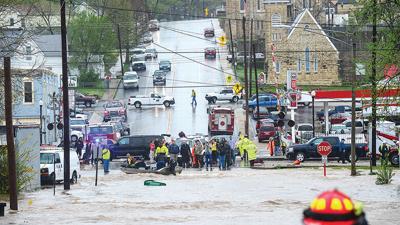
De Soto residents will be asked on Tuesday, May 16, to share their opinions about how the city should prioritize its flood resiliency and mitigation strategies.
A community meeting for Resilient De Soto will be held from 6:30-8:30 p.m. that day at the De Soto Community Center, 400 Boyd St. The first meeting was held March 7 at City Hall, and 11 people attended.
In December 2021, the De Soto City Council was awarded a $104,500 Community Development Block Grant to hire a planning consultant to address flooding. The city hired H3 Studio, a multidisciplinary planning and design firm based in St. Louis, to come up with a flood resiliency and mitigation plan for the city, which is called Resilient De Soto.
According to H3 Studio, in the past six years, the city has completed multiple studies to better understand and address flooding hazards along Joachim Creek, including the Upper Joachim Creek Floodplain Management Plan (U.S. Army Corps of Engineers); Joachim Creek Food Study (U.S. Geological Survey); and the De Soto Emergency Action and Evacuation Plan.
The Resilient De Soto plan has been a yearlong process that is expected to wrap up this month, according to the plan website.
The plan will provide recommendations on how to finance, construct and enact strategies the community members want to see.
“We encourage all community members and interested parties to join us and come voice their opinions regarding the plan, its strategies, and the future growth and safety of the city of De Soto as a whole,” said Javier Diaz Vicens, urban planner for H3 Studio. “Community members will have an opportunity to learn about the process and participate in a workshop to provide their input and feedback for a vision of the future of De Soto and its flood resiliency priorities and mitigation strategies.”
H3 has been working with the city, Citizen’s Committee for Flood Relief, Buy-In Community Planning and officials with St. Louis University and SLU Community Planning Lab to develop the plan.
On March 25-26, H3 Studio, in partnership with Buy-In Community Planning, hosted neighborhood meetings at The Just Be Kind Coffee Shop, Pogolino’s and De Soto Public Library. They also conducted one-on-one meetings with people who live in the floodplain.
Residents or building owners who have experienced flooding may fill out a buyout interest survey, and community members may fill out a survey on eight priorities online at buy-in.org/resilientdesoto.
According to the study, the city has had five flood events in the past four years.
The De Soto floodplains affect 354 homes, 109 commercial properties, an electrical substation, the De Soto Rural Fire Protection District and the De Soto Public Library. Water in the floodplain can get as deep as 10-13 feet during a major precipitation event.
Priorities
These eight priorities are listed in Resilient De Soto plan:
■ Community development and livability – A healthy balance of resources to develop housing, amenities, recreation and walkability in De Soto.
■ Emergency preparedness and response – Community planning and development for emergency evacuation and community readiness with expanded resources for police, fire and medical.
■ Education and engagement – Actively training staff and community members and providing open and transparent communications resources for flooding, flood risks, financial resources and relief.
■ Environment and hydrology – Forming county, state and local partnerships to actively maintain the Joachim Creek and mitigate water runoff while promoting green infrastructure.
■ Infrastructure – Continually working to improve storm, sewer, electrical services with increased mobility networks inclusive of key bridges and channels.
■ Policy and regulation – Actively cooperating with state and county leadership to enact best practice measures and regulatory code updates for the watershed to actively protect against development impacts and runoff.
■ Economic sustainability – Forming partnerships, pursuing grants, helping protect and expand local businesses, funding city programs and amenities, contributing to buyouts.
■ Voluntary property acquisition program – Helping De Soto residents who have experienced and are under threat of serious flooding from the Joachim Creek move somewhere safer, using a mix of federal, state and local funding, and converting their properties into a public, floodable open space that all residents in the community can enjoy.