


Union Pacific Corp. has announced the closure and potential sale of Selma Farm, the sprawling corporate retreat the company owns about 4 miles south of Festus.
“Our decision to close the facility is part of our plan to reduce our general and administrative support structure,” said Hannah Bolte, regional public relations spokesperson for Union Pacific.
The company acquired Selma Farm in 1986 when it merged with Missouri Pacific, and the property has served as a business, conference and hospitality property for the past 32 years, Bolte said.
She declined to provide any other information, noting that the company is “not accommodating local interview requests.”
Jackie Moran of Festus, former general manager of Selma Farm, lived there for 34 years until her retirement in 2007.
She said the staff numbered “more than 30” during her tenure, although she knows there has been some downsizing since she left.
The 2,000-acre property includes several homes, barns and outbuildings; a fishing lake with a dock and lodge; a gun range; a tennis court; a swimming pool; and riding trails and stables.
Nearby is the Castle Ridge Golf Course (formerly Crystal Highlands), which was built in 1988. It was open to the public for a time but since 2002 has been reserved for Union Pacific employees and guests.
The company has made the course available several times a year to nonprofit groups for charity events, most recently the Andrew Habseiger Foundation golf tournament on Oct. 20.
The castle
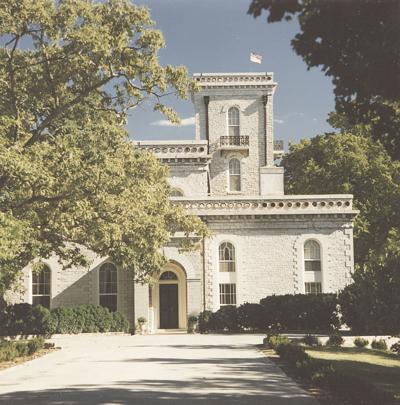
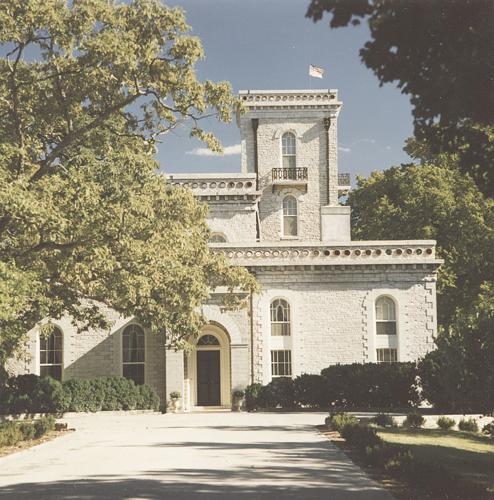
The most famous feature of the Selma Farm property is Selma Hall, which was built in 1854 and is known widely as “Kennett’s Castle,” after Ferdinand Kennett, the Mississippi River steamboat operator who spent $125,000 (about $4 million in 2018 dollars) to build it, according to historical documents.
Many Jefferson County natives have fond memories of making the strictly illegal but scenic trek from Crystal City south along the railroad tracks to view the castle, with its turreted tower rising above the trees atop a river bluff.
The Italian Renaissance-style mansion was made from gray limestone quarried on the property, likely with slave labor. The Kennett family brought cabinetmakers, plasterers, sheet metal workers and other artisans from the eastern U.S. to build the home, and ordered the ornamental iron and the parlor mantel from Europe, the historical documents said.
The home was designed by George Barnett, who also designed the Henry Shaw Mansion in St. Louis.
The property was sold several times before William O. Schock of St. Louis bought it in 1918. The mansion was gutted by fire on March 13, 1939, and the Schock family spent more than it cost to build the original home to restore it, the records show.
The Mississippi River Fuel Corp. purchased the estate in June 1953, and company president William Marbury and his wife continued to restore the home and add antiques and furnishings.
“They were oil magnates out of Oklahoma,” Moran said. “They didn’t want the castle at first; but the Schocks said it was all or nothing, so that’s how they got the property.”
Mississippi River Fuel would go on to become Missouri Pacific, which later merged with Union Pacific.
Mansion lives up
to its reputation
Mark Patterson of Festus did freelance photography work at the estate on many occasions starting in about 1999. He said his assignments often involved taking photos of company officials and their guests.
“Union Pacific officials would take their clients there as a reward; the house could accommodate probably 15-20 people,” he said. “I would shoot formal photos of the groups – three, six , maybe as many as 12 people – these ‘smile-at-the-camera’ type posed photos for them to have as a keepsake of their visit.”
Patterson said the company hosted two, three-day parties each week.
“They’d have a couple of groups there for three days, then they’d leave and the staff would turn the place around in one day for the next group,” he said. “It was pretty efficient.”
Patterson said he has “hundreds and hundreds” of pictures of Selma Hall, inside and out, about 50 of which were bound into a small souvenir book and distributed to guests.
The book depicts the home’s opulent furnishings and fitments, including many antique and one-of-a-kind items. Nearly every room has a fireplace, and custom millwork and window treatments are common as well.
The formal dining room is finished with wallpaper imported from France. Only two copies of the wallpaper are known to exist; the other was installed in the White House during the Kennedy administration.
Patterson said rumors of the mansion’s luxury are understated, if anything, and knowing how few people in the area had access to the property made getting to see it firsthand even more exciting.
“I knew when I was there that this was something really special, that not just everyone was getting the chance to see this,” he said. “I mean, I could actually feel the exclusivity of it.”
Next step?
Union Pacific has declined to answer questions or entertain any speculation about whether the property will be put up for sale as one large parcel or divided; whether the golf course will remain open; or what the fate of “the castle” will be.
But Kennett’s Castle – complete with its legends of Civil War occupation, its ghost stories and its magnificent Mississippi River views – will always be a part of the history of the area.
Much of the historical information about the estate came from the book, “Historic Sites of Jefferson County,” by Walter Eschbach.