

Before most of you who read this were born, a victory for humanity happened quietly right here in Jefferson County.
In September 1954, more than a year before Rosa Parks refused to sit in the back of a Montgomery (Ala.) bus and sparked the U.S. civil rights movement, 23-year-old Willa Haney started teaching a typing class at Festus High School.
Willa Haney was black. Every student staring back at her was white.
There were no protests, boycotts or news stories when Haney accepted an invitation from Festus R-6 Superintendent Ralph Tynes to commute from her teaching job at the all-black Douglass High School to all-white Festus High for that one class every day. She had no car, so Tynes served as her chauffeur.
It was the first crack in the wall of local school segregation. Despite the Equal Protection clause of the 14th Amendment to the U.S. Constitution, African-Americans in Jefferson County and across the country could not attend the same schools as white people, or use the same restrooms or sit at the same lunch counter.
About two-thirds of American citizens – those born after 1960 – have no memory of a segregated society.
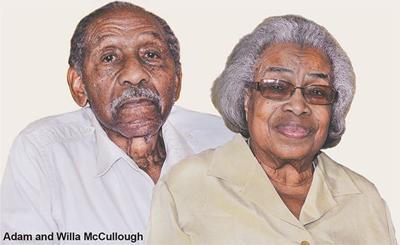
Willa McCullough remembersMonths after marrying Adam McCullough in the spring of 1955, she became the first black educator to work full time in a formerly all-white public school in Jefferson County.
She taught at Festus High until her retirement in 1994; Adam, or “Coach McCullough” as so many remember him, was a pioneer himself as the first black man in the county to cross the color line in both coaching and officiating. He helped pave the way for Willa by serving as an assistant football coach at Festus starting in 1950. He retired from the high school in 1993.
The McCulloughs’ long careers of service will be celebrated at 6 p.m. Friday in a gathering at the First United Methodist Church of Festus/Crystal City. The public is invited.
And it is the public who still benefits from the McCullough legacy: With Tynes’ vision and a community’s kindness, the Jim Crow barriers came down, peacefully, persistently.
After that experimental year of 1954-1955, teaching the one class, Willa went full-time as an English teacher at Festus High for the 1955-1956 school year.
That year the black students from Douglass High who lived in the Festus district came over as well, in Tynes’ careful plan of integration. Other Douglass High students from outside Festus started attending other local schools, such as Crystal City, De Soto and Herculaneum. North and west Jefferson County did not have any significant black populations in those days.
“This process of integration had been tossed around for lots of years before it actually happened,” Willa said. “Mr. Tynes was very positive. And I shall never forget him. It would not have been possible that it worked so well, without him.”
She said Tynes called all the Festus teachers to an assembly in 1954 – around the time of the U.S. Supreme Court’s groundbreaking Brown v. Board of Education of Topeka decision outlawing segregated schools – not to solicit their opinions, but to tell them what he planned to do, bringing Willa over from Douglass to Festus High.
“He was getting everybody prepared for this. Not just me,” Willa said. “Mr. Tynes, because of his attitude, made this thing work. Not everybody could have done it.”
Willa said she later heard that other school superintendents in the county asked Tynes how he did it and adopted his approach. Tynes, who came to Festus in 1939 and was the superintendent when Festus reorganized into the R-6 district in 1949, retired in 1977 and died in 1992.
Change didn’t happen overnight
A small group of white female teachers “adopted” Willa, as she called it, almost from the first day. Once, on their way back from a teachers’ conference in Cape Girardeau, Willa and her friends stopped to eat at a truck stop reputed to have good food.
“The person who was seating folks, he looked at me and he didn’t know what to do,” she recalled. “He was very apologetic and all of that, but he couldn’t serve me. This was before integration. So they (her fellow teachers) said, ‘If she can’t eat here, we can’t eat here either.’ So we all left and went somewhere else.
“They were all very kind to me.”
Willa experienced much the same thing years later when the last traces of legal racial discrimination were finally being erased. Many Americans may not remember that segregation continued outside the schools, in places like restaurants and movie theaters, until the Civil Rights Act of 1964 banned all discrimination based on race, color, religion, sex or national origin in all public accommodations.
Sometime in the early 1960s, Willa and her young daughter, Sibyl, went to eat a hamburger at the old Woolworth store on Main Street in Festus. Two waitresses were working the long lunch counter, each starting at the far end and moving toward the middle, where Willa and Sibyl sat.
The waitresses ignored them.
Along came Elsie Wampler, the white proprietor of the old E&D Style Shop in Festus who was one of the leading businesswomen in Jefferson County.
“So, we’re sitting there waiting our turn, and Elsie came and sat down and started talking to us,” Willa said. “And this (waitress), who wasn’t quite sure what she was supposed to do, came up to Elsie and asked her what did she want? And Elsie said, ‘It’s not my turn, these people were here first. I’ll give my order when you get through with them.’ Well, there wasn’t anything for (the waitress) to do but to say, ‘What do you two want?’”
Living with Alzheimer’s
Willa, 86, and Adam, 92, have lived in the same home in Festus since 1969. That was the same year Adam, who taught physical education and industrial arts, was promoted from assistant to head coach of the Tiger football team. He served as head man through the 1978 season and compiled a record of 38 wins, 50 losses and six ties.
Adam, who also served for 16 years (1987 to 2003) as a Ward 1 Festus City councilman, has lived with Alzheimer’s disease for about 10 years. Willa is his caregiver. He can still take care of himself physically – although he tires easily – but has suffered significant memory loss.
“Adam can fool you,” Willa said. “You think he knows what you’re talking about, with his Alzheimer’s.” Whenever they’re in a store, inevitably friends and former students will recognize their old mentor and strike up a conversation.
“When they’re gone,” Willa said, “he’ll say, ‘Now who was that?’”
The organizer of Friday’s celebration, Tom Wells, graduated from Festus High in 1973 and played football for Coach McCullough. He has vivid memories of the great respect the coach commanded, especially among the students.
“When we played football, we had a pep rally, and Coach would always get more applause than any of us,” Wells said. “And I thought, ‘Why is that?’ Later on, I kind of figured out, it was the period when we went through integration, and here’s this big, strong black man standing in front of a lot of white kids. And they respected and loved him so much; that’s why he got that applause.”
Current Festus Superintendent Link Luttrell called the McCulloughs “treasures of the Twin Cities” and said the Festus School District was fortunate to have them serve for so long. And as for his predecessor Ralph Tynes?
“He was ahead of the curve,” Luttrell said. “He started thinking about integration well before the national movement even came about. He was all about collaboration – bring people together – and the Twin City people followed his lead.”
Wells expressed his personal take on what kind of pioneers the McCulloughs were.
“It’s like you’ve got two Jackie Robinsons, right here.”
Willa, though, said it wasn’t just about them.
“I have thought about that so much over the years, how the whole community accepted us,” she said. “Everybody was so kind. That’s what sticks with me. Because all over the country there was trouble here and trouble there. And we didn’t have those problems.
“It’s a testimony to the children themselves, the parents and to the community, to have accepted us. It’s a tribute just to this whole area.”